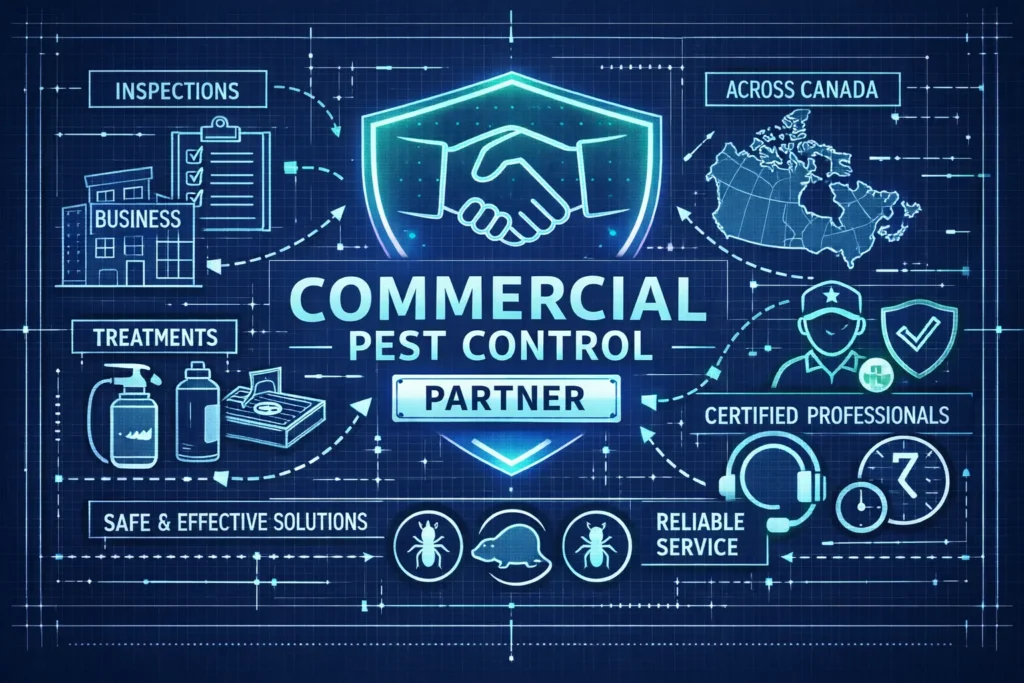
Closed kitchen. A failed health inspection. A manager’s frantic photo of a rodent in storage. Commercial pest problems cost time, money and reputation — fast. This guide walks you through what matters when selecting a commercial pest-control partner so you can confidently shortlist vendors, compare services and contracts, and use an 8‑point checklist to pick the right team.
If you want a local benchmark while you evaluate, Bug Managers provides licensed, IPM‑first programs, free inspections and written SLAs across Ontario and the Greater Toronto Area — use those standards to compare proposals.
Why the right commercial pest-control partner matters
Pests create four immediate business risks: regulatory non‑compliance, legal liability, operational disruption and reputational damage. For a restaurant or food processor, a single sighting can trigger a public health inspection and costly downtime. For a warehouse or retail chain, recurring rodent activity can mean product loss, rejected shipments and failed audits. (See our Effective Rodent Control Services in Brampton | Bug Managers for local rodent response examples.)
Choosing a vendor isn’t about the lowest hourly rate. It’s about predictable, documented prevention that protects your operations and passes audits. A good provider reduces surprises: documented inspections, repeatable corrective actions, and measurable monitoring that auditors and insurers respect.
Industries with the highest risk — restaurants, food processing, warehousing and multi‑site retail — need tailored programs. Their priorities differ: frequent monitoring and audit documentation for restaurants; access control and exclusion for warehouses; consistency and roll‑up reporting for multi‑site operations.
What modern commercial pest management should include
Integrated Pest Management (IPM) is the foundation. IPM begins with a thorough inspection and accurate identification, then uses targeted treatments, sanitation recommendations and follow‑up monitoring. IPM reduces chemical use, lowers recurrence rates and creates defensible records for audits.
Monitoring and data matter. Bait stations, digital trap monitoring, capture counts and trend reports turn pest control from guesswork into a data discipline. Those numbers are evidence for auditors and the business case for fewer emergency visits and long‑term savings.
Exclusion and proofing are often the highest-return activities. Sealing entry points, installing door sweeps, fitting pipe collars and repairing structural gaps stop pests at the source and reduce service frequency. A partner that budgets proofing work into the program is saving you recurring treatment costs. (Examples of our local proofing and service programs are available for areas such as Pest Control Services in Milton by Experts | Bug Managers.)
For multi‑site operations, expect dedicated account management, central billing and consistent SOPs across locations. Look for a reporting dashboard or regular roll‑up reports that let you see trends across the chain and satisfy corporate compliance requirements. Confirm local branch support in the regions you operate (for example, see our coverage in Pest Control Vaughan, Bug Managers).
Emergency and wildlife response should be humane and safety‑first, and integrated with proofing work. Immediate removal without follow‑up proofing leaves the door open for repeat incidents.
Finally, for food facilities, confirm the provider can supply HACCP/CFIA‑friendly reports, corrective action plans and audit‑ready documentation formats. That paperwork matters more than advertising claims when an inspector asks for evidence.
Licences, certifications and insurance to verify
Ask for — and record — four items right away: a provincial operator/business licence, applicator or exterminator certificates for staff, a current commercial general liability insurance certificate, and training or competency records for technicians assigned to your site.
Licensing is provincial. Ontario, Quebec and British Columbia each have their own regimes, so request licence numbers and verify them on the appropriate provincial registry. If a vendor hesitates or can’t produce licence details, consider that a fail. For guidance on provincial licensing rules, review the official provincial registry pages such as Ontario pesticide licences and permits, and consult federal oversight resources like the Pest Management Regulatory Agency (PMRA) for national pesticide policies.
For food sites, ask about HACCP or third‑party audit experience and request examples of site‑specific IPM policies. Store scanned copies of licences, certificate numbers and expiry dates with your vendor contract so auditors can retrieve them quickly.
Red flags: inability to produce licences, insistence on cash‑only payments, or vague insurance statements without a certificate and policy limits.
Pricing models, contract types and SLAs — what to expect and what to avoid
Common pricing models include monthly or annual retainers, per‑visit fees, per‑incident emergency rates, and one‑time setup or proofing fees. Specialized treatments such as fumigation or structural heat remediation will be quoted separately and can exceed $1,000 depending on scope. For details on commercial fumigation options and how they’re typically scoped, see commercial service references like Orkin Canada’s fumigation service.
Use ballpark planning figures cautiously: small retail or office sites sit at the lower end of the scale, while restaurants, warehouses and manufacturing sites pay more because of frequency and regulatory needs. Always get site visits and written quotes.
Insist on these SLA elements: guaranteed response windows for urgent calls, defined re‑treatment periods, a clear list of covered services (interior vs exterior), reporting cadence and format, and explicit termination/renewal terms. Avoid vague “as needed” clauses and long lock‑ins without performance metrics.
Negotiation tips: bundle proofing work into the contract, request a pilot period for a single location before rolling out multi‑site, and demand transparent line‑item quotes that list setup fees, monitoring hardware and consumables. For a sense of the types of commercial programs available from national providers, you can review typical commercial pest management services.
The 8‑point checklist to shortlist and score commercial vendors
Use this checklist as a pass/fail and scoring tool when you review proposals:
- Licensing & Insurance— confirm business and applicator licences and a current insurance certificate with policy limits. Ask for licence numbers and insurer contact.
- IPM‑first approach & exclusion work— request a written IPM plan and examples of proofing/exclusion work. Prioritize vendors that emphasize exclusion.
- Monitoring & reporting— ask for sample reports, digital access to trap/monitor data and a delivery schedule.
- SLAs & response times— demand defined response windows for urgent calls and written re‑treatment guarantees.
- Food‑safety / HACCP & audit experience— for regulated sites, request prior client examples and audit‑ready documentation formats.
- Multi‑site capabilities & local footprint— verify account management, consistency across locations and local branch support.
- Transparent pricing & contract clarity— insist on line‑item quotes, setup fees, and clear renewal/cancellation terms.
- References & proof of results— ask for 2–3 commercial references in similar industries and permission to contact them.
Scoring suggestion: weight compliance at 25%, IPM/exclusion 20%, reporting 15%, SLAs 15%, references 15% and pricing 10%. Set a pass threshold (for example, 70%) and use that to shorten your shortlist. Red flags include no licences, no written SLAs, no references, or a chemical‑only pitch with no monitoring or proofing.
Deciding and next steps — RFP prompts, a quick comparison routine and when to call Bug Managers
Build a one‑page comparison grid for vendors — here’s a compact table you can copy into a spreadsheet:
| Vendor | Licence # | IPM plan? | SLA response | Reporting cadence | Price (est.) | Pilot outcome | Reference score |
|---|---|---|---|---|---|---|---|
| Vendor A | XXXXX | Yes | 24–48 hrs | Monthly | $ | Pass/Fail | 8/10 |
Run a 30–90 day pilot before committing to a long contract. Score outcomes with the checklist, verify documentation and inspect proofing work in person. If the vendor can’t produce timely reports or proofing invoices during the pilot, don’t roll out to other sites.
If you want a licensed, insured Ontario/GTA partner that offers IPM‑first programs, free inspections and written SLAs, book a no‑obligation site walk with Bug Managers to receive an audit‑ready proposal tailored to your operations. Choose the partner that provides predictable documentation, measurable monitoring and fast emergency response — not just the lowest price. (We serve the region with city-specific programs such as Pest Control in Toronto, Bug Managers and Affordable Pest Control Services in Mississauga | Bug Managers.)
Keep records of licences, reports and SLAs and schedule quarterly reviews with your provider. Regular review protects continuity, strengthens audit readiness and prevents small issues from becoming disruptive incidents.
Quick summary
Pick a vendor that proves compliance, prioritizes IPM and exclusion, measures pest activity with data, and commits in writing to response times and reporting. Use the 8‑point checklist and a short pilot to validate performance before scaling.
Ready to compare proposals with a local, IPM‑first standard? Contact Bug Managers for a free inspection and an audit‑ready proposal across Ontario and the GTA. For reference on commercial program structures and commonly offered service agreements, you may find it useful to review national commercial service outlines such as those from Orkin Canada.