Intro
You want certainty, not surprises. Commercial extermination mistakes cost time, money, and credibility: vague scopes, thin SLAs, and unexpected charges can derail operations. At Bug Managers, we see the same errors play out across the GTA. This commercial extermination playbook strips away the noise, giving facility managers exact items, exact numbers, and exact questions to ask. Use it to shorten your shortlist, prevent regret, and ensure your commercial extermination program delivers predictable, measurable results.
What a robust commercial pest program looks like
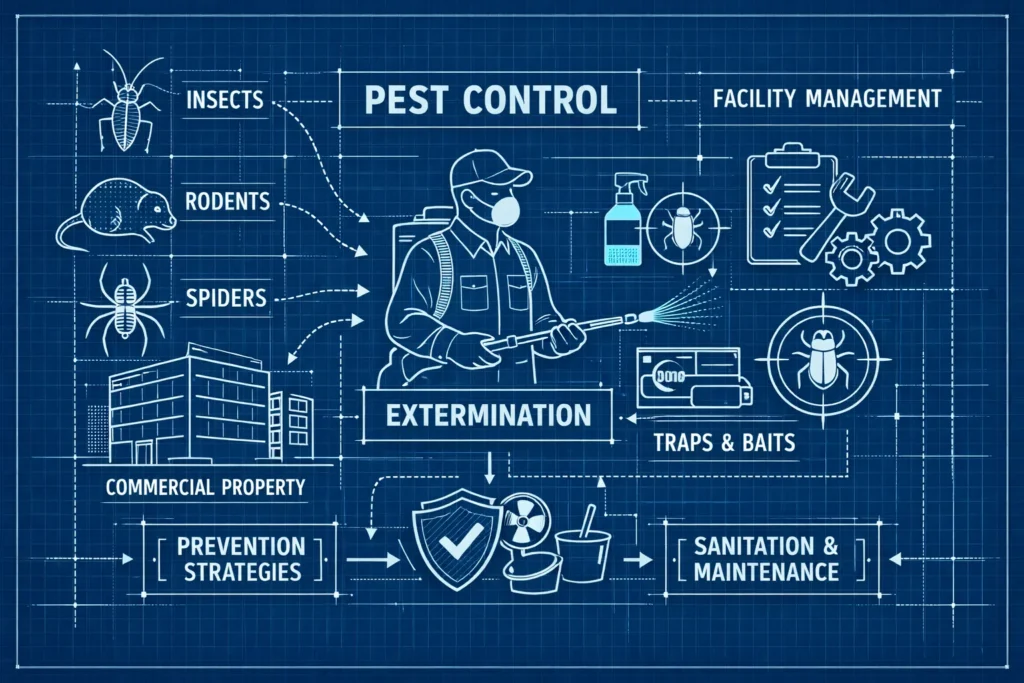
Prevention is the job’s ROI. A commercial pest program that actually works is a system, not a one-off spray. Its backbone is simple and measurable: an initial site assessment, a written integrated pest management plan, mapped monitoring stations, exclusion and pest‑proofing, scheduled visits, and documented reporting for audits and inspectors.
Deliverables facility managers should insist on:
- Signed initial assessment report with photos and prioritized findings.
- A written IPM action plan with timelines and assigned responsibilities.
- Mapped bait/trap locations and monitoring schedule.
- Digital service log (date, technician name, actions taken, photos) accessible on demand.
- SDS sheets for every product used and a record of alternatives/low‑toxicity options.
- Staff training records and tenant/occupant notification procedures.
Serious proposals make these items front and centre. If you can’t see a trap map or a signed assessment within the first week, walk away.
One‑page IPM snapshot (example)
| Risk Level | Visit Frequency | Key Mitigation Steps |
|---|---|---|
| High — Food prep areas | Weekly monitoring; monthly preventive service | Seal entry points, install glue and bait stations, drain cleaning, staff sanitation training |
Pricing decoded: realistic ranges and what drives cost
Price is a story. Know the chapters.
Benchmarks you can use immediately: initial one‑time treatments commonly range from about $75 to $2,107 depending on pest and severity. Recurring maintenance runs broad — roughly $30 to $2,107 per month. Quarterly visits typically land $100–$300 per visit. Per‑square‑foot guides are useful: initial work about $0.25–$0.75 per sq ft; an annual preventive program roughly $0.05–$0.15 per sq ft.
By property type: restaurants and foodservice trend higher because of stricter regs and more visits; warehouses scale by square footage and complexity; offices sit mid‑range; retail falls between office and foodservice. Expect bed bugs, termites, and heavy rodent control services to push you to the top end.
Cost drivers are predictable: pest species (bed bugs, termites, and large rodent problems cost more), infestation severity, required prep and access, regulatory compliance (food sites), visit frequency, and multi‑site logistics.
How to read quotes: watch the format. Providers quote as a flat monthly retainer, per‑visit fee, or per‑bait/station charge. Add‑ons you should expect priced separately include heat treatments for bed bugs and termite baiting systems. Red flags for artificially low bids: no written assessment, vague deliverables, or a “chemical only” plan with no exclusion work.
For further benchmarking and sample price lists, see specialist pricing guides such as How to set commercial pest control prices and the aggregated pest control prices list.
Licences, insurance, and green credentials to require
Paperwork keeps you out of trouble.
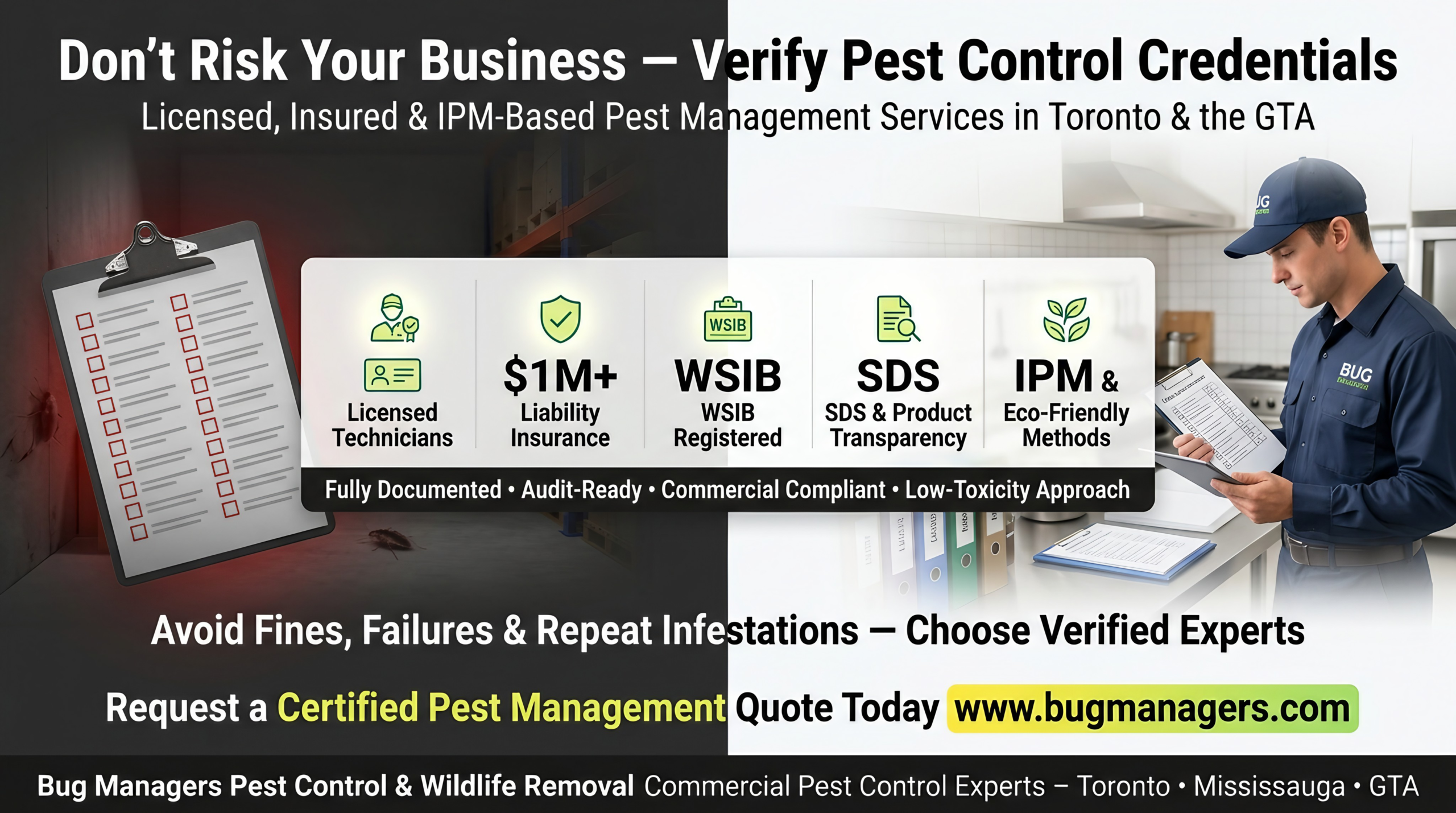
In Ontario, require the operator/business licence and individual exterminator/pesticide applicator licences for technicians. Ask for licence numbers and expiry dates. Insist on WSIB registration for the company, commercial general liability (CGL) insurance and pollution liability, and commercial auto where vehicles are used. Regulatory minimums to request on your RFP: CGL of at least $1,000,000 per occurrence and pollution liability coverage (commonly $1,000,000 per occurrence); WSIB proof; and listed technician certifications.
On IPM and green verification: demand SDS sheets, evidence of IPM training or relevant courses, and a real plan that prioritizes exclusion and low‑toxicity options. National standards (e.g., the Canadian pesticide training standard) exist — ask vendors which approved courses their techs completed.
Use this checklist in your RFP: licence copies, insurance certificates (CGL, pollution, commercial auto), WSIB number, technician certification numbers, SDS sheets for proposed products, references from similar facilities, and municipal business licence where applicable. For official Ontario requirements and permits consult the provincial guidance on pesticide licences and permits: Pesticide licences and permits (Ontario).
Service levels, response times, and contract clauses that protect you
A promise without metrics is a wish. Put numbers in the contract.
Tiered SLA model (prose): urgent — active infestation or health hazard — require acknowledgment within 4–8 hours and an on‑site action plan within 24–48 hours; routine requests — response within 24–72 hours; scheduled maintenance — a fulfillment rate target (e.g., 98%) with defined make‑up visits for missed appointments.
Contract essentials you must include: explicit scope of services (list species included), visit frequency, pricing structure with inclusions/exclusions, reporting cadence, warranty terms (30–365 days depending on pest), liability limits, cancellation/termination language, an escalation matrix, and a transparent price escalation clause tied to CPI or defined inputs.
Penalties and remedies: negotiate predefined service credits for missed SLAs (example: 5% credit for each percentage point below agreed fulfillment), and require corrective action plans for repeated failures. Have counsel review the contract before signing if penalties, liabilities, or scope are complex. For practical tips on structuring commercial agreements and expectations from service providers, a field guide on winning and managing commercial pest contracts can be helpful reference reading: How to get commercial pest control contracts.
The interview: exact questions to ask when they quote you (and how to score answers)
Ask like a buyer. Score like a buyer.
| Question | Why | Good answer |
|---|---|---|
| Are you licensed and insured for our province? Can you send certificates? | Paperwork proves legal and financial protection. | Provides licence numbers, insurance certificates with limits and expiry dates. |
| Which technicians will attend and what are their certifications? | Ensures qualified staff and continuity. | Named techs, cert numbers, recent training dates. |
| What’s included in the initial site assessment and deliverables? | Determines baseline and transparency. | Trap map, IPM plan, photos, prioritized timeline. |
| Which pests are covered and what are exclusions? | Prevents scope disputes. | Explicit species list and price list for add‑ons. |
| What is your IPM approach and what non‑chemical options will you use? | Checks for prevention focus and reduced pesticide reliance. | Exclusion, sanitation, monitoring first; chemicals last. |
| What chemicals or baits will you use? Can you provide SDS? | Safety and disclosure. | Supplies SDS and names; offers low‑toxicity options. |
| What are your SLA response times for urgent and repeat issues? | Accountability for emergencies. | Written tiers, escalation path, committed response windows. |
| How do you report and what sample report will you provide? | Needed for audits and trend analysis. | Digital log with photos, recommendations, and trends. |
| Can you manage multiple sites centrally and provide consolidated billing/reporting? | Key for multi‑site programs. | Portal access or consolidated monthly reports available. |
| Can you provide references for similar facilities and a recent case study? | Proof of experience and results. | Names, contact info, and a short case study with outcomes. |
| How do you handle follow‑ups and warranties? | Defines post‑service responsibility. | Clear warranty window and no‑charge follow‑ups within it. |
Scoring rubric (compact): pass/fail on licences and insurance. Then weight: 25 points IPM and reporting, 20 points SLA and guarantees, 20 points references/experience, 15 points price transparency, 10 points value‑adds (pest‑proofing, wildlife removal options). Red flags: missing licences/insurance, no written reports, chemical‑only answers to IPM, evasive SLA replies, unclear pricing.
Compare bids, onboard the winner, and what to expect in the first 90 days
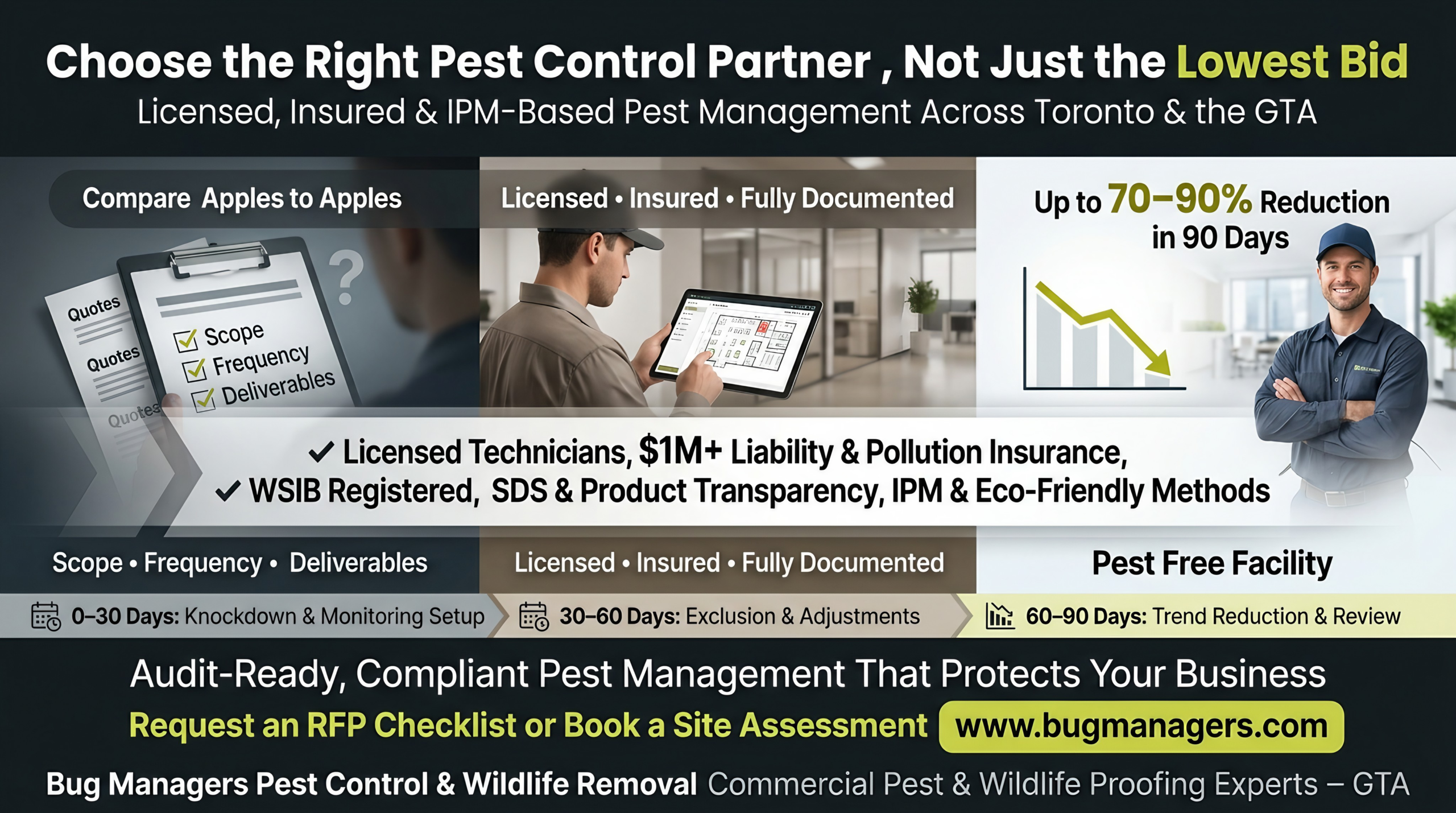
Signing is the middle, not the end. Apply your rubric and force an apples‑to‑apples comparison: same scope, same visit frequency, same deliverables. If unsure, require a short pilot or trial and include an exit clause for material failure.
Onboarding deliverables to require: a site‑specific service plan, trap map, named technician contacts, portal access to service logs, scheduled staff briefings, and tenant/occupant pre‑treatment notices.
- 0–30 days: initial knockdown, monitoring stations installed, baseline data collected.
- 30–60 days: adjustments to baiting, exclusion/pest‑proofing work begins, staff training delivered.
- 60–90 days: trend lines emerge, sightings fall, formal quarterly review and next steps set.
KPI examples: capture counts by location, bait uptake, number of service calls, SLA fulfillment rate, and trend reduction percentage (aim for 70–90% drop in sightings within 90 days for typical infestations).
Why consider Bug Managers? Licensed and insured across the GTA, we pair eco‑friendly IPM with humane wildlife removal, fast emergency response, and professional Pest & Wildlife Proofing Services, Bug Managers for high‑end properties and commercial sites. Ask About, Bug Managers for an RFP checklist or arrange a site‑scoping call to begin vetting vendors with confidence. We also operate local service teams, for example see Pest Control Services in Milton by Experts | Bug Managers and Pest Control Caledon, Bug Managers for regional coverage details.
Summary and next step
Hire for certainty, not the lowest price. Insist on a signed assessment, IPM plan, mapped monitoring, digital logs, licences, and clear SLAs. Use the interview script and scoring rubric to shortlist. Onboard with a 30/60/90 plan and measure results.
When your contract reads like a checklist and your vendor answers like a partner, surprises stop happening.
You don’t hire for price. You hire for certainty. Use the playbook; reduce surprises.