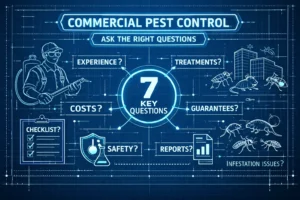
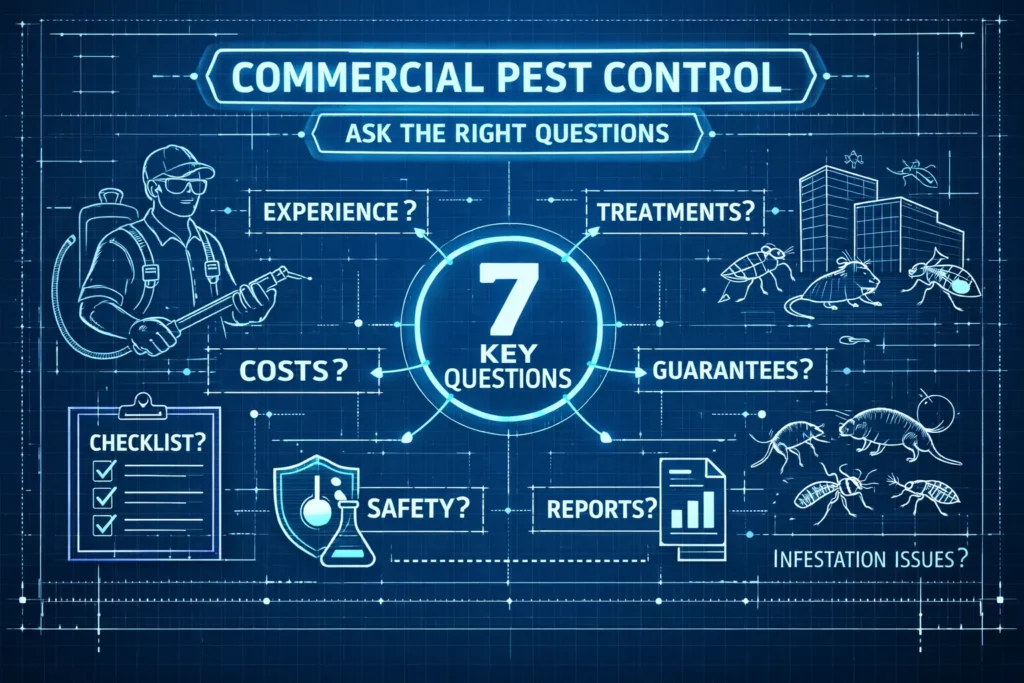
The 7 questions that separate competent providers from poseurs
Questions reveal methods. Answers reveal intent.
Are you licensed and insured for work in my jurisdiction?
Why it matters: Licensing and insurance shift legal and financial risk away from you. If a treatment harms staff or property, the paperwork matters more than a handshake.
What to expect: a company licence/registration number, principal operator name, applicator/category credentials for assigned technicians, and an original Certificate of Insurance (COI) showing limits and expiration. Quick follow‑up: ask for the technicians’ credential numbers.
Bad answer: “We’ll send it later” or “we’re covered” with no proof.
Sample ask: “Please email company licence numbers, technician certifications, and an original Certificate of Insurance naming [Your Company] as certificate holder and listing policy limits.”
Do you have experience with properties like mine?
Why it matters: A restaurant’s risks aren’t an office’s risks. Different buildings need different playbooks, not one-size-fits-all promises.
What to expect: a named case study or a reference you can call with similar scope and size.
Bad answer: “We handle everything” without a single comparable reference.
Sample ask: “Provide one recent client reference for a comparable property (name, contact, scope, and start date).”
Do you run an Integrated Pest Management (IPM) program?
Why it matters: IPM reduces chemical use and produces measurable outcomes. It’s prevention, not painting over problems.
What to expect: inspection + monitoring (traps/sensors) + exclusion + least‑toxic targeted treatments + staff training and scheduled reviews.
Bad answer: “We treat on a calendar basis” or “We spray periodically.”
Sample ask: “Email your IPM plan and a sample monthly report showing monitoring data and thresholds.”
What are your SLAs and emergency response times?
Why it matters: Timing protects product, people and reputation. Fast action preserves stock and inspections.
What to expect: written response windows for routine, and clear emergency options (same‑day or 24‑hour on‑site), plus a re‑treatment window.
Bad answer: “We’ll try to come when we can.”
Sample ask: “Please provide your written SLA with routine response time, emergency response commitment, and re‑service guarantee timeline.”
Exactly what will you put in writing?
Why it matters: Reports are proof for audits, health inspectors and contracts. Verbal promises vanish in disputes.
What to expect: itemized quote, scope of work, trap map, treatment log, product list and MSDS sheets, and monthly trend reports.
Bad answer: “We don’t do a lot of paperwork.”
Sample ask: “Confirm you will supply itemized invoices, trap maps, treatment logs, product lists with MSDS, and monthly trend reports.”
Who performs the work—your staff or subcontractors?
Why it matters: Subcontracting can hide credentials and reduce accountability. You need to know who will be on site and their licences.
What to expect: in‑house certified technicians; if subcontracted, the company must provide names, certificates and insurance for those techs.
Bad answer: “We use trusted partners” with no names or credentials.
Sample ask: “List the technicians assigned to our account with licence numbers and proof of insurance.”
What guarantees and metrics do you use to measure success?
Why it matters: A promise without metrics is marketing. Metrics let you hold vendors to results.
What to expect: clear KPIs (trap counts down, sightings down), re‑service guarantees with timelines, and an escalation path documented in the SLA.
Bad answer: “We guarantee satisfaction” with no targets or timelines.
Sample ask: “Define two KPIs you will track, the target improvement in 90 days, and your re‑service guarantee window.”
Bug Managers example (blueprint): provincial operator licence on file; original COI showing $1M+ GL and WSIB; documented IPM (inspection, monitoring, exclusion, least‑toxic treatments, staff training); same‑day emergency response; monthly reports with trap maps and trend charts. (About, Bug Managers)
Licenses, certifications and insurance — what to demand and how to verify
Paperwork is not paperwork. It’s protection.
Ask immediately for company licence/registration, principal operator name, applicator/category credentials for all technicians who will service your site, background‑check policy, and an original Certificate of Insurance (not a photo).
Check for general liability, product/completed operations coverage, and workers’ compensation (provincial equivalents). Decide whether you need to be listed as certificate holder or additional insured under your lease.
Verification steps: look up licence numbers on the regulator’s website (for example, see the Ontario guide to pesticide licensing), call the insurer if policy limits look low, confirm COI expiry dates, and insist on MSDS and product lists for any proposed pesticides. For a multi‑jurisdictional view of requirements, consult an overview of pest control license requirements and business setup by state.
Sample wording to send vendors: “Please attach company licence numbers, technician certifications, and an original Certificate of Insurance naming [Your Company] as certificate holder and listing policy limits.”
Price, frequency and SLAs — how to compare apples with apples
A cheap number is noise. Normalize the signal.
Convert every bid to annual cost and cost per visit. Typical commercial frames: one‑time treatments vary widely by pest and severity (low hundreds to over a thousand dollars), monthly contracts commonly fall in the low hundreds per month for general prevention, and quarterly plans sit between those extremes depending on risk. Regional and specialty surcharges (termite, bed bug, structural exclusion) change the math quickly.
What should be included in price: initial inspection, monitoring devices and trap checks, scheduled reporting, labor, travel, and re‑treatments for the same issue within a guarantee window. Watch for exclusions and hidden fees.
SLA elements to demand: routine call response (24–72 hours), emergency response (same day or within 4–8 hours for active infestations), report delivery (48–72 hours), re‑treatment guarantee (7–30 days), and a written escalation path and termination clause. For why fast response matters in commercial settings, see why your pest control problems deserve a fast response.
How to score bids: annualized price (40%), SLA/response (25%), IPM approach and documentation (20%), references and fit (15%). If a bid is far below market, ask for a detailed scope and cost breakdown before you celebrate.
Integrated Pest Management and documentation — proof over promises
IPM is a plan, not a spray.
A true commercial IPM program starts with a thorough inspection, ongoing monitoring (traps/sensors), exclusion and structural correction, sanitation recommendations, targeted least‑toxic treatments, staff training and scheduled follow‑ups. For a concise industry perspective on IPM components, review components of an effective integrated pest management strategy.
Audit‑ready records are non‑negotiable: inspection logs, trap maps, bait usage logs, photos of entry points and repairs, trend charts that show captures over time, product lists with active ingredients and MSDS, and training records.
Evaluate a quote for thresholds that trigger treatment (not “treat on calendar”), a corrective action plan for building repairs, and scheduled review meetings with stakeholders. Quick test: ask for a recent monthly report. If they hedge, they either don’t produce one or it’s poor.
Pests by facility — what an effective plan looks like for restaurants, warehouses and offices
Different buildings, different playbooks.
Restaurants: rodent, cockroach, fly and pantry pest control prioritizes sanitation, drain maintenance, exclusion, sealed bait stations and monitoring at storage and service lines. Treatments must be food‑safe and fully documented for inspectors.
Warehouses and food storage: focus on rodent control, stored‑product pest detection, and bird exclusion. Loading docks, pallet management and shipment inspection are program essentials. Trap maps should align with inventory zones.
Offices: ants, mice and occasional spiders. Priorities are sealing entry points, discreet targeted traps away from public areas, low‑odor options, and clear tenant communication about service windows. (Pest Control Services in Milton by Experts | Bug Managers)
Bring a specialist when a facility operates under HACCP, healthcare or pharmaceutical standards—those sites require tight documentation and proven food‑safety experience. (Commercial Pest Control Services in Brampton | Bug Managers)
Red flags, shortlist checklist and a sample RFP you can copy
Walk away if the vendor hides the facts.
Red flags include refusal to provide COI or licence numbers, vague IPM answers, no written reports, undisclosed subcontractors, free offers that later add fees, prices far below market with no scope, and an inability to give references in your industry.
- Shortlist checklist: verified licence, original COI on file, two recent references in comparable properties, sample monthly report, written SLA, IPM plan included, list of active ingredients/MSDS, clear itemized pricing and a re‑service guarantee.
Scoring rubric: compliance (30%), IPM technical approach (30%), SLA & response (20%), price (10%), references & fit (10%).
Sample RFP (copy/paste)
Subject: RFP — Commercial Pest Management for [Site Name / Address] — Response by [Date]

Please provide the following in your submission:
• Company licence and registration numbers; principal operator name.
• Technician names and applicator/category certifications for assigned staff.
• An original Certificate of Insurance naming [Your Company] as certificate holder with policy limits and expiry date.
• Two recent references for similar properties (name, contact, scope, start date).
• Itemized pricing: initial inspection, per‑visit cost, annualized total, and any specialty surcharges.
• A sample IPM plan and one recent monthly report (monitoring data, trap map, treatment log).
• Proposed SLA: routine response time, emergency response commitment, re‑service guarantee, and report delivery timeline.
• List of proposed products with active ingredients and MSDS.
• Estimated timeline to start and any required corrective actions (with costs).

Please submit by [Date]. We will shortlist two vendors for a paid site walk and require a final corrective action list as part of the final proposal.
Final nudge: schedule a paid site walk with the top two vendors and require their corrective action list in writing before final selection. (FAQ, Bug Managers)
Questions beat discounts. Ask the seven. Compare the documents. Then pick the contractor who signs the SLA you can enforce — not the one who sold you the cheapest story.
Bug Managers follows these standards: licensed technicians, original COIs, documented IPM, same‑day emergency response and audit‑ready monthly reports — use that blueprint when you vet local commercial pest management firms. (Pest Control Vaughan, Bug Managers)