
Intro
Pests aren’t just an operational nuisance — they can undermine your brand reputation. One sighting in a public space, on social media, or in a customer review can erode trust faster than any repair or refund can restore it. That’s why choosing the right pest management services is critical. This guide helps you map risks at your facility, ask vendors the right questions, compare quotes sensibly, and drop a ready RFQ into your procurement process. Practical, direct, and field‑tested — drawn from a decade of commercial work at Bug Managers across GTA sites.
Quick risk map: Which pests matter for your site (fast triage)
Not all pests carry the same operational or reputational risk. The pressure points are predictable by sector. Treat this as a triage: identify primary vectors and next‑step monitoring.
Restaurants
Top pests: rodents, German cockroaches, flies. Control logic: seal entry, tamper‑proof bait stations, pheromone or sticky traps, daily sanitation and trap logs tied to your HACCP records.
Warehouses & food storage
Top pests: rats/mice, stored‑product beetles and moths. Control logic: pallet inspection, pheromone traps in storerooms, inbound inspection protocols, and temperature/humidity controls to starve pests of favorable conditions.
Hotels & lodging
Top pests: bed bugs, mice, cockroaches. Control logic: bed‑bug protocol (inspection, heat or targeted treatment), guest‑room monitoring, and a fast incident response so a single guest sighting never becomes a press story.
Healthcare & labs
Top pests: flies, cockroaches, rodents. Control logic: sterile IPM with approved products only, strict documentation, minimal chemical use, and protocols that pass audits.
Education & offices
Top pests: ants, mice, occasional cockroaches. Control logic: exclusion, staff education, regular monitoring and low‑toxin interventions.
What to look for now: droppings, greasy trails, egg casings, gnaw marks, unusual food loss, and customer complaints. These are trigger events. Treat them as audit flags, not mysteries.
What a modern IPM program looks like — and the vendor questions that expose competence
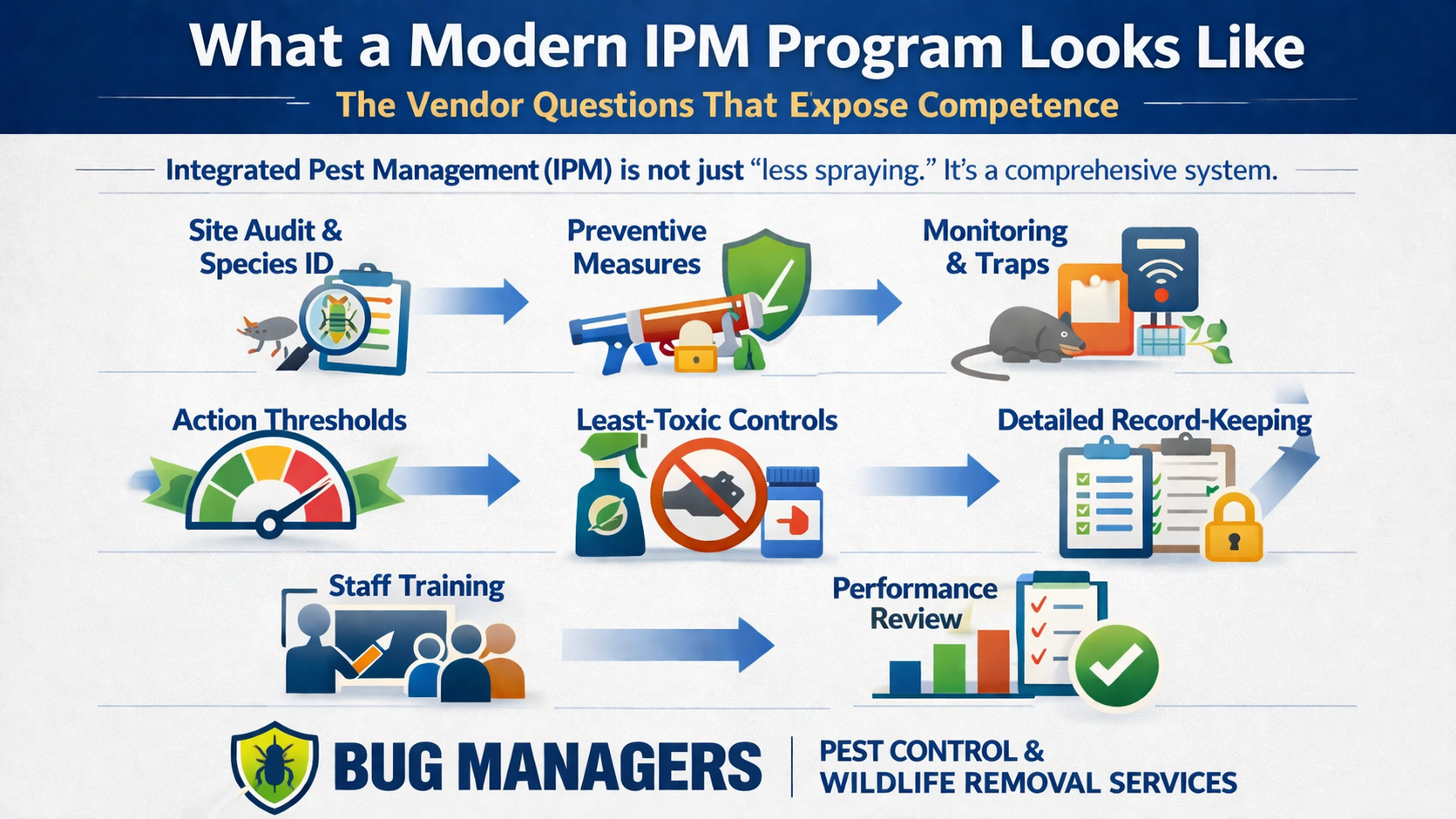
IPM is not “less spraying.” IPM is system design: audit, monitoring, thresholds, prevention, targeted action and documentation.
Expect a program built around a clear sequence: a site audit and species identification; prevention measures (sealing, sanitation adjustments); monitoring through traps and sensors; defined action thresholds; least‑toxic controls first; disciplined record‑keeping; staff training; and a review cadence tied to performance metrics. For a short reference on core program components see the essential elements of IPM.
Ask these questions — copy into your RFQ or interview
- How do you inspect and how often? (ask for sample inspection checklist)
- What monitoring devices do you deploy and where will you place them?
- What are your action thresholds for rodents, cockroaches, and bed bugs?
- Which non‑chemical options will you use before pesticides?
- How do you handle sensitive environments (kitchens, ORs, guest rooms)?
- Show me a recent IPM report you delivered to a similar facility.
- Who is the account lead and what are their licences/certifications?
What a good answer sounds like: scheduled audits plus real‑time monitoring; a mapped bait‑station and device plan; monthly IPM reports tied to trap captures and entry‑point closures; staff briefings; and a 24/7 escalation path for confirmed activity. For an additional practical checklist of IPM components see the 8 components of an IPM program.
Credentials, insurance and non‑negotiables (what to demand)
Paperwork is not bureaucracy — it is risk transfer. If a vendor won’t show documents, they are asking you to take the risk.
- Company operator licence and business permit (province‑specific).
- Technician/exterminator licence numbers for staff who will work on site (attach certificates).
- General liability insurance certificate with policy number and limits.
- Workers’ compensation proof (for Ontario, WSIB clearance).
- List of registered pesticides/biocontrols with Health Canada/PMRA registration numbers.
- Evidence of staff training (WHMIS, IPM training) and background checks if required.
- Relevant accreditations (QualityPro, GreenPro, food‑safety badges) where applicable.
For details on provincial pesticide licences and permits in Ontario, require vendors to provide the appropriate documentation listed on the official government page: Pesticide licences and permits (Ontario).
Red flags: refusals to provide documents, vague or evasive answers, expired insurance, and missing technician IDs. Walk away early — remediation later costs more than due diligence.
Pricing, SLAs and what the numbers really mean
Cheapest is only cheap until the problem returns. Buy outcomes and transparency, not a low monthly line item.
Common pricing structures: one‑time emergency visits; setup plus recurring plans (monthly or quarterly); tiered packages (insects only vs insects + rodents); and custom multi‑site contracts with volume discounts.
Benchmarks to sanity‑check quotes:
- One‑time commercial visits: roughly $250–$1,500 depending on scope (initial inspection + treatment).
- Recurring contracts: roughly $30–$1,250/month depending on risk level and site size (commercial kitchens hit the upper end).
- Specialized treatments (bed bugs, termites): often separate line items — from several hundred to several thousand per incident.
How to compare quotes: compare scope first — device counts, placement maps and monitoring frequency; watch exclusions — structural repairs and sanitation tasks; ask for sample monthly reports and proof of service logs.
SLA essentials to require: an emergency response window (same business day or 24 hours for critical sightings); a re‑service guarantee until activity is resolved (time‑boxed); scheduled service cadence and reporting frequency; and clear termination and remediation clauses.
Copy‑paste vendor checklist & RFQ template (use today)
RFP header suggestion: Subject: RFQ — Pest Management Services for [Facility Name], [Address]. Please respond by [date].
Fields to require in vendor response (copy these exact headings into your RFQ):
- Company legal name, address, primary contact, years in business.
- Provincial operator licence # and list of technician licence numbers (attach certificates).
- Insurance: insurer, policy #, limits, WSIB/WCB evidence (attach COI).
- IPM program summary: inspection frequency, monitoring device types and counts, action thresholds, non‑chemical methods used.
- Proposed service scope: initial setup work (map bait/trap locations), ongoing services, staff training, sanitation consulting.
- Reporting: sample report, frequency, delivery method, access to digital logs.
- Pricing: itemized — setup fee, recurring fee (per month/quarter), per‑visit rate, materials, travel/time charges, multi‑site discounts.
- SLAs: response times for sightings, emergency contact, re‑service guarantee terms.
- Product list: pesticides/biocontrols used with registration numbers.
- References: three commercial clients (similar sector) with contact info.
- Contract terms: minimum term, termination, warranty period.
Quick sample ask to append: “Please attach a sample inspection report and COI. Provide one paragraph describing how you would handle a confirmed Effective Rodent Control Services in Brampton | Bug Managers activity in our kitchen during service hours.”
How to choose: a simple scoring rubric and onboarding game plan
Decision logic: score for risk mitigation, not for lowest price.
| Category | Weight |
|---|---|
| Compliance & licences | 25% |
| IPM approach & monitoring | 25% |
| Reporting & SLA | 15% |
| Price / value | 15% |
| References & experience | 10% |
| Response capacity / multi‑site support | 10% |
Method: score each vendor 1–5 per category, total, shortlist top two. If tied, run a paid 30‑day pilot with defined KPIs (capture rates, sighting reductions, closure of entry points).
Onboarding checklist — 30/90/180 milestones:
- Day 0–7: site walk, device map, staff briefing, initial setup and placement of traps/bait stations.
- 30 days: first performance report; review captures, sightings, and immediate sanitation or exclusion actions.
- 90 days: formal review — measurable reduction in activity, closure of major entry points, staff training completed.
- 180 days: contract review, KPI reset, and decision on long‑term cadence.
Final red flags: refusal to provide licences or COI, no sample reports, reliance on broad‑spectrum spraying with no monitoring, or no clear emergency plan. If you see these, stop the process and move on.
For local support across the GTA see Affordable Pest Control Services in Mississauga | Bug Managers, Pest Control Vaughan, Bug Managers, and Pest Control Caledon, Bug Managers.
Conclusion
You’re buying certainty, not chemicals. The vendor you choose should prove process, reporting and response — every time.
If you’d like a brief site‑risk snapshot and to see this checklist filled out for a real GTA facility, Professional Pest and Wildlife Removal Services | Bug Managers will run a short assessment and walk you through sample reports so you can hire with confidence.