Act fast. Smell or sight of a skunk is not a wait-and-see problem.
If you catch that unmistakable odor or spot a den, move now. At Bug Managers we get these calls every week. Licensed techs. Humane methods. Fast results. This guide tells you what to do first, when to DIY, how to vet a local pro, what they’ll actually do, and what it will likely cost.
Triage first: what to do the moment you spot a skunk or your pet gets sprayed
Keep people and pets away. Skunks spray when frightened. Don’t corner or chase the animal. Give it an escape path and watch from a safe distance.
If a pet was sprayed
Isolate the pet outdoors and keep everyone away until you treat it. Use this proven home solution mixed fresh each time: 1 quart 3% hydrogen peroxide + 1/4 cup baking soda + 1–2 teaspoons dish soap. Work carefully. Avoid eyes and ears. Apply, wait five minutes, then rinse thoroughly. Repeat if needed. If you’re unsure, or if spray got in the pet’s eyes or mouth, call your vet.
If there’s a bite, scratch, or aggressive behavior
Call local health services and animal control immediately. Do not handle the animal yourself.
Ventilate rooms. Open windows and run fans. Don’t run your central HVAC if the smell is strong — you’ll push odor through the ducts. For inspections, a quick script works: “I have a skunk under/near my house. Can you come inspect today? Are you licensed and insured? Do you use humane exclusion or relocation?”
DIY vs pro: when it’s safe to handle it yourself and when to call help
DIY is reasonable when the skunk is loose in an open yard and can leave on its own, or when a pet is lightly sprayed and you can safely treat it. It’s fine for tiny properties with no structural access points.
Call a professional if the animal is under a porch, shed, or crawlspace; if there are pups; if multiple animals are involved; if the smell or droppings are inside structures; or if you find a dead skunk in an attic. Also call if you need permits or legal assurances about relocation.
Pros matter because they reduce the chance of a second spray, follow local wildlife rules, and install lasting exclusion so the problem doesn’t come back.
Simple rule: If the animal has access to your structure — call a pro.
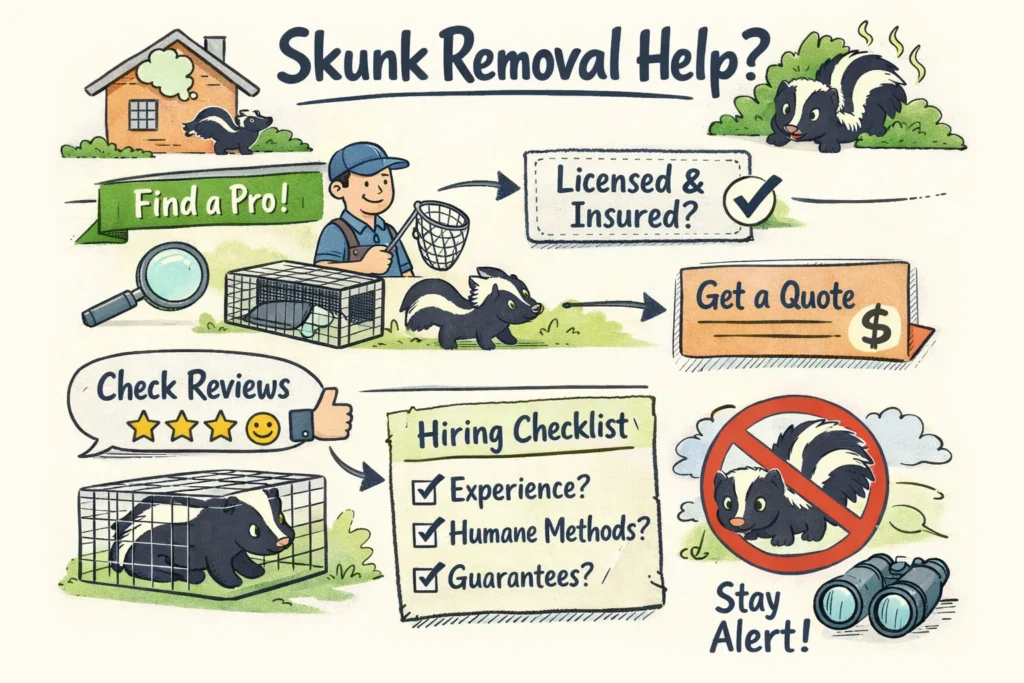
7-step local hiring checklist: vet wildlife pros fast
- Confirm licensing and insurance. Ask for the company license and proof of liability insurance. In many regions wildlife permits are required.
- Ask about methods. Do they use exclusion and one-way doors? Do they relocate? If relocation is mentioned, ask where and whether it’s legal locally.
- Get an itemized written estimate. The quote should separate inspection, trapping/exclusion, odor remediation, repairs, and follow-up.
- Warranty and follow-up. How long is the guarantee against re-entry? Is a re-inspection included and for how long?
- Timing and emergency fees. When can they start? What are same-day, weekend, or after-hours charges?
- References and proof. Check recent reviews, ask for before/after photos, and request a local reference.
- Watch for red flags. Cash-only deals, vague answers about relocation, no written quote, or prices that look too good to be true.
On the first call, try: “Can you inspect today? Do you provide a written itemized quote? What are your humane methods and warranty?” At Bug Managers we answer yes to those every time: licensed, insured technicians, humane exclusion preferred, itemized estimates, free inspections in many areas, and clear warranties. (See our Skunk Removal, Bug Managers page.)
What a pro actually does: humane methods, permits, and timeline
Expect a plain sequence: inspection → humane exclusion or trapping → odor cleanup → permanent sealing → follow-up inspection. Most jobs start with a same-day or 48-hour inspection. Trapping or exclusion usually takes 1–3 visits. Permanent sealing waits until the animal has exited and clearance is confirmed.
Humane methods include one-way doors, motion-camera verification, and buried mesh or hardware cloth to stop digging. Relocation is limited in many jurisdictions because of legal rules and animal welfare: relocated skunks often don’t survive, and some areas ban transport to prevent disease spread. For more on best practices, see skunk damage prevention and control methods.
Permits vary. Some provinces and municipalities restrict relocation or require operator certifications. Always ask the provider how they comply locally. A trustworthy company will explain permits and give you documentation if required. For species-specific handling and training references, review material about wildlife species: skunks.
Extra work — insulation replacement, crawlspace repairs, structural patching — adds time and cost. Plan for several days to a few weeks for full resolution depending on scope.
How much will it cost? Real price ranges and scenarios
National averages give a quick sense: basic removal runs roughly $300–$700. Odor remediation adds $200–$1,000 depending on contamination. Inspections commonly cost $100–$300. Exclusion work often starts around $350–$700 and climbs for structural fixes. For additional national cost references see typical skunk removal cost estimates.
| Service | Typical Range (CAD) | Notes |
|---|---|---|
| Single skunk, accessible yard | $300–$350 | Includes trapping/relocation or eviction |
| Skunk under porch/crawlspace + odor clean | $450–$900 | Exclusion, multiple visits likely |
| Multiple skunks or family den | $400–$700+ | Extra visits, more traps/exclusion |
| Dead skunk removal | $150–$250 | Handles disease risk and disposal |
| Major crawlspace cleanup/insulation repair | $500–$4,000 | Depends on contamination and repairs |
Emergency or weekend calls usually add 25–50%. Insist on an itemized quote that separates trapping, odor work, and repairs. Very low estimates often skip odor remediation or sealing — that’s how the problem comes back.
Odor, pets and prevention: de-skunking now and keeping skunks away for good
The peroxide + baking soda + dish soap mix neutralizes skunk oil effectively when used correctly. Mix fresh. Don’t store. Avoid eyes and limit contact to 5–20 minutes. Vets endorse it as the go-to first aid. For step-by-step guidance on treating pets after a skunk spray, review instructions on de-skunking your dog.
For fabrics and household odors, enzyme cleaners work best. Wash soft goods promptly. Ventilate. If the spray reached ducts or insulation, professionals may need to isolate and treat those areas — sometimes insulation must be replaced.
Professional odor remediation options include enzyme treatments, thermal fogging, ozone applied only in vacated spaces, and insulation replacement where contamination is severe. Expect $200–$1,000 depending on the severity.
To keep skunks away: bury 12–20 inches of hardware cloth around foundations; seal gaps under decks and sheds; secure garbage and pet food; remove brush and woodpiles near the house; trim vegetation that offers shelter; and consider motion-activated lights or sprinklers. These are durable, low-tech defenses. For full property hardening and exclusion work see our Pest & Wildlife Proofing Services.
Bug Managers offers follow-up inspection and exclusion warranties and will document permit compliance where required. We prefer humane exclusion, give written guarantees, and provide free estimates in many parts of Ontario and the Greater Toronto Area.
Don’t let a skunk problem become permanent. Triage now. Use the 7-step checklist when hiring. If a structure or pets are involved, call a licensed handler.
If you want it handled right — humane, licensed, fast — call Bug Managers for a free inspection and a clear, written quote. We also handle other wildlife like raccoons and common rodents — see our Rat & Mice Removal service pages.