
Learn effective Squirrel-Removal methods to handle infestations with humane approaches and fair pricing in your area.
Squirrels are noisy and annoying. Most problems are fixable without drama. Read this and you’ll know how to spot an infestation, what to do tonight, what a fair price looks like, which humane and legal approaches pros should use, and exactly what to ask before you hire anyone.
If you’re in Ontario or the GTA, Bug Managers is one of the local teams that handles humane exclusion, repairs, and follow-up inspections. This piece explains what proper service looks like so you can compare quotes rather than guess.
How to spot a squirrel problem — fast signs and what’s urgent
Listen first. Daytime scurrying or thumping in the attic or inside walls is the clearest sign. Other reliable clues: shredded insulation and twig nests, small oval droppings in an attic or garage, fresh chew marks and entry holes about golf‑ball size or larger, bird feeders stripped and bark missing from nearby trees, and a sudden musky odor or stains that look like water damage.
Quick triage: if you hear activity but can’t see it, check the attic at daylight for fresh droppings or nest material. If you find chewed wires, scorch marks, flickering lights or any sign of exposed electrical conductors — treat it as urgent. That’s a fire risk. Call a pro immediately and don’t try to fix live wiring yourself.
What’s not a squirrel: mice and rats leave much smaller droppings, produce constant night activity, and leave greasy rub marks along pathways. Bats are active at dusk and leave crumbly, pepper‑like guano clustered beneath roosts, often near eaves. If you’re unsure, photograph what you find and ask a professional to identify it before you act.
Short-term fixes you can do today — safe, humane mitigation
Small, sensible steps buy time. Don’t trap or poison. Don’t block all exits. Dead animals inside walls cause far worse problems than a few nights of noise.
Chimney tips
If a squirrel is stuck in the chimney, close the fireplace damper so it stays in the flue and not in your living room. Block the fireplace opening with a sheet of cardboard to prevent it from jumping into the house while you encourage it up and out. Make noise near the firebox and open the chimney top if you can safely access the roof. Don’t climb if you’re uncomfortable on a ladder — call a pro.
Attic tips
From inside the attic temporarily seal inactive gaps with hardware cloth or metal flashing — not loose foam or chicken wire (squirrels chew through both). Over the active hole you can fashion a short one‑way tunnel from metal mesh so animals can leave but not return. Use strong odors like diluted ammonia only briefly and ventilate afterward; they’re a temporary nuisance repellent, not a solution.
Safety and humane cautions
Never use poison or glue. They kill unpredictably and lead to rotten carcasses, smells and health hazards in walls. If you suspect there are young in a nest, stop and call a licensed wildlife remover — timing matters and mishandled evictions can be inhumane and illegal.
What this actually costs — realistic ranges and why prices vary
Expect a wide range: $200–$1,500 depending on scope. Most small jobs fall in the $300–$600 band. Full attic exclusion jobs — removal plus sealing and cleanup — commonly run $500–$1,500. For general market comparisons see typical squirrel removal cost guides to confirm local ranges.
Typical breakdowns look like this: a single-animal removal often costs $200–$300; trapping and relocation usually $200–$600; installing a professional one‑way door $200–$400; inspections $100–$150; cleanup and decontamination $150–$1,000 or more if insulation must be replaced; sealing and repairs generally $100–$1,000+ depending on access and materials. Where euthanasia is legal and chosen, prices vary roughly $375–$900, but humane exclusion is preferred where possible. For another benchmark you can review a squirrel removal cost breakdown.
Why the spread? Size of the infestation, where the squirrels are (attic, chimney or walls), how hard the access is, whether wiring or insulation needs replacing, local labor and permit costs, and whether relocation or other legal steps are required. Practical rule: always get an itemized quote. Beware per‑animal pricing that can balloon if more animals appear through unsealed gaps. Ask whether sealing and cleanup are included or billed separately.
Humane, legal methods pros should use — and what to refuse
Good crews start with a thorough inspection, then remove animals using non‑lethal exits when possible (one‑way exclusion devices) and trap only when relocation is legal and safe. They time evictions to avoid separating mothers and young, seal entry points with durable, chew‑proof materials like stainless mesh or metal flashing, and replace or professionally decontaminate contaminated insulation. A written plan and a follow‑up inspection are standard.
Legal note: rules vary. In Ontario, property owners may capture and relocate squirrels causing property damage under specific local limits (for example, relocation within roughly 1 km and humane handling rules); other municipalities have tighter guidance. A reputable company knows the local wildlife rules and works within them or has the proper permits. For tips on choosing a trustworthy provider consult guidance on choosing a wildlife control company.
Refuse firms that push poisons or glue, those that trap without sealing, or companies unwilling to remove carcasses or provide a written warranty. A responsible local crew like Bug Managers will walk the roof, point out the active entry, explain the chosen exclusion method, provide a written plan and a follow‑up guarantee, and offer eco‑friendly cleanup options.
Hiring checklist — questions, credentials, contracts and red flags
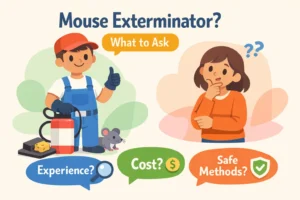
Don’t hire blind. Insist on three basics up front: valid license, proof of insurance, and a written estimate detailing scope and costs.
Exact questions to ask
- Are you licensed for wildlife removal in this province/state?
- Do you carry general liability and workers’ compensation? Can I see proof?
- What exact method will you use for this job (one‑way exclusion, live trapping, euthanasia)?
- Will you perform exclusion and sealing after removal? Is sealing included in the price?
- Do you handle carcass removal and attic clean‑up? Is decontamination included?
- What guarantees or warranties do you provide and for how long?
- Can you give references or recent photos of similar work?
- What is the payment schedule and do you accept cards?
Red flags: evasive answers, no contract, open‑ended per‑animal pricing, pressure to approve on the spot, or refusal to commit to sealing. Phone script you can use: “Hi — I hear scavenging in my attic during the day. Can you confirm you inspect attics, do humane exclusion, and provide a written quote for removal + sealing + cleanup?”
Repairs, prevention and what comes after
Removal without repairs is a temporary fix. That’s the common mistake. Permanent results require patching the gaps animals used and removing attractants.
Common fixes: install chimney caps, fit soffit and vent screens with metal mesh, apply metal flashing around chipped siding or roofline, replace shredded insulation, and have an electrician evaluate and repair any chewed wiring. These are not optional if you want the problem solved for good.
Yard work helps: trim tree limbs 8–10 feet from the roof, secure or remove bird feeders, lock compost and garbage bins, and remove easy food sources that teach animals to hang around.
Expect at least one follow‑up inspection a few weeks after service. Consider annual checks on eaves and vents. If you want a local, licensed team that offers humane removal, sealing, cleanup and a guarantee, call for a free inspection. In Ontario and the GTA, local licensed teams provide free quotes, eco‑friendly methods, insured technicians and itemized estimates so you know what you’re paying for.
Summary and next step
Don’t rush into poison or messy DIY. Triage the problem, use safe short‑term fixes, get at least two itemized quotes, and hire a licensed team that guarantees exclusion and cleanup.
You’ll sleep better knowing the animal’s out, the hole is closed, and the attic isn’t hiding a bigger problem. For a free inspection in Ontario or the GTA, call a local licensed team and insist on a written plan and follow‑up guarantee.