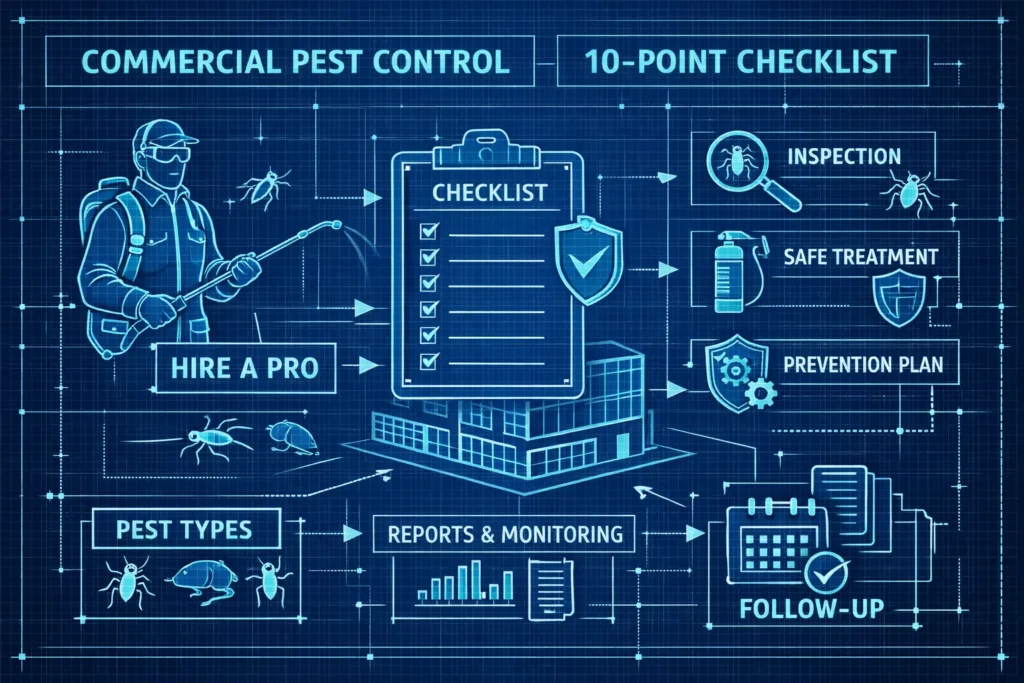
When choosing a pest control provider, using a commercial pest control checklist can save your business from costly infestations, health violations, and operational downtime. Ten quick truth-tests. Fail one and move on. Below is a field-tested checklist you can use on calls, inspections, and bids — fast, sensible, and non-negotiable.
Start Here: Bug Managers’ 10‑Point Test
Ten quick truth‑tests. Fail one and move on.
Licensing and certified applicators
Why: Licensing is the legal and safety baseline — no license, no business.
Ask: “Show licence numbers and applicator IDs; may I verify them?”
General liability & workers’ compensation
Why: You must not inherit their risk. Insurance protects your people, property, and balance sheet.
Ask: “Can you provide a Certificate of Insurance naming our business as additional insured when appropriate?”
IPM‑first plan
Why: Prevention beats repeat sprays. IPM reduces surprises and long‑term costs.
Ask: “Do you prioritize integrated pest management and provide a written prevention plan?”
Written treatment plan & methods
Why: You deserve to know what happens, when, and how long your business will be affected.
Ask: “What methods will you use, what are the alternatives, and what’s the expected disruption and re‑entry time?”
Facility‑specific experience
Why: Kitchens, hospitals, warehouses — they require different playbooks.
Ask: “Have you handled similar sites? Can you provide references or a recent case study?”
Transparent pricing model
Why: Ambiguity hides future fees. Clear pricing prevents surprises and bait‑and‑switchs.
Ask: “Provide an itemized quote: inspection, labor, materials, travel, monitoring devices, and re‑treat policy.”
SLAs & guarantees
Why: Service commitments are what separate vendors from partners.
Ask: “What’s your emergency response time and warranty period for re‑treatments?”
Reporting and documentation
Why: Food safety audits, health inspections, and insurance claims need records.
Ask: “Will you deliver inspection reports, trap logs, MSDS/product labels, and corrective action plans?”
Local reputation & references
Why: Reputation implies reliability. Local clients mean faster, proven responses.
Ask: “Give two local client references and a recent case study from a comparable site.”
Red flags & behavior test
Why: How they talk is how they work.
Note: Decline if they quote without inspection, refuse paperwork or MSDS, push long‑term contracts before proving results, or pressure for immediate signatures.
This checklist is field‑tested. Bug Managers uses the same test on every commercial bid — practice, not puffery.
Credentials, Insurance, and Safety: What to Demand
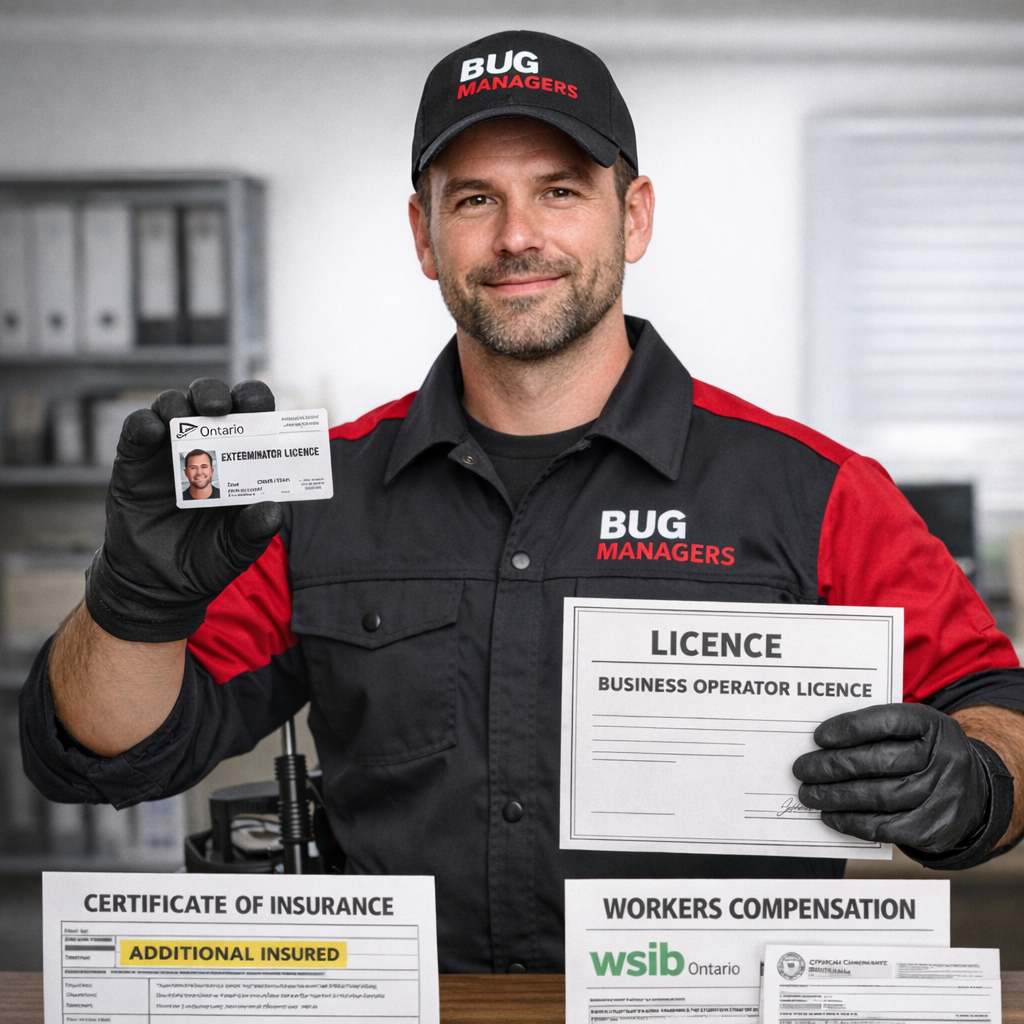
A badge, a bond, a backup plan.
Check licence types: business operator or commercial applicator licences, individual applicator IDs, and technician training certificates. Ask about continuing education for their crew.
Insurance specifics: require a Certificate of Insurance showing general liability and workers’ compensation. For most commercial clients request at least CAD/US$1M general liability; major accounts often request higher limits. Insist the COI can name your business as additional insured and includes a 30‑day cancellation notice. For reference, review standard Schedule A insurance requirements used in many commercial contracts.
Safety proof: demand MSDS sheets, product labels, a written PPE policy, and documented confined‑space or electrical safety procedures if the work touches those hazards.
How to verify quickly: request licence numbers and the COI in the proposal. Then pause and verify — online registries or a quick call to the regulator will flag problems before you sign. See the provincial pesticide licensing guidance for details on licences and permits.
Match Method to Risk: IPM, Heat, Fumigation, Baits and When to Use Them
Treat the problem, not just the symptoms.
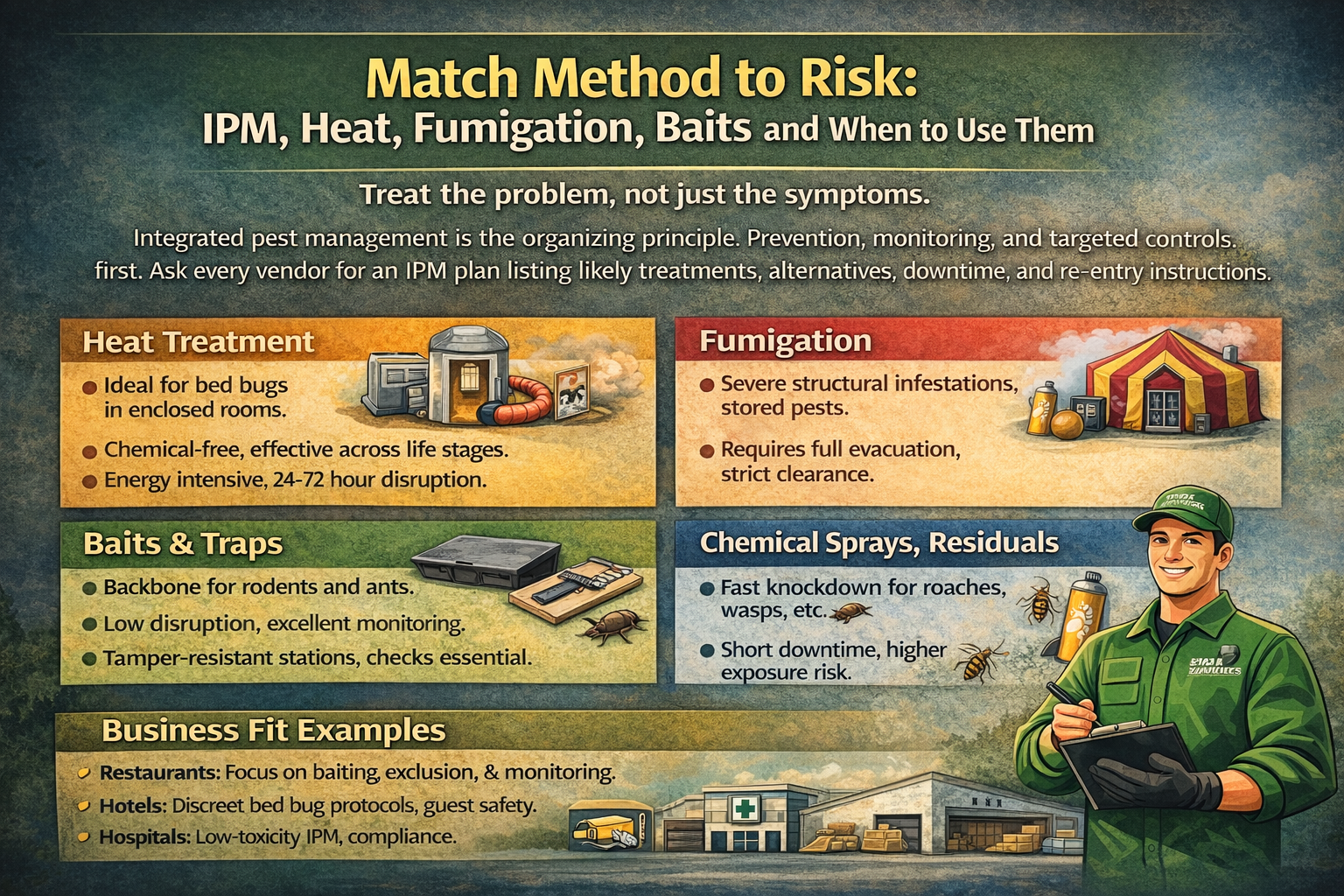
Integrated pest management is the organizing principle. Prevention, monitoring, and targeted controls first. Ask every vendor to propose an IPM plan that lists likely treatments, alternatives, expected downtime, and re‑entry instructions.
Methods and fit, in plain terms:
Heat treatment — ideal for bed bugs in enclosed rooms. Chemical‑free and effective across life stages. Energy intensive. Expect a 24–72 hour disruption for setup, heat, and cool down.
Fumigation — reserved for severe structural infestations or stored‑product pests. Penetrates voids but requires full evacuation and several days of disruption. Use it sparingly and only with strict clearance procedures.
Baiting & traps — the backbone for rodents and ants. Low disruption, excellent for monitoring, but slower to finish the job. Tamper‑resistant stations and documented checks are essential.
Chemical sprays/residuals — fast knockdown for roaches, wasps and localized problems. Short downtime but higher exposure risk. Use residuals strategically as part of an IPM program, not as the whole plan.
Trapping/monitoring — minimal disruption and indispensable for compliance. If your vendor skips trap logs, walk away.
Business fit examples: restaurants focus on baiting, exclusion and monitoring; hotels need discreet bed‑bug protocols and guest safety; hospitals require low‑toxicity IPM with documented compliance; warehouses may need targeted fumigation or prophylactic treatments for stored goods.
Money and Models: How Bids Are Priced and What to Expect
Price tells a story. Read it.
Common models: one‑time/emergency calls, monthly or annual contracts, and tiered or per‑square‑foot rates for large facilities. Preventative contracts cost less over time than repeated emergency calls.
Benchmarks (indicative, regionally variable): one‑time emergency calls often run CAD 300–600+; monthly contracts frequently start around CAD 150–400 for small sites and scale up for larger, higher‑risk facilities. Large facilities may use tiered pricing — ask for the thresholds and inclusions.
How to compare bids: insist on itemized quotes that separate inspection, labor, materials, travel, monitoring devices, and re‑treats. Normalize by frequency and deliverables — what reports and logs do you get each visit?
For an industry perspective on typical pricing models and what to expect when comparing vendors, consult a comprehensive pest control pricing guide.
Negotiation tips: ask for a trial period (30–90 days), cap annual price increases, and tie payments to documented deliverables (inspection report + trap counts). Beware lowball offers that omit licences, COIs, or subcontractor disclosures.
Contracts, SLAs, and Guarantees to Insist On
Get commitments on paper before chemicals hit the floor.
Must‑have contract elements: a clear scope of work (listed pests and interior/exterior boundaries), service frequency and monitoring schedule, emergency response time (target 24–48 hours for active rodents/wasps), warranty/re‑treatment window (for example, free re‑treat within 30 days), reporting deliverables, insurance and indemnity clauses, termination and auto‑renewal terms (30 days’ notice), no‑subcontracting without consent, and an IPM‑first clause when that is a priority.
Sample negotiation language:
“Vendor will provide monthly written reports, respond to emergency calls within 48 hours, and re‑treat covered pests at no charge within 30 days of initial treatment. Client may terminate with 30 days’ written notice.”
Shortlist, Hire, and Prepare: From RFP to Day‑Of
Plan the hire like you plan a drill.
- Create an RFP or short checklist of must‑haves (licences, COI, IPM plan, reporting).
- Invite three vendors for site inspections — no walkaway quotes.
- Compare written proposals against the 10‑point checklist.
- Call references and verify licences/COIs.
- Contract with clear SLA language and a scheduled start/inspection report.
- Prepare the site: secure food/meds, move inventory, assign a staff liaison, post signage, arrange temporary closures if required.
- Keep documentation: inspection reports, follow‑ups, trap logs — these protect you and help future vendors.
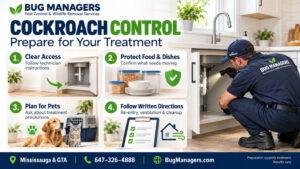
Day‑of quick checklist for staff: remove food exposures, secure pets and medications, isolate heat‑sensitive electronics if requested, and confirm access points with the technician.
End the conversation if they refuse an inspection, withhold MSDS or licence numbers, pressure for immediate signatures, or balk at reasonable contract clauses.
If you operate in the GTA and want a licensed, IPM‑centred partner who serves luxury estates, restaurants, hotels and commercial sites, Bug Managers provides site inspections, documented IPM plans, and emergency response — request an RFP visit to see this checklist in action. We serve local commercial clients across the region, including Commercial Pest Control Services in Brampton, Pest Control Vaughan, Affordable Pest Control Services in Mississauga, and Pest Control Burlington. To schedule a site visit or request an RFP, contact Bug Managers.
A good vendor keeps records. A great one prevents calls.
Key takeaways: demand licences and COIs; insist on an IPM‑first plan and written SLAs; normalize bids by deliverables, not price alone. Then hire deliberately.