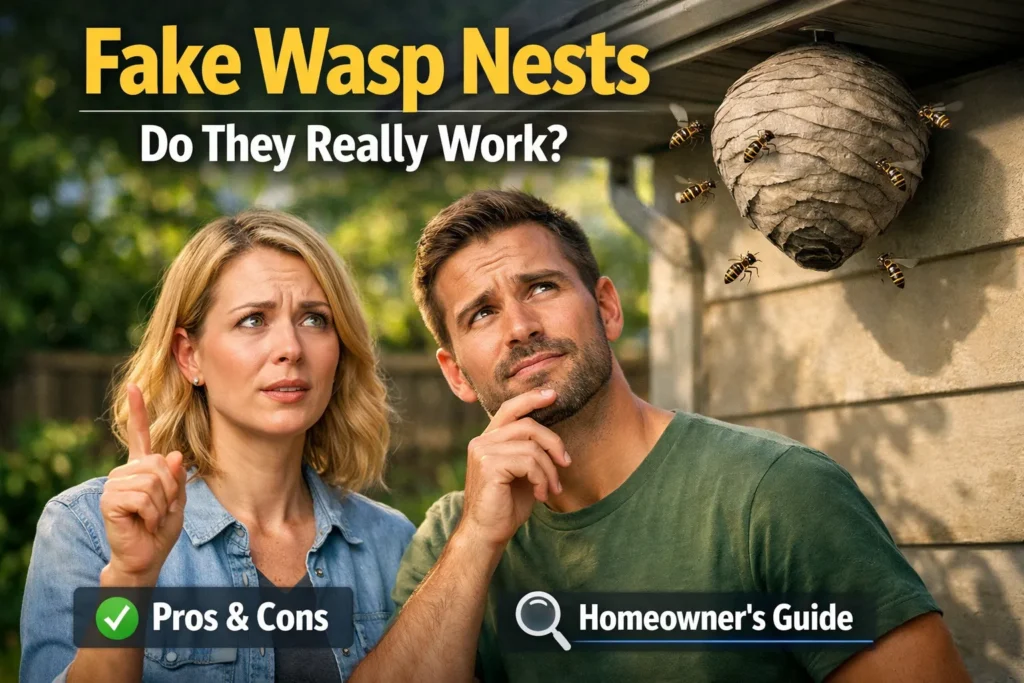
Intro
The paper-bag trick is a cheap experiment, not a promise. Bug Managers hears the same question every spring: will a pretend nest keep wasps away? Short answer: the science doesn’t support decoys as a silver bullet. Longer answer: for certain wasps, early in the season, a credible-looking decoy can be a low-risk test. Try it if you like experiments. Don’t treat it as protection.
Quick verdict: what the evidence actually says
No peer‑reviewed studies prove decoys reliably stop new wasp colonies. Entomologists are skeptical. The idea rests on a neat theory: social wasps are territorial, so a scouting queen might skip a place that already looks occupied. That makes sense on paper. In practice, field observations are messy. Queens sometimes build next to or even on old nests. Commercial tests exist, but they’re not rigorous.
Practical takeaway: view a wasp decoy as a cheap, low-risk experiment for early spring prevention against open-nest paper wasps. It’s not a reliable strategy for ground‑nesting yellowjackets or for aggressive hornets. Decoys do not replace exclusion, sanitation, or professional removal when risk is present.
Who might respond — and who won’t
Species and nesting style matter more than the prop you hang. Know which insects are on your property before you invest time in a decoy.
Paper wasps
Paper wasps build open, umbrella‑style combs under eaves, porches, and rafters. Queens scout in spring and can be discouraged by visual “occupied” cues—sometimes. If you have a history of paper wasps on your house and it’s early in the season, a realistic decoy can occasionally redirect a queen to a different location.
Yellowjackets
Yellowjackets often nest in the ground or inside cavities. They rely heavily on chemical and site cues rather than a visual “no vacancy” sign. Decoys rarely affect them. If you’ve had ground nests or cavity infestations, skip the decoy and focus on exclusion and baiting strategies tailored for yellowjackets.
Hornets (bald‑faced hornets)
Hornets build large enclosed aerial nests and are aggressive. They are largely indifferent to fake nests. Don’t rely on a decoy for hornet control—these require professional assessment and, in many cases, removal.
Practical note: if you see ground activity or recurring yellowjacket problems, escalate to prevention and pro help rather than DIY decoys.
DIY decoy that reads “occupied”: materials, size, and a simple step‑by‑step
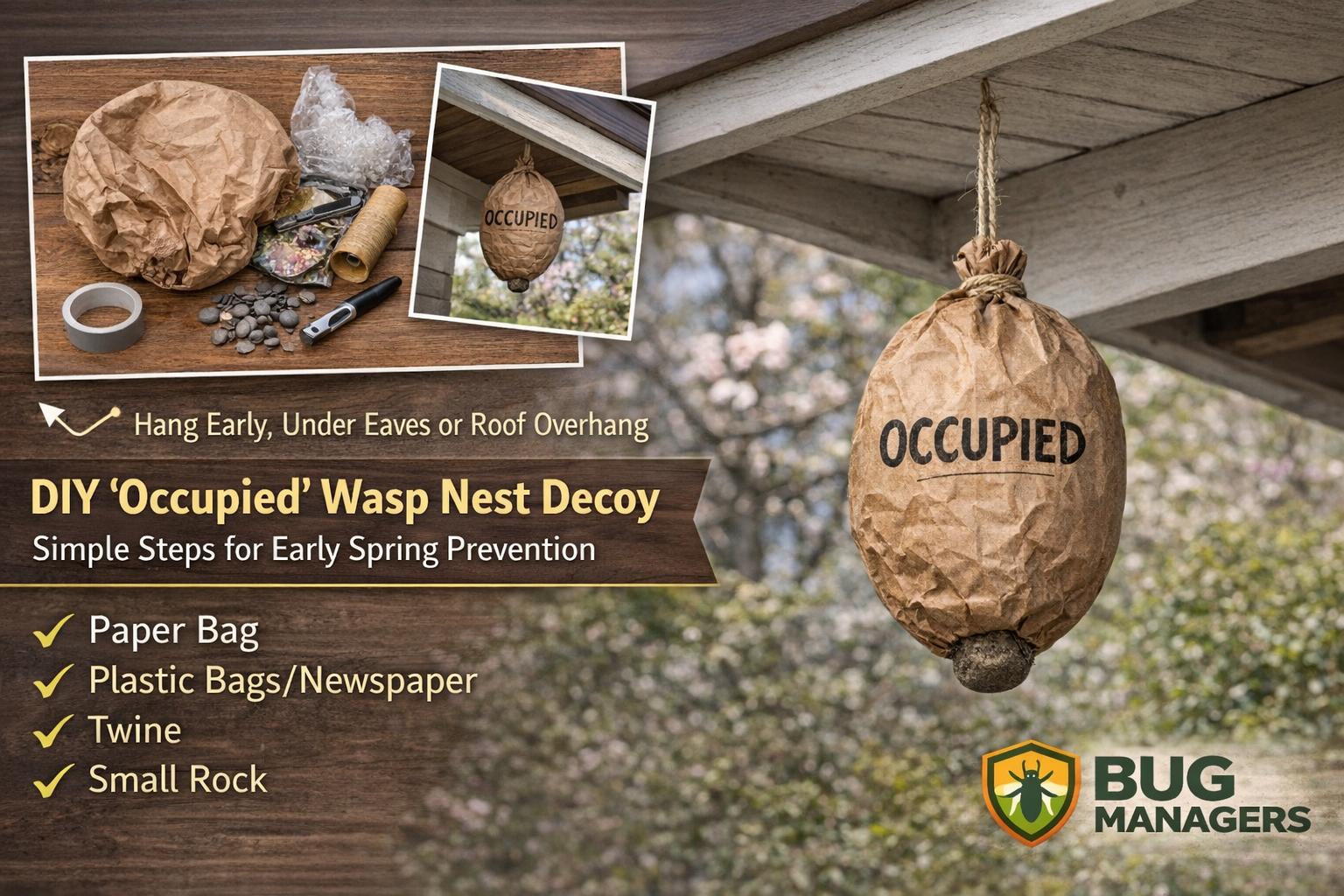
If you’re going to try a decoy, make it look believable and hang it early. The easiest, most-cited method uses a plain paper grocery bag—lightweight, textured, and quick to make.
Materials: one large brown paper grocery bag; filler (plastic bags, newspaper, or bubble wrap); twine; small rock or gravel for a tiny weight; tape, hole punch, marker (optional).
- Stuff the bag into an oval roughly 8–12 inches tall — real nests are about this size. Add filler until it’s firm but slightly irregular.
- Twist and tape the opening so the stuffing stays dry. Punch a reinforced hole through the top and thread twine for hanging.
- Add a small weight at the base so the bag hangs teardrop‑style and doesn’t spin wildly in the wind.
- Puff the sides to create subtle texture. Optionally, draw faint gray‑brown ridges for realism. Avoid bright colors.
Alternatives: a crocheted decoy gives nicer texture but weathers; papier‑mâché looks realistic but is heavier and can crack; store‑bought plastic decoys are durable but vary widely in how convincing they appear. Replace your decoy yearly and keep it sheltered from driving rain. Never hang a decoy onto or inside a real nest.
Where and when to hang — timing, placement, and realistic limits
Timing is the biggest variable. The only window where decoys might matter is early spring—before queens choose sites. In the Greater Toronto Area that’s typically March through May; adjust earlier or later for milder or colder climates.
Placement matters. Hang decoys in visible, sheltered spots where paper wasps commonly nest: under eaves, porches, soffits, or near roof overhangs. Aim roughly 6–12 feet high, out of direct wind, in shade or semi‑shade. In larger yards, use multiple decoys spaced about 20–50 feet apart so a scouting queen is likely to encounter the “no vacancy” sign.
Realistic limits: once a colony is established nearby, a decoy is ineffective. Decoys won’t fix food sources, garbage issues, or structural entry points. Use them alongside sanitation and exclusion for any real chance of impact.
When decoys fail — safer alternatives and when to call Bug Managers
Decoys fail for predictable reasons: wrong species, wrong season, a faded or wet decoy, attractive food sources nearby, or existing nests in the area. They can give a false sense of security if you stop doing the basics. For a concise overview of the broader evidence around decoy effectiveness, see this review of the topic.
Smarter, proven steps:
Sanitation: remove open drinks and fruit, secure garbage and compost, clean sugary spills. Exclusion: seal soffit gaps, screen vents, cap chimneys, and fix torn siding—use steel mesh for durable repairs. Targeted control: traps and bait can help for yellowjackets but use them carefully; they attract as well as kill and are species specific. Natural scents like peppermint oil have mixed evidence and should be complements, not replacements.
Call a professional when the stakes are high: visible large nests, aggressive species, occupants with allergies, small children or pets, recurrent problems despite DIY efforts, or when you want humane removal and long‑term exclusion. That’s where Bug Managers steps in. Our licensed technicians provide humane removal or relocation when appropriate, eco‑friendly treatments, professional pest‑proofing for high‑value GTA properties, same‑day emergency service, and a peace‑of‑mind guarantee. We serve the Greater Toronto Area and specialize in discreet, experienced handling of wasp and wildlife issues.
A short plan: decide, try, monitor, escalate
Keep it simple. Try a cheap decoy only as an early‑spring experiment. Watch closely. Move to proven fixes when needed.
- Identify the species. If you suspect yellowjackets, hornets, or ground nests → call a pro.
- If it’s likely paper wasps and it’s early spring: hang 1–3 realistic decoys under eaves and remove nearby attractants.
- Monitor for 2–4 weeks. If no new nests, leave decoys up through early summer; replace if weathered.
- If nests appear, activity increases, or anyone is allergic → stop DIY and contact Bug Managers for inspection and safe removal.
What to look for in a decoy: muted gray‑tan color, textured surface, an 8–12 inch oval shape, lightweight hanging loop, and protection from heavy rain.
Final nudge: a wasp decoy is worth the cost of a paper bag and a weekend experiment. But it’s an experiment. If you want reliability, safety, and long‑term prevention, call the licensed team at Bug Managers. Peace of mind is not expensive—it’s professional.