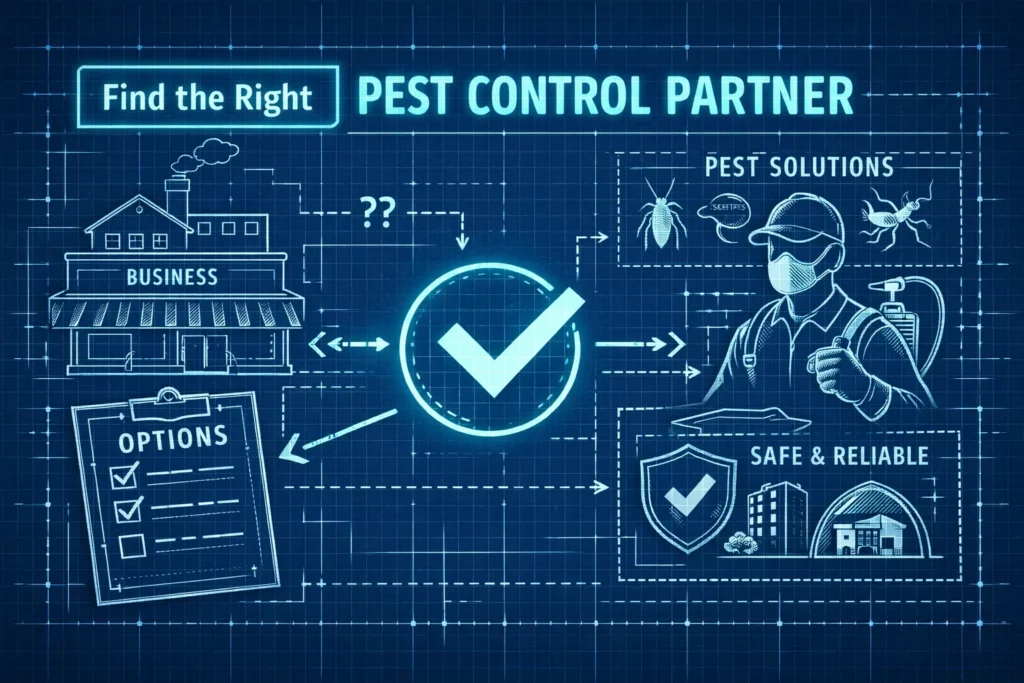
Business owners hire certainty, not sprays.
A wrong vendor costs more than money. It costs time, fines, and a reputation that took years to build. After two decades fixing avoidable mistakes across Greater Toronto Area properties, Bug Managers distilled what matters into a fast, practical checklist. Use it to vet contenders quickly and choose a partner that delivers predictable protection.
The 10 essentials to vet a commercial pest partner
Licensing & certifications
Ask for the company licence and applicator IDs up front. Verify those numbers with the provincial regulator. In Ontario that means an operator licence for the business and valid exterminator or applicator certificates for technicians. Why it matters: unlicensed work transfers legal and environmental risk to you.
Insurance & worker coverage
Require current ACORD insurance certificates that name your business as an additional insured when possible. Ask for pollution, vehicle and general liability coverage and a WSIB or equivalent clearance letter. Why: claims happen. You cannot be the insurer when accidents or contamination occur.
IPM-first approach
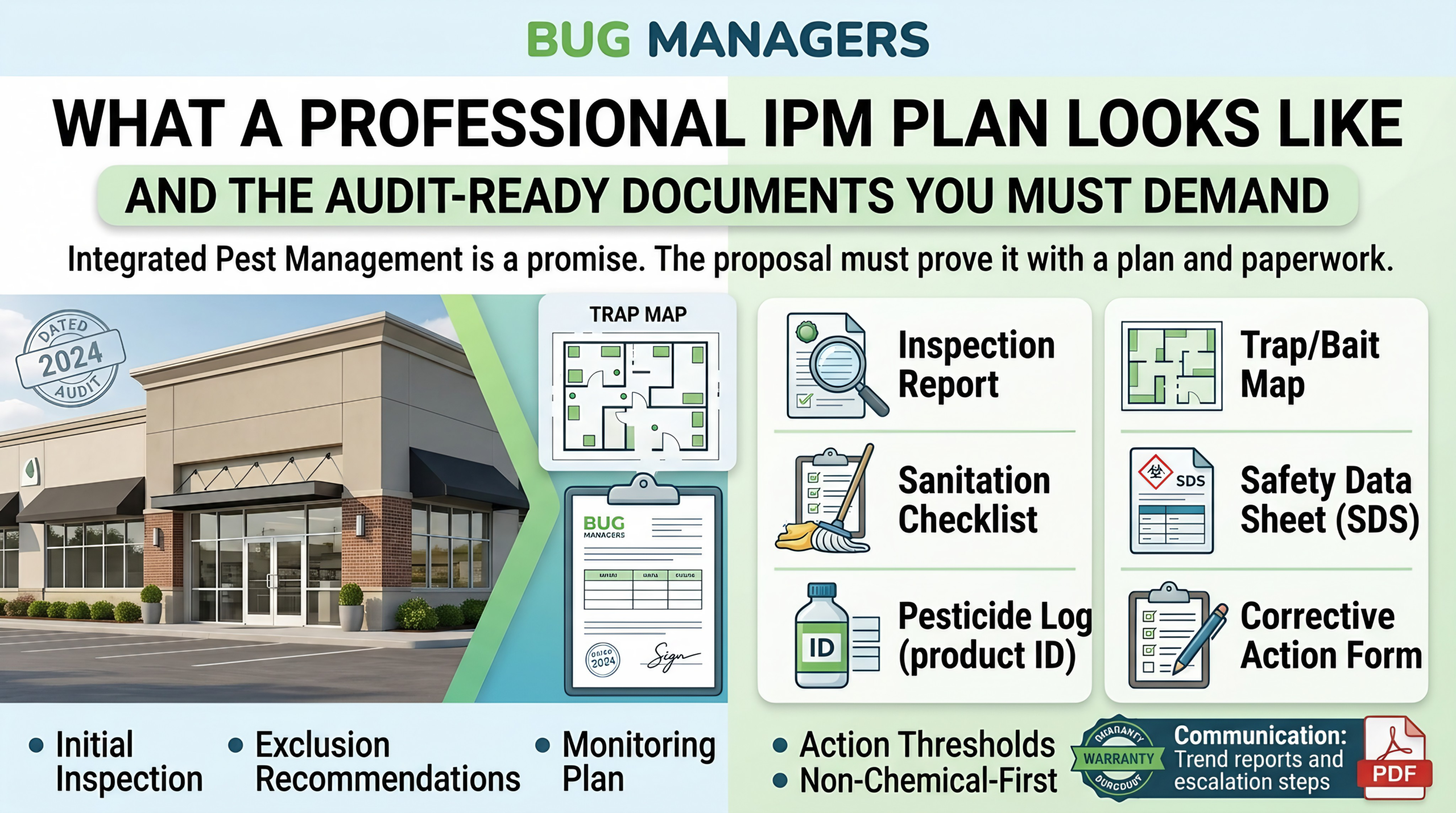
Insist on Integrated Pest Management — not a chemistry-first pitch. A proper IPM plan starts with inspection, monitoring and exclusion. Chemicals are a targeted tool, not the strategy. Why: prevention reduces repeat calls, regulatory headaches and product liability.
Sector experience & references
Demand references from similar facilities — restaurants, hotels, warehouses or offices. Pests behave differently around food service versus warehousing. Experience in your sector shortens the learning curve and avoids costly missteps.
Multi-site & scalability
Can they manage consistent programs across several locations? Ask whether reports, metrics and service standards are centralized. Coordination prevents gaps between sites and protects chain-wide reputation.
Pricing transparency
Require a clear pricing model: what’s included, what’s extra, and how outbreaks are billed. Surprise fees show up later. A transparent contract keeps budgets predictable and vendors accountable.
SLA & response times
Confirm guaranteed windows for active infestations and emergencies. Example benchmarks: 24‑hour response for indoor Effective Rodent Control Services in Brampton, 72‑hour for active wasp nests. Timing limits damage and liability.
Monitoring & reporting tech
Ask for trap maps, digital logs, Safety Data Sheets and monthly service reports. Demand evidence — not anecdotes. Where possible insist on portal access or exportable data for audits.
Exclusion & pest-proofing
Make sure structural fixes are part of the plan: sealing, proofing, and long-term exclusion. Traps and sprays are temporary. Structures that are pest-proofed reduce recurring costs and insurance exposure.
Contract clarity & exit terms
Never sign “as needed.” Insist on scope, warranties, termination notice periods and liability limits in writing. Avoid contracts that allow vendors open-ended discretion to add fees or alter scope mid-term.
How commercial pricing works — models and realistic ranges
Commercial pricing follows familiar models: recurring subscriptions (monthly or quarterly), tiered plans by service level or square footage, flat-rate per incident, and bundled multi-site pricing. Which model fits you depends on property type, risk profile and operational tolerance for surprises. For industry pricing context, review a standard pest control pricing guide to compare models and common line items.
| Property Type | Typical Model & Range | Key Factors |
|---|---|---|
| Restaurants | $100–$400 per visit; annual $1,200–$4,000 | Food regs, kitchen risk, inspection frequency |
| Hotels | $500–$2,000 per visit; bedbug responses higher | Room count, laundry flows, guest turnover |
| Warehouses | $200–$1,000 per visit; quarterly $400–$1,200 | Storage type, inventory sensitivity, dock exposure |
| Offices | $150–$500 per visit; annual $1,000–$3,000 | Size, break-room risk, tenant obligations |
What to ask about pricing: Is inspection included? Are materials and application fees covered? How are outbreaks priced? What multi-site discounts or escalation clauses exist? Red flag: very low fixed prices with vague scope — that usually means corners will be cut later.
Verify credentials — the documents and checks that matter
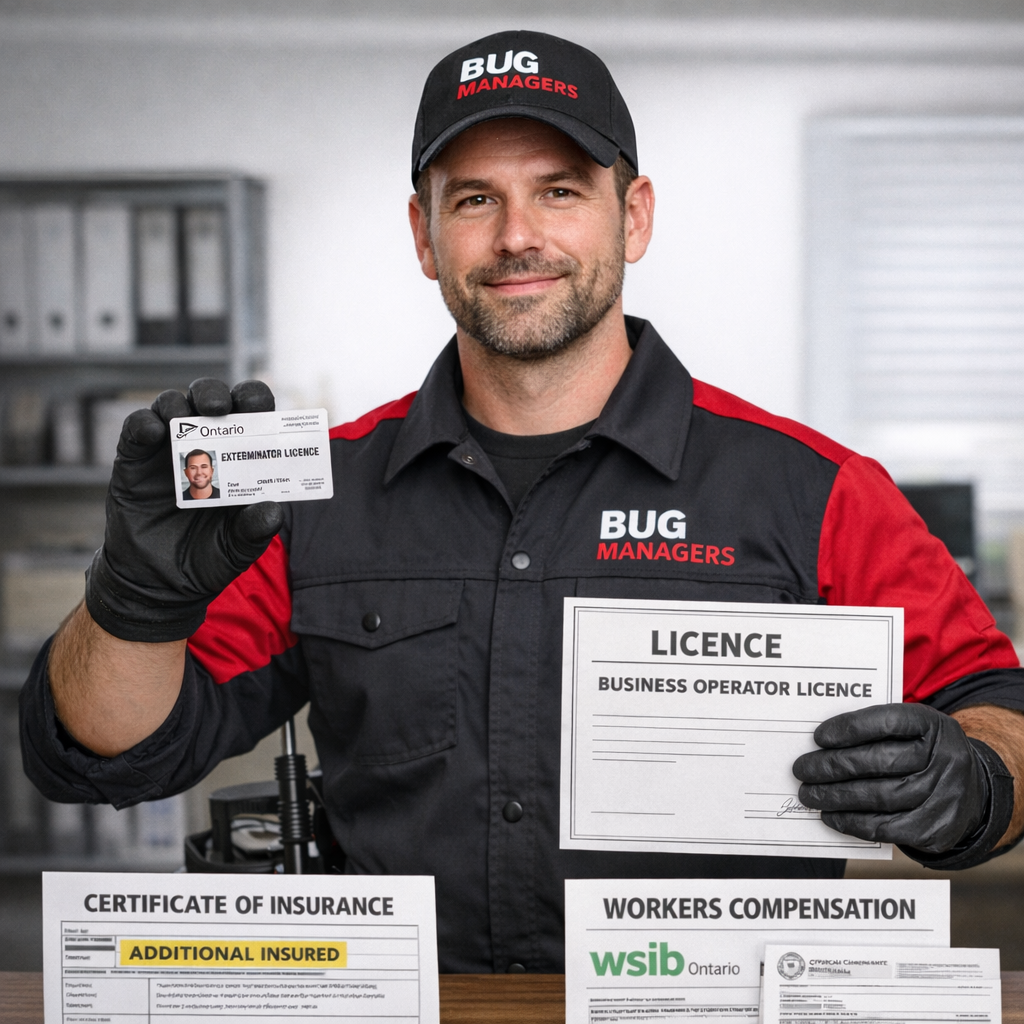
Ask vendors to produce the documents below and verify them before signing.
- Company licence and applicator/technician certificates
- ACORD insurance certificate and WSIB clearance
- Safety Data Sheets (SDS) and pesticide registration numbers
- Business registration and sample service report
How to verify: cross-check licence numbers with the provincial regulator (e.g., Ontario’s pesticide/operator licence authorities), call the insurer to confirm coverage dates, and request a recent WSIB clearance letter or equivalent. Red flags include reluctance to share numbers, blurry or expired certificates, “we’ll sign it later” answers, or cash-only deals. In the GTA, expect transparency. About, Bug Managers provides verifiable licence numbers and sample reports on request.
IPM in practice — what you should see and how it pays back
An IPM program on site looks like a ledger, not a spray calendar. It starts with a detailed inspection and a mapped monitoring layout: glue boards, bait stations, trap locations and scheduled checks. It pairs sanitation and exclusion recommendations with treatment thresholds so chemicals are used only when monitoring shows a need. For a concise overview of principles, consult EPA’s integrated pest management principles.
Demand measurable outcomes in reports: trap counts over time, bait uptake trends, monthly sighting logs, number of service calls, and photos of completed exclusion work. Ask vendors to show 3–6 month trend data from a similar client. A declining bait uptake curve and before/after photos of sealing work are proof, not promise.
Why IPM saves money: fewer emergencies, reduced chemical use, better regulatory compliance, and fewer customer-facing incidents. The first months may require effort; the return is predictable protection and lower long-term cost.
Contract must-haves: SLAs, reporting, technology and exit clauses
Contracts should be precise. Core items include scope of work, visit frequency, list of pests covered/excluded, permitted methods, emergency response times and re-treatment guarantees. Include pricing inclusions and escalation limits.
Reporting and technology belong in the contract. Require monthly digital reports, SDS and pesticide logs, applicator names, and portal access or CSV exports for audits. Include SLA examples such as 24‑hour indoor rodent response, 72‑hour active wasp response, and monthly monitoring logs uploaded within five business days.
Legal protections: indemnity clauses, clear limits of liability, auto-renewal notice periods, price adjustment caps, termination for cause and performance remedies. Avoid buried exclusions or open-ended fee clauses. For contract templates and industry forms, refer to resources such as the NPMA contracts and forms library when drafting your RFP or vendor agreement.
Run the RFP and interview: the exact questions that separate pros from pretenders
Ask for evidence, not promises. Require a sample site-specific IPM plan and a recent monthly report before you shortlist.
- Show me your company licence and applicator certificates for the team assigned to our account.
- Do you have experience in my sector? Provide three similar references.
- Describe your IPM program — what you monitor, thresholds, and examples of exclusion work.
- What pricing model do you recommend for our site and what is excluded?
- What is your guaranteed response time for active infestations and emergencies?
- How do you handle multi-site consistency and centralized reporting?
- Provide a recent sample report, SDS and pesticide labels for products you use.
- Do you perform pest-proofing or subcontract structural exclusion work?
- How are technicians trained and certified? Who will be our on-site contact?
- What are your warranty and re-treatment policies in writing?
- How is monitoring data stored and can we access it?
- What typically triggers extra charges and how are pricing disputes handled?
For practical tips on running a successful commercial procurement and winning consistent service delivery, review industry guidance like how to get commercial pest control contracts to shape your RFP and evaluation criteria.
Scoring rubric to shortlist: Compliance (licenses & insurance) 30%, IPM approach 25%, Reporting & tech 20%, Response & SLAs 15%, Cost transparency 10%. Shortlist 2–3 top scorers, visit references and insist on a site-specific proposal before signing.
Conclusion — two clear choices
You can buy a cheap service or durable protection. The difference is clarity. Use the 10-point checklist. Score vendors against evidence, not charm.
If you want a local, IPM-first partner in the GTA that shares verifiable reports and performs pest-proofing, contact About, Bug Managers for a site inspection and a site-specific IPM proposal. Learn more about regional service pages such as Pest Control in Toronto, Commercial Pest Control Services in Brampton, and Pest Control Oakville, Bug Managers.
Keep the building sealed. Keep the claims low. Choose certainty.