Intro
Choosing the right warehouse pest control provider isn’t about finding the cheapest option—it’s about protecting your operations, audits, reputation, and bottom line. Effective warehouse pest control prevents infestations before they become costly disruptions. This checklist helps you quickly evaluate and shortlist reliable commercial pest management partners. At Bug Managers, we apply these ten questions to every warehouse pest control site visit—so you can make informed decisions, save time, and avoid expensive mistakes.
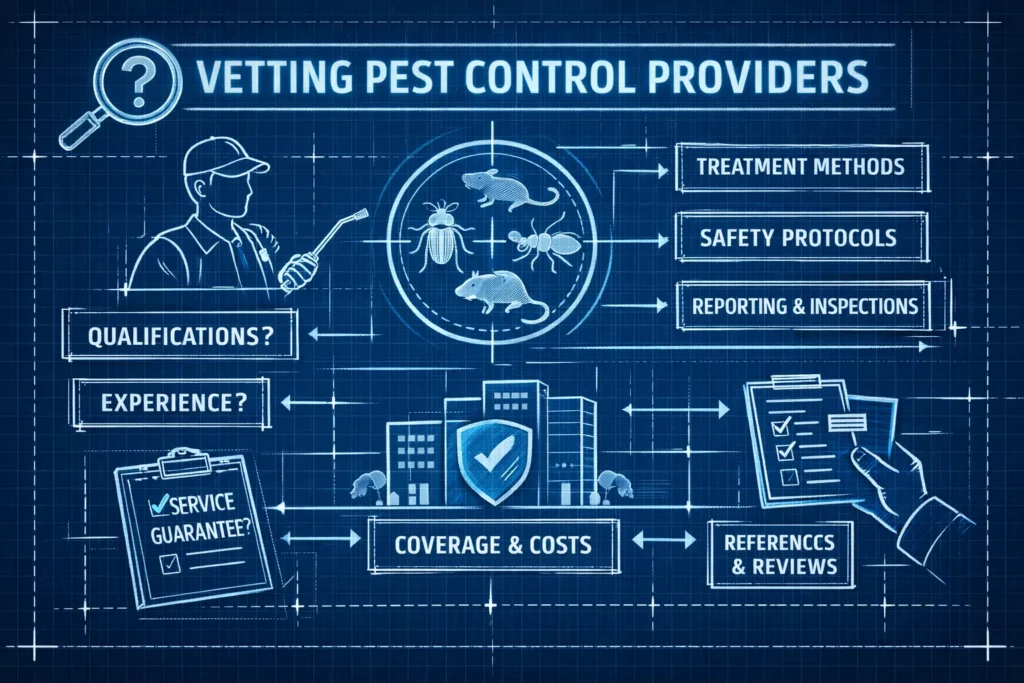
Quick litmus: 10 questions that separate pros from pretenders
- Do you follow an Integrated Pest Management (IPM) program tailored to our site and industry?
- How will you monitor pest activity and set action thresholds for our facility?
- Which specific treatments will you use for our key pests (rodents, roaches, bed bugs, wasps) and why?
- Are your technicians certified and is your company fully licensed in our jurisdiction?
- Can you provide proof of insurance, an applicator of record, and SDS for chemicals used?
- What pricing model do you use (initial assessment, per visit, monthly, quarterly) and what’s included?
- Do you offer multi-site contracting or volume pricing and how is billing consolidated?
- What are your response times, emergency procedures, and on-call coverage?
- What guarantees or re‑treatment policies do you offer and what voids them?
- How will you report results—what KPIs, logs and documentation will we receive?
Keep each exchange short and factual. If a vendor dodges any of these, flag them and move on.
IPM and treatment strategy: what to probe first
IPM is the difference between a monthly spray and long‑term control that protects operations and compliance. For food‑service, warehouses, and multi‑site chains, IPM is not a nice-to-have. It’s the baseline.
A confident answer is a stepwise plan: inspection, monitoring with thresholds, prevention (exclusion, sanitation), targeted controls, and evaluation. Ask for a site-specific plan—ideally written—and recent monitoring data from a comparable facility.
On site, request trap maps, monitoring logs and photos of exclusion work. Ask to see a written IPM plan that lists action thresholds. If they can’t produce recent monitoring reports, they aren’t running IPM—they’re guessing.
Expectations and red flags by pest:
Rodents: expect thorough exclusion, tamper‑resistant bait stations, trapping and ongoing monitoring. Red flag: routine broadcast rodenticides or loose bait without secured stations.
Cockroaches: expect gel baits, insect growth regulators, targeted perimeter work and sanitation plans. Red flag: one‑off fogging or claims that an aerosol solves an infestation.
Bed bugs: expect heat when feasible, encasements, targeted insecticides, and staged follow‑ups. Red flag: “one treatment and done.”
Wasps/vespids: expect nest removal when safe, localized treatments and prevention guidance. Red flag: technicians who climb without proper PPE or without permits where required.
Quick script to use on site: “Show me your IPM plan and the last three monitoring reports for a comparable site.” If they hand over nothing, treat that as a fail.
Licenses, insurance and the paperwork you must see
Before any work begins demand documentation. At minimum you should get copies or scans of technician certifications and category endorsements, the company’s business/operator license and applicator‑of‑record designation, general liability insurance certificates, safety data sheets for planned products, and pesticide application logs.
Verify quickly. Ask for digital scans you can check. Confirm license numbers on the regulator’s site. For larger contracts request an insurance certificate that names your company as a certificate holder. If they balk or send vague statements like “licensed techs” with no proof, move on.
Red flags include expired insurance, no applicator‑of‑record listed, refusal to provide SDS or application logs, and any promise to deliver paperwork “later.” Paperwork is part of the service. No paperwork often means no accountability. For common questions on documentation and licensing see our FAQ, Bug Managers.
Pricing, scope and multi‑site deals: compare apples to apples
Pricing models vary: one‑time remediation, monthly or quarterly maintenance contracts, per‑visit billing, and multi‑site bundles. What drives cost is simple: pest type, site risk (restaurant vs office), square footage, entry points, and specialized treatments (heat, fumigation).
Normalize quotes. Require every proposal to list visits per period, included monitoring devices or traps, materials covered, who pays for exclusions and structural repairs, and whether the initial assessment fee is separate. If a quote is “per site” without details, it’s not comparable.
For multi‑site contracts insist on consolidated invoicing, per‑site reporting and written volume tiers. Negotiate price by trading commitment length for reduced rates, but demand a short pilot before a full rollout. Lowball quotes that omit monitoring or reporting are almost always followed by extra charges.
Service levels, guarantees and reporting: what good looks like
Insist on service levels in the contract. Define response times for normal and emergency calls, re‑treatment windows, and exactly what the guarantee covers. Your contract should require digital service reports after each visit, monthly trend reports, and an annual compliance packet for audits.
Meaningful KPIs to demand include trap counts and runs closed, confirmed sightings per week, logged service calls, time‑to‑response, and corrective actions completed. Require trend analysis that shows reduction over 30/60/90 days, not just “no visible pests today.”
- Sample SLA bullets you can paste into an RFP: Emergency response ≤ 24 hours (4 hours for active food‑service outbreaks); Digital service report within 24 hours after every visit; Re‑treatment at no extra cost within 30 days for covered pests; Monthly trend reports and yearly compliance packet for audits.
Get documentation: pesticide application logs, SDS, before/after photos and a corrective‑action plan for structural fixes. Contract clauses to demand include scope of work, exclusions, termination for poor performance, and a pilot clause with acceptance criteria. For guidance on drafting and reviewing vendor agreements see practical resources about pest control contracts. Verbal promises alone are worthless.
Red-flag callouts
1) No written IPM plan or monitoring data on request—fail.
2) Expired insurance or evasive licensing proof—stop the conversation.
3) “One treatment” guarantees or vague pricing that hides monitoring—walk away.
Score, pilot, hire: a simple decision framework
Don’t sign a long contract on a handshake. Run a compact acceptance process that protects your site and budget.
- Quick‑check (phone): require yes/no answers to the 10 questions. More than two fails = disqualify.
- Document check: request licenses, insurance, a sample IPM plan and three monitoring reports; score each item 0–3 (0 absent, 3 excellent).
- Pilot: run a 30–90 day pilot on one or two sites with two KPIs—sightings and trap counts. Clear acceptance criteria before work begins.
Sample thresholds: total score ≥ 80% → shortlist two vendors; request references and a formal proposal; pilot before scaling. Structure pilots with defined start/end dates, KPI targets, agreed remediation steps and a price credit if the pilot leads to a full contract.
Why Bug Managers is a safe call
Bug Managers operates with licensed technicians and IPM‑first programs across the GTA. We provide eco‑friendly options, pest‑proofing and wildlife exclusion, consolidated multi‑site reporting and guaranteed service backed by insurance and documented procedures. We work with property managers, restaurants, warehouses and luxury estates where precision and discretion matter.
If you want documentation before you decide, request a site assessment or ask for a sample monitoring report so you can see the level of detail you’ll receive. After you book an assessment you’ll receive confirmation and next steps on our Thank You, Bug Managers page.
Printable one‑page checklist
| Checklist Item | ✓ |
|---|---|
| IPM program tailored to our site | |
| Monitoring & thresholds explained | |
| Specific treatments named for key pests | |
| Technician certifications & company license provided | |
| Insurance certificate and SDS available | |
| Pricing model and inclusions itemized | |
| Multi‑site billing & reporting approach | |
| Response times & emergency procedures | |
| Guarantee terms and re‑treatment policy | |
| Reporting cadence and sample KPI |
Closing nudge
Your building needs a guardian, not a salesperson. Ask these ten questions. Run a short pilot. Choose the partner who answers plainly and produces the paperwork. When you’re ready in the GTA, Commercial Pest Control Services in Brampton | Bug Managers will share an IPM plan and sample reports so you can judge on substance, not promises.
For a primer on the IPM concept and the stepwise approach we describe above, see the university extension overview of IPM concept and the general Integrated Pest Management entry for quick background.