
Ants are scouts — they show the path to a problem, not the full battle. In the next seven rules you’ll be able to find, vet, compare and book a safe, effective local ant exterminator. Bug Managers sees the same mistake every week: speed without proof. We’ll fix that.
Rule 1 — Shortlist local pros: find the right door before you knock
Find the door before you knock on it. The next 60 seconds decide whether a company is worth calling.
Start with a quick local search (Google Maps and community sites). Scan the top three profiles for recent reviews that specifically mention ant work. Look for an explicit service area and same‑day or emergency availability. Photos of technicians on the job are a plus — they show a team that works in the field, not just marketing photos.
On each listing, check for a visible license or registration badge, proof of insurance, clear service pages naming ant removal and carpenter ant treatment, recent 4★+ reviews about ant jobs, and a published guarantee or follow‑up policy. Community sources like Nextdoor and local Facebook groups often surface recent, unvarnished experiences.
If a company lists “ant nest removal” and carpenter ant experience, move them up the list. If you’re in the Greater Toronto Area, Bug Managers is an example of a licensed, eco‑minded option with emergency slots and exclusion services — the package you should expect.
Action: pick three companies to call or message now.
Rule 2 — Know what a pro will actually do: methods, timing, and why it matters
Killing scouts isn’t the same as breaking the supply line. A good technician targets the colony and seals the entry points.
Treatment primer
Bait stations and gels. These are designed to be carried back to the nest and can collapse a colony in roughly 3–14 days. Expect visible declines in worker numbers within 24–72 hours but plan for up to two weeks for full effect.
Targeted dusts and foams. Used when nests sit inside walls or voids. Pros apply dusts into galleries and use foam to reach hidden spaces.
Liquid perimeter barriers. Good for prevention and reducing new foragers. Not a reliable colony killer on their own.
Nest injections/draining. Sometimes used on outdoor mounds. They can reduce surface populations but often miss the queen unless the nest is properly located.
Species matter
Carpenter ants need a different approach. They nest in wood and require nest location, wood treatment, and often structural inspection. Sugar and odorous ants respond best to baiting. Misidentifying species wastes money and time. For professional options and treatments specific to different ant species, see Ant Control, Bug Managers.
Day takeaway: insist on a plan that explains method, expected timeline, and follow‑up visits before you book.
Rule 3 — Ask these seven questions on the first call
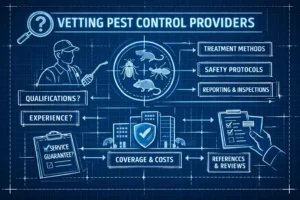
Good answers come from good questions. Use this compact checklist on the first call, text, or chat.
- Are you licensed and insured? — Confirms legitimacy and liability coverage.
- Can you identify the ant species and show how you’ll treat it? — Reveals skill and approach.
- Which treatment will you use and what active ingredients are involved? — Check pet/kid safety and eco options.
- What is the estimated cost and will I get a written quote? — Avoids surprises.
- Do you offer a satisfaction guarantee or free re‑treats? — Ensures follow‑through.
- How soon can you come, and what prep is required? — Sets expectations for same‑day or scheduled work.
- Can you provide references or before/after photos from similar jobs? — Proof of competence.
Sample script: “Hi — I have a kitchen trail of small ants. Can you ID the species, tell me your planned method, give a written estimate, and confirm any guarantees?”
Action: call your top pick with the script and collect a written estimate.
Rule 4 — Costs decoded: compare value, not just price
Price without line‑items is guesswork. Translate numbers into services so you can judge value.
| Treatment Type | Typical Cost (CAD) | Notes |
|---|---|---|
| One‑time visit — standard ants | $150–$400 | Inspection, baiting, basic sealing |
| Carpenter ant treatment | $375–$1,000 | May include access, wood treatment, and repairs |
| Ongoing/annual plans | $300–$1,800/year | $29–$55/month options; higher for structural prevention |
What drives price: species and colony size, house size, access to nests (walls/attic), exclusion work, and eco‑friendly product choices (often $50–$100 extra). Compare quotes by asking for itemized line items: inspection, baiting, exclusion, follow‑ups. Check how many follow‑up visits are included and whether re‑treats are free within a specified window.
Value tip: a slightly higher quote that includes exclusion work and a written guarantee usually saves more than a cheap one‑off spray.
Action: shortlist the quote that provides clear itemization and a 14–30 day re‑treatment guarantee. For an example of a local service page you can use to compare offerings, see Pest Control Georgetown, Bug Managers.
Rule 5 — Green flags, red flags, and day‑of prep
Trust is visible. A credible pro will show evidence, not pressure.
Green flags include prompt proof of license and insurance, a clear bait strategy and timeline, a written estimate, included follow‑ups or guarantee, and recommendations for exclusion, not only chemicals. They accept cards and give receipts.
Red flags include door‑to‑door lowball offers, high‑pressure sales to sign on the spot, an immediate blanket spray without a bait plan, cash‑only transactions with no paperwork, or evasiveness about active ingredients.
Day‑of prep: clear counters, store pet food in sealed containers, secure pets and children per the tech’s instructions, and launder any surface linens if requested. Ask the technician for the estimated re‑entry time for treated areas. Expect bait stations to remain and dead ants to show up for days while the colony collapses; a follow‑up is usually scheduled within 7–14 days.
For safe at‑home handling and when to avoid DIY sprays, see this practical guide on how to manage ants at home: How to Kill Ants — Healthline.
Action: refuse work without a written plan and a guarantee.
Rule 6 — When to call an emergency pro (and when Bug Managers is worth a quick call)
An ant that eats wood is a problem that needs a professional hand. Know the line between nuisance and risk.
Call emergency help if you find frass (sawdust), hollow‑sounding wood, large indoor colonies, ants in baby formula or food‑prep areas, nests inside walls or near electrical wiring, or repeat re‑infestation after DIY fixes. These are signs the issue is structural or spreading fast.
If you’re in the GTA, Bug Managers offers same‑day or priority response for structural and emergency ant issues. They focus on eco‑friendly methods, exclusion work, and written guarantees — the combination you should expect from any pro handling urgent, potentially damaging infestations. For nearby localized service pages see Pest Control Oakville, Bug Managers.
For information on household-level approaches to outdoor carpenter ant colonies (when a pro might still be needed), pest specialists have practical summaries here: Home Remedies for Outdoor Carpenter Ant Colonies — YalePest.
Final nudge: don’t wait for scouts to become an army. Book a licensed pro at the first sign of structural damage or persistent indoor colonies.
Action: call when you see wood damage or rapid spread; insist on a written plan and scheduled follow‑up.
Rule 7 — The 30‑second checklist
Stop the scouts, check the proof, and book the pro who shows a plan.
Quick checklist: short‑list three licensed companies; use the seven question script; compare itemized quotes and guarantees; prep the house for treatment; and call a trusted local provider. If you live in the Greater Toronto Area, Bug Managers is one tested option that matches these criteria. For more local coverage examples, check Pest Control Burlington, Bug Managers and Pest Control Caledon, Bug Managers.
Delay lets the colony grow. Ship it.