Quick note from Bug Managers
We see this every spring and summer. No need to panic. You need one clear decision: identify, contain, call the right person. Read five minutes. Know what to do now and who to call next.
Spot the difference: bees, wasps and why it matters
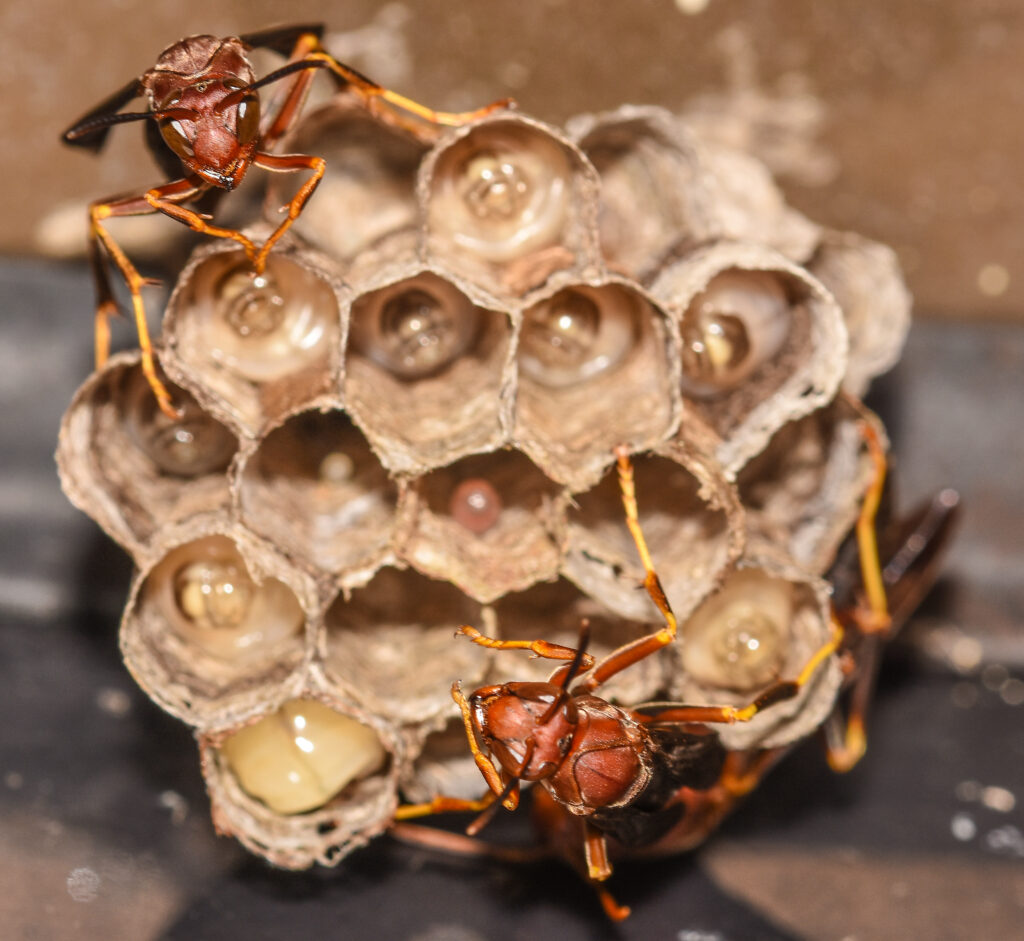
First rule: look for fuzz. Honey bees are hairy. Wasps and hornets are smooth and narrow-waisted. That difference changes everything. Bees are pollinators worth saving when possible. Wasps are often a safety problem that demands control.
| Feature | Honey bees | Wasps / Hornets |
|---|---|---|
| Body texture | Fuzzy, especially thorax | Smooth, shiny |
| Shape | Stout, barrel-like | Slender, narrow waist |
| Color | Muted yellow-brown with black bands | Bright yellow-black contrasts or pale/white markings |
| Nests | Wax combs; cavities or free-hanging swarms | Paper-like nests; aerial teardrops or underground for yellow jackets |
Behavior helps. Bees fly purposeful routes to flowers. Wasps dart and hover. A swarm looks like a hanging ball of individual bees — they’re usually searching for a new home and are surprisingly calm. Paper nests nailed to eaves or branches identify wasps.
Photo tips: stand back. Zoom in. Capture body texture, the nest type, and the location where insects enter and exit. Send those photos to a pro. They’ll tell you fast whether this is a live relocation or a removal job.
Beekeeper or pest pro: a simple decision map
Short rule: swarm = beekeeper when possible. Nest inside walls or ceilings = licensed removal pro. Aggressive stingers (yellow jackets, hornets) = pest control specialist such as our skilled wasp removal specialists.
Beekeepers usually handle visible swarms and small, accessible hives. Many do it free or for a modest donation. Their aim is live relocation — queen and colony moved to a hive.
Call a licensed pest or wildlife removal company when the bees are inside structures, when the hive is large or hazardous, or when the species is aggressive. Wall and attic cutouts need tools, carpentry, and follow-up repairs. That’s not a volunteer job.
Good companies work with beekeepers. If live relocation isn’t possible, ask whether the provider will transfer any salvageable bees to a registered apiary or ensure humane disposal. Don’t accept vague answers.
What it will cost and how fast help arrives
Straight numbers, no fluff. Swarms that are easy to access are often free or low-cost. Typical removals run about $100–$500. Humane relocations usually land in the $150–$400 range. Emergency calls commonly cost $200–$600. Complex wall extractions and structural repairs can rise to $500–$2,000 or more; in Ontario, extensive jobs sometimes reach $1,000–$3,500 depending on damage and repairs.
Why the spread? Access, hive size, the species involved, whether carpentry is required, and regional demand. Urban areas and peak season push prices up. A cramped attic cutout with drywall repair is always more expensive than a backyard swarm.
Response times: many services offer same-day emergency response, especially for public-safety cases. Non‑emergency removals are often next business day. Expect delays in peak season — call early.
Pricing tip: get a written, itemized estimate before work starts. Confirm travel fees, disposal or transfer costs, repair charges, and whether follow-up visits or guarantees are included. For national cost averages and practical tips on bee removal pricing, see Angi’s bee removal cost guide and homeowner-focused breakdowns like the estimates provided by LawnLove.
Do this now: immediate safety steps while you wait
- Keep people and pets indoors and away from the area. Close windows and doors facing the hive.
- Don’t spray, swat, or seal the entrance of an active colony. Those moves usually make things worse.
- If you must step outside, wear long sleeves and pants, move calmly, and avoid sudden movements around the insects.
- Photograph from a distance. Note the exact location and time. These details speed identification and quoting.
- If anyone shows signs of a severe allergic reaction (trouble breathing, swelling, collapse), call emergency services immediately.
Quick note: bees inside living spaces or breaking into rooms are an urgent situation. Treat them as such.
Find and vet local removal services and volunteer rescuers
Where to look: a local search for “bee relocation,” “swarm removal,” or “local bee rescue” is a start. Also check Bee Culture’s local beekeeper directory, Pollinator Partnership, Bees-on-the-Net, Facebook neighbourhood groups and Nextdoor. Local beekeeping clubs often run swarm patrols and volunteer rescues. For a quick refresher on visual differences between bees and hornets, see Orkin’s bees vs hornets guide.
How to vet quickly. Ask plain questions and expect plain answers. Avoid salesy scripts. If someone dodges these, move on.
Must‑ask questions:
- Do you perform live relocations or do you use pesticides/extermination? Explain your process.
- Are you licensed and insured? Can you provide proof (license number, certificate of insurance)? For information about licensing and pesticide regulations in Ontario, reviewOntario’s pesticide licensing guidelines.
- Will I get a written, itemized estimate before work begins?
- Where will the bees be relocated, and can you document the destination (apiary, sanctuary)?
- Do you handle structural cutouts and repairs, or do you subcontract that work?
Red flags: cash-only requests, evasive answers on relocation or insurance, pressure to act immediately without clear pricing, and refusal to show references or credentials.
Volunteer rescuers do great work. Expect them to fetch swarms and small hives free or cheap. Don’t expect volunteer clubs to perform major structural cutouts or repairs — that’s a pro’s scope.
When to call Bug Managers — what we do and why it helps
We’re a licensed, insured pest and wildlife team serving Ontario and the Greater Toronto Area. We handle emergency response, humane relocations when feasible, and structural extractions with cleanup and repairs. We also provide bird removal and bird proofing services as part of our wildlife solutions.
What you get when you call us: a fast inspection, a clear written quote, humane first‑option where possible, and professional wall cutouts and repairs when removal is necessary. We follow up and proof the area so bees don’t come back. We also work with local beekeepers when that’s the right solution.
No nonsense. We’ll tell you up front if a live relocation is feasible or if structural work means removal. We accept all major credit and debit cards and offer free quotes and inspections across our service area.
Service area: Brampton, Mississauga, Toronto (including Scarborough), Caledon, Vaughan, Markham, Richmond Hill, Oakville, Burlington, Milton, Halton Hills (Georgetown, Acton), Hamilton and Guelph.
Call us for a free inspection and quote: 647 326 4888. Book online: https://bugmanagers.com/wasp-control/ . Or visit our Contact page.
One-minute plan — what to do right now
ID it. Keep people and pets back. Photograph from a safe distance. If it’s a swarm in the open, contact a beekeeper for relocation. If it’s in a wall, attic, chimney, or it’s aggressive yellow jackets or hornets, call a licensed removal pro. If you’re in Ontario or the GTA, Bug Managers will give you a straight assessment and a free quote.
Two key points: don’t panic; get the right person for the job. That saves time, money, and lives — including the bees when relocation is possible.
Need immediate help? Call Bug Managers at 647 326 4888 or book a free inspection online at bugmanagers.ca/book . We’ll tell you what it is, what it will cost, and what to expect next — plain and simple.