Introduction
Stop hiring on price. Hire on paperwork. That’s the difference between a momentary fix and a long-term program that keeps your facility audit-ready.
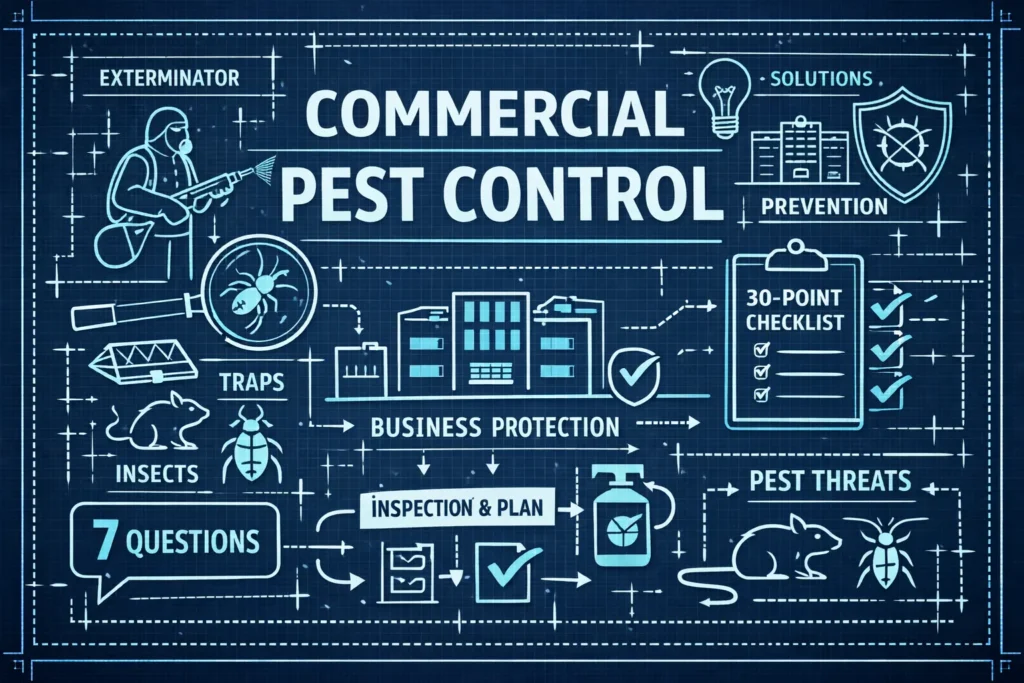
At Bug Managers we inspect dozens of commercial sites a year; here’s the exact process we use to pick a vendor or win the job ourselves. Below: seven questions to ask on the first call and a 30‑point checklist you can use immediately.
Quick triage: a 3‑minute shortlist that saves you hours
Most bad vendors fail the basics. If they can’t handle this short test, you don’t need a site visit.
The 3‑minute test: ask for licence numbers, proof of insurance (COI), one recent reference in your industry, and a sample service report. If any answer is evasive or delayed, move on.
Phone script (two lines + two quick follow-ups): “Please send your licence number and current COI. Can I have one reference in [your industry] and a recent service report for a similar site?” Follow-ups: “Can you confirm the technician name who will be assigned?” and “Please email those docs now so we can verify.”
A confident “good” reply is immediate: licence and COI attached, a named reference, and a sample report on file. No documents. No visit.
National firms can offer scale and program consistency. Local specialists—like Bug Managers—are often faster on emergency response and proofing work. Neither is automatically best. The right vendor matches your priorities.
What you must demand: services, IPM and paperwork
Top providers deliver integrated pest management (IPM), monitoring (traps, bait stations), rodent control, bed‑bug and termite specialists where needed, wildlife exclusion/proofing, sanitation consulting, and multi‑site program management for chains.
A proper IPM plan is short and specific: identify the pest, set action thresholds, prevent entry and attractants, monitor with devices and logs, apply targeted controls only when needed, and review results to adjust tactics. Good providers will supply a model IPM plan you can adapt to your facility.
Insist on these documents before you hire:
- Licence numbers (verify online where possible)
- Current certificate of insurance (COI)
- Applicator certifications and technician credentials
- SDS sheets and product labels listing active ingredients
- Sample service report and trap/monitoring logs
- References from similar facilities within the last 12 months
What to look for in the sample report: clear pest ID, trap counts and dates, photos or diagrams, a prioritized list of proofing recommendations, products used (including active ingredients), and technician name and date.
The 7 vetting questions to ask on the first call — and what good answers sound like
Are you licensed and insured for commercial work here?
Why it matters: legality and liability hinge on this. Good: instant licence/COI, verifiable online. Bad: vague, “we’ll send later,” or no verifiable licence.
Do you follow Integrated Pest Management (IPM)? Can you send your IPM plan?
Why it matters: prevention reduces treatments and compliance risk. Good: a written IPM plan with monitoring and thresholds. Bad: “We just spray on schedule.”
Have you handled sites like ours (industry, size)? Can you give a reference?
Why it matters: similar sites have unique risks and health codes. Good: recent, named references in your sector. Bad: generic claims with no contacts.
Who will service the site and what are their credentials?
Why it matters: continuity and accountability matter for record-keeping. Good: named technician, certifications, background checks. Bad: rotating temps or “someone local.”
What are your guarantees and re‑treatment terms?
Why it matters: ensures follow-up without surprise bills. Good: explicit window (e.g., 30 days free re‑treatment) or SLA. Bad: “we’ll do our best” with no timeline.
How do you report and how often? Can I see a sample log?
Why it matters: auditors want records. Good: digital reports, trap logs, photos delivered by portal or email. Bad: no logs or scribbled notes.
How do you price this? What’s included vs extra?
Why it matters: avoids scope creep and surprise invoices. Good: itemized quote with proofing as a separate line. Bad: vague “as needed” pricing.
Follow up: ask for the documents by email and set a 48‑hour deadline. If they miss it, they miss the shortlist.
Contracts, pricing models and the red flags
Common pricing models: per‑visit flat fee, monthly retainers, per‑sq‑ft or per‑door for big facilities, pay‑as‑you‑go, and tiered plans tied to service levels.
Cost drivers are predictable: industry risk (restaurants cost more than offices), facility size, visit frequency, monitoring devices, and proofing labor.
Negotiate these contract items: exact scope of work, a re‑treatment guarantee (30 days is standard), an emergency response SLA (24–48 hours), invoice schedule, a cap on annual increases, and a written proofing scope with payment responsibility clarified.
Red flags to walk away from: long auto‑renewals with heavy cancellation fees, vague “as necessary” scope, no COI or licence on file, refusal to provide SDS/product labels, and prices too low to include monitoring or reporting.
Plain clause examples to request:
- Free re‑treatment for the same pest within 30 days.
- Service reports delivered within 48 hours of each visit.
- Termination without penalty after a 60‑day trial with 30 days’ notice.
The 30‑point checklist you can copy and use on quotes and inspections
- Vendor licence number (and regulator to verify)
- Current certificate of insurance (COI) on file
- Applicator certifications for assigned technicians
- Company safety program / worker training evidence
- SDS and product labels for pesticides proposed
- Sample service report (recent, site‑specific) provided
- Trap/monitoring log sample with counts and dates
- Reference from similar industry within last 12 months
- Written IPM plan tailored to your facility type
- Clear list of pests covered under the base contract
- Emergency response SLA (hours to respond stated)
- Re‑treatment guarantee (time window specified)
- Proofing/exclusion scope and separate pricing line
- Photos or diagrams showing treatment locations (sample)
- Monitoring devices to be used (glue boards, bait stations)
- Frequency of visits and inspection checklist per visit
- Reporting method (PDF portal, email; frequency)
- Data retention policy for logs and reports (how long)
- Price model stated (monthly/quarterly/per visit/per sq ft)
- Itemised inclusions and exclusions on the quote
- Initial treatment cost vs ongoing service cost clear
- Price escalation clause (how increases are calculated)
- Cancellation and auto‑renewal terms (clear language)
- Limits of liability and indemnity (acceptable or not)
- Customer responsibilities (access, sanitation, proofing)
- Multi‑site support (single bill, consolidated reporting) if needed
- Compliance with local food‑safety/health codes noted (if relevant)
- Sample contract pages showing signature blocks and dates
- Trial period option (60 days or first two visits trial)
- Follow‑up and maintenance plan for proofing items (who fixes what)
Industry tweaks and next steps: pick, test, decide
Restaurants and foodservice: insist on IPM, sticky trap logs, licensed applicators, and HACCP coordination—no routine fogging and clear records for inspectors.
Warehouses: focus on perimeter rodent control, bait station plans, and proofing around loading docks; compare flat‑fee per sq‑ft proposals.
Offices and retail: lower visit frequency is fine, but require monitoring and a fast response window for rodent or roach signs.
Multi‑site programs: demand a central account manager, standardized reporting, and consolidated invoicing.
Simple scoring rubric: rate each vendor 1–5 on compliance (licenses & insurance), IPM quality, reporting transparency, SLA & guarantees, scope/value, and references. Add scores and pick the top two for a trial.
Sample RFP/email (two short paragraphs):
We operate a [type] facility, [square footage], hours [X–Y]. We need a site‑specific IPM plan, current licence and COI, a recent sample service report, technician credentials, and a quote showing what is included and what is extra. Please provide availability to start and a deadline for the proposal: [date].
We will shortlist three vendors, run a 60‑day trial, and expect service reports after each visit. Awarded vendor signs a 12‑month contract with the re‑treatment and SLA clauses described above.
If you want a local licensed firm to do your free inspection and fill this checklist on site, Bug Managers offers free quotes, eco‑friendly IPM, proofing solutions, and fast emergency response across Ontario and the GTA.
Conclusion
Three simple takeaways: demand paperwork, insist on IPM and proofing, and use the checklist plus the seven vetting questions. Run a 60‑day trial before you sign long‑term. Use the checklist. Don’t let fine print cost you later.