Verdict — one line
Match the Pest Control Method to Your Building, Occupancy, and Infestation Severity – The Right Solution Saves Money
Quick Cheat-Sheet for Property Managers:
- Hotels with High Turnover:Requirefast, verifiable fixeswith minimal downtime to avoid guest complaints.
- Multi-Unit Buildings:Need a combination ofknockdown and residual protectionto prevent re-infestations.
- Light or Early Infestations:Can often be resolved withtargeted steam, cryonite treatments, and monitoring.
Bug Managers’ Field Playbook:
- Severe Infestations:Heat treatments for fungal-prone or severe pest problems.
- Occupied Rooms:Residual sprays that are safe for ongoing occupancy.
- Spot Treatments:Steam or cryonite for localized infestations without disrupting residents.
Verdict: Using the right pest control method for the situation not only resolves the problem faster but also saves money and protects your property long-term.
1 — Quick verdict: one‑page playbook
You don’t need every tool. You need the right one for the situation.
One‑line rules: use whole‑room thermal remediation for severe, established infestations; use Aprehend (or a Beauveria‑based residual) where rooms must stay in service and downtime must be low; use steam or cryonite for targeted kills in seams, mattresses and furniture; use conventional residuals as part of an IPM follow‑up or where resistance is not suspected.
Scenarios in plain terms: hotels with rapid turnover — prioritize fast, verifiable treatments and a short downtime plan; multi‑unit buildings — heat the “hot” suites and add residual barriers to keep bugs from moving back in; early, light infestations — steam + targeted chemical applications and aggressive monitoring. At Bug Managers we pair thermal logs for heat with a 30‑day monitoring plan — we’ll show you the data.
2 — How each treatment works and when it fits
Mechanism determines limits. Know what each method actually does before you buy it.
Heat (whole‑room thermal)
How it works: sustained lethal temperatures delivered to all harborage above the lethal threshold kill adults, nymphs and — if done correctly — eggs. Strength: immediate knockdown and egg mortality in a single event. Operator needs: thermal mapping, circulation fans, and experienced technicians who log temperatures in real time. Limits: cost, risk to heat‑sensitive items, and uneven heating if the crew lacks experience. Evidence caveat: highly effective when executed well; success is operator‑dependent. For commercial operators seeking guidance on scaling whole‑room solutions in hospitality settings, see industry resources on bed bug heat treatments.
Aprehend / Beauveria‑based residual sprays
How it works: infective fungal spores transfer from treated surfaces to bed bugs; death can occur days later and the product leaves a residual barrier. Best fit: occupied rooms or high‑turnover units where long residual action and low odor matter. Advantages: residual protection without strong pesticide smell. Limits: surface type affects pickup, applicator must follow label (professional‑only use in many jurisdictions), and large‑scale comparative data remain limited. Expect residual activity measured in weeks rather than hours. Field performance and label details have been documented in manufacturer‑linked studies and independent trials — for an independent field study on Aprehend see the Aprehend field study, and for peer‑reviewed research on newer bed bug interventions see recent literature summarized on PubMed.
Steam
How it works: direct contact heat applied to seams, tufts and cracks. Good for mattresses, box springs and furniture seams. Strength: immediate, chemical‑free contact kill. Limitations: no residual protection; operator must avoid over‑wetting and pushing bugs deeper into voids. Steam is a component of IPM, not a standalone fix for heavy infestations.
Cryonite (CO₂ snow)
How it works: super‑cold CO₂ “snow” freezes and shatters bed bugs on contact. Strengths: on‑contact kill, no chemical residue, near‑immediate re‑entry, suitable for sensitive or high‑value rooms. Limits: specialized equipment, higher per‑use cost, and limited availability in some markets.
Conventional insecticides / IPM
How it works: targeted residuals applied in cracks and voids reduce populations over time. Proper IPM couples targeted insecticide use with monitoring, encasements, dusts and sanitation. Strengths: residual control, cost flexibility, and proven population reductions in field trials. Limits: resistance is common; chemicals alone rarely eliminate infestations without non‑chemical support.
Combination thinking wins: heat for immediate egg and adult kill, followed by a residual fungal or chemical barrier and interceptors for proof. The first treatment is the punch; the follow‑up is the fence.
3 — Money and time: budget, downtime and hidden costs
Price is one column. Downtime and lost revenue are the other.
Conservative cost guidance: expect wide variation. Whole‑room heat ranges from a few hundred dollars for a small unit to several thousand for larger rooms; commercial hotel or multi‑unit projects commonly move into the low thousands and can exceed CAD $5,000 for larger or complex buildings. Residual sprays and fungal‑based applications typically run from a few hundred to low‑thousand dollars per room or project, depending on scope. Steam and cryonite treatments are typically lower per‑spot but add up when used across many rooms. These figures are region‑ and severity‑sensitive — get itemized quotes. For commercial operators looking for program guidance specific to hospitality settings, industry providers offer dedicated commercial bed bug control resources.
Downtime guide: thermal remediation normally runs 6–8 hours in a treated space; rooms are safe to re‑enter after cooling and inspection. Spray‑based treatments (including Aprehend) usually permit re‑entry within a few hours after drying; always confirm label and applicator guidance. Steam and cryonite are often same‑day with minimal residual downtime.
Hidden costs: linen and laundry replacement, lost room‑nights, guest relocation or tenant moves, staff overtime, potential heat damage claims for vulnerable items, and reputational cost for hotels. A slow or partial cure multiplies these costs — a fast, documented resolution preserves revenue.
4 — Prepare the property: practical site prep and safety checklist
A good treatment fails or succeeds on preparation. Don’t let poor prep sabotage a solid plan.
Hotels: reassign guests discretely, stage evacuated belongings in sealed containers, control laundry flow (containment bags), post clear signage for treated rooms, and use a brief front‑desk script: “We’ve scheduled a professional treatment; your room is being moved for your comfort — here’s where we’ll place your luggage and how housekeeping will handle linens.” Keep disruption minimal and documented.
Multi‑unit and landlords: issue tenant notices, clarify legal and lease responsibilities ahead of time, require bagging of personal items when instructed, clear clutter from cracks and baseboards, and coordinate technician access windows to avoid repeated callbacks.
Treatment‑specific prep: for heat — remove live plants, aerosols and pressurized cans, and secure or remove temperature‑sensitive electronics where possible; for chemical/Aprehend — clear food and exposed dishes and follow the product label on contact surfaces; for steam/cryonite — identify fragile antiques and point them out to the crew.
Safety & documentation: insist on SDS sheets, EPA/PMRA registration numbers and product labels, thermal‑logger exports for heat jobs, and a written SOP for the job. Verify applicator licensing and insurance before work begins and obtain a written scope of work (check your state licensing and requirements where applicable).
5 — Hire right: vendor checklist, certifications and contract essentials
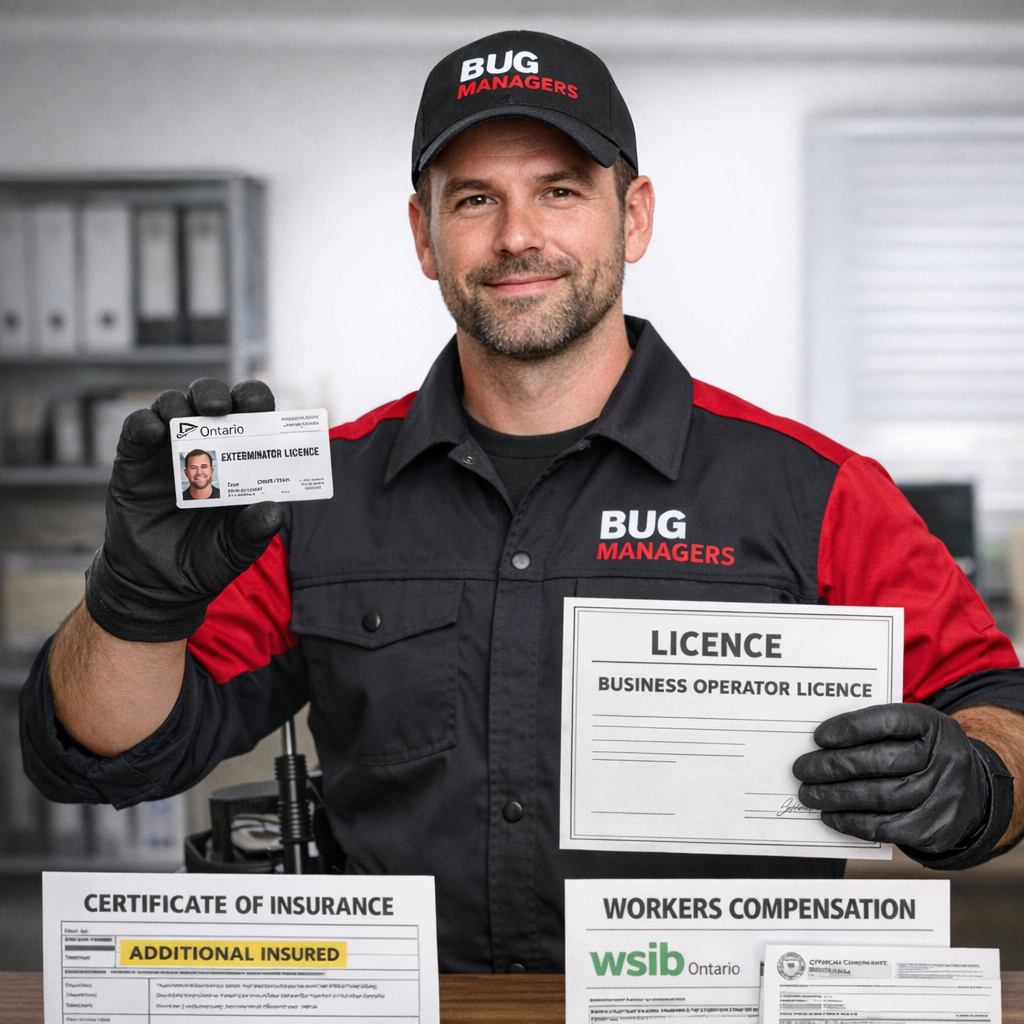
A signed contract should not be blind trust. Use a short scorecard and stick to it.
Vendor scorecard — must‑haves in plain language: active pesticide applicator certification; business license and current insurance (general liability and workers’ comp); references from hotels or multi‑unit clients; sample case studies or thermal logs from similar jobs; a clear scope of work covering inspection, treatment, exclusion and monitoring; explicit re‑treatment and guarantee terms with timeframes; written reporting including photos and thermal maps; copies of SDS and product labels; provision of monitoring devices (bed bug interceptors); on‑site staff training as part of handover; and transparent, itemized pricing. Ask for these before you sign.
Good questions to ask: “Show me your thermal log from a similar job.” “What exactly is your re‑treatment guarantee and timeline?” “Who is liable for lost revenue or heat damage?” “Can you provide a written follow‑up schedule?” “Are you familiar with local hotel or landlord regulations?” For a compact starting point of common customer queries, see our FAQ, Bug Managers.
Contract essentials to insist on: a re‑treatment clause with clear timelines; damage liability language; confidentiality for hotel clients; deliverables (thermal logs, inspection reports, photos); and measurable performance criteria (for example, zero live bugs after X consecutive inspections). For formal contract language and buyer protections, review our Terms and Conditions, Bug Managers for typical clauses to request.
How Bug Managers shows up
Licensed technicians, thermal‑logger proof on heat jobs, a 30‑day monitoring plan, eco‑friendly options, and full GTA coverage — request a sample report and scorecard before you commit. Learn about our regional service scope on our Commercial Pest Control Services in Brampton | Bug Managers page.
6 — Aftercare: monitoring, prevention and the metric of “done”
Treatment is step one. Proof is step two.
Verification plan: conduct weekly checks for 4–8 weeks, use interceptors under bed legs, fit mattress and box‑spring encasements, and require at least two consecutive no‑sighting inspections before declaring clearance. Document every check with date, inspector name, method used, photos, and interceptor catches.
Prevention for hotels and rentals: give housekeeping a short inspection script (check seams, headboards, lamps), set a guest reporting flow that routes reports immediately to management and pest control, run periodic hotspot audits, train staff to recognize early signs, and schedule periodic spot treatments or residual applications in high‑risk areas.
When to call them back: any live adult or nymph sighting, a meaningful rise in interceptor catches, or a guest complaint with photographic evidence. Your vendor’s guarantee should include defined response windows for callbacks.
Final practical truth: good documentation reduces disputes and protects reputation. Treatments kill bugs; proof protects the bottom line.
If you want a written checklist, a sample thermal log and a vendor scorecard for your property, Bug Managers can provide a free inspection and a sample report. To arrange an inspection, Contact, Bug Managers. After booking, you’ll receive confirmation and next steps on our Thank You, Bug Managers page.