Intro
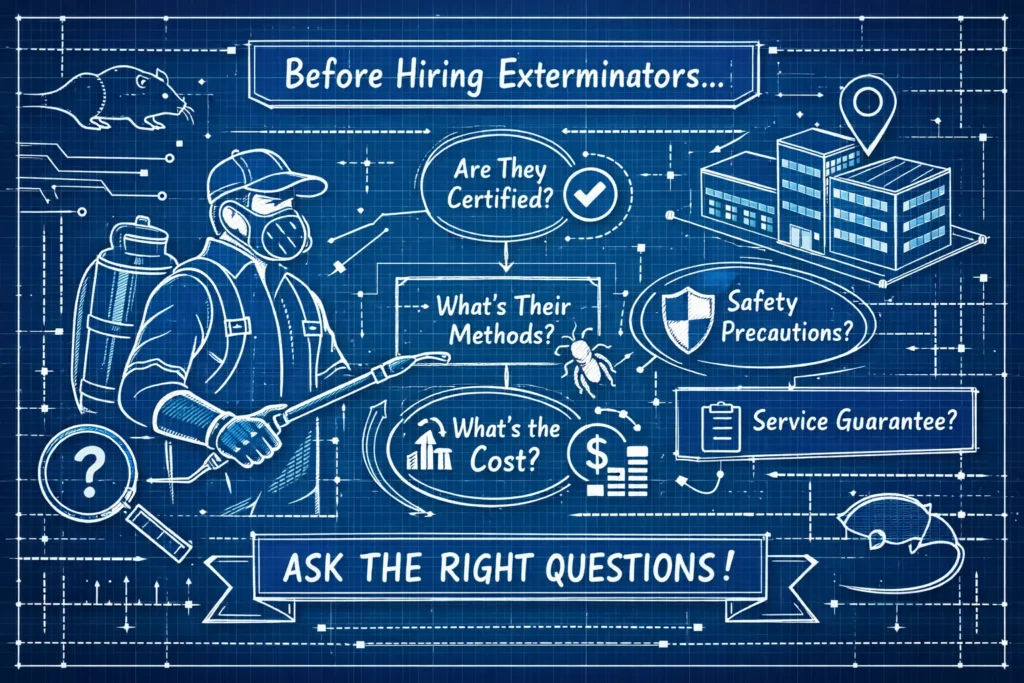
Pests are symptoms. The vendor is your doctor. Pick the wrong one and you treat the fever forever. Ask the right questions first and you fix the cause.
After a decade in the field, Bug Managers boiled commercial procurement down to essentials: ten sharp questions, verifiable proof, and a one‑page RFP you can run in a week. Read this. Use the checklist. End up with vendors who show up ready to work.
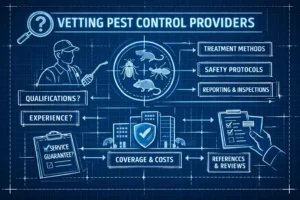
The 10 questions to ask now — the immediate checklist
- Are you licensed and insured for work in our jurisdiction? Ask for license numbers, operator certificates and a current certificate of insurance that names your business as additional insured. Red flag: evasive answers or no documents.
- Do your technicians hold applicator certifications and facility‑specific training? Request copies of individual certificates and training logs (food service, healthcare, bed‑bug protocols). Red flag: “on‑the‑job” only training.
- Do you use Integrated Pest Management (IPM)? Can you show a site‑specific IPM plan? Require a written plan with thresholds, monitoring points and exclusion recommendations. Red flag: “we just spray.”
- What are your response times and SLA commitments for routine, corrective and emergency calls? Ask for sample SLA language with guaranteed turnaround and re‑treatment windows. Red flag: vague timelines.
- How is your pricing structured and what’s included? Get an itemized quote: initial inspection, recurring visits, emergency calls, materials, removals and disposal. Red flag: lump sum with no detail.
- Do you have references from similar facilities? Request three local references and a short case study. Red flag: only residential jobs or none at all.
- What documentation will we receive after every visit? Expect digital reports, trap counts, photos, product labels/MSDS, and actionable recommendations. Red flag: paper receipts only.
- What pesticides or products will you use and can we pre‑approve them? Request product lists and MSDS up front. Red flag: secrecy about chemicals.
- What are the contract terms, guarantees and exit clauses? Ask about auto‑renewal, cure periods and limits of liability. Red flag: long lock‑ins with no SLAs.
- How do you manage multi‑site accounts, backups and escalation? Expect a named account manager, centralized reporting and an escalation path. Red flag: no account structure or single tech only.
Credentials, insurance and verification — the short primer
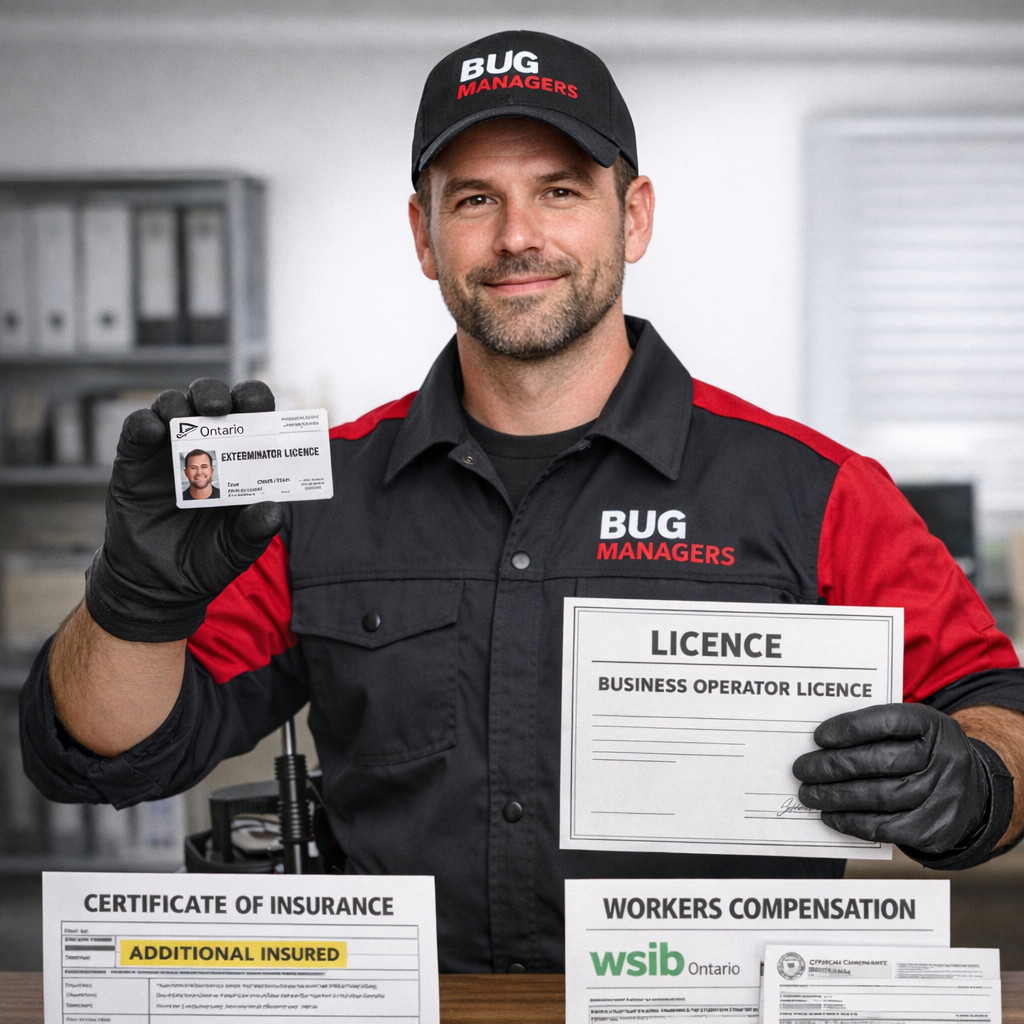
Licences and insurance are non‑negotiable. For commercial work you should see: state/provincial applicator licences, a business/operator licence where required, general liability (commonly $1M+), workers’ compensation and, when applicable, errors & omissions or bonds.
Canada: provinces issue applicator/operator licences. In Ontario, for example, exterminator and operator licences are standard. Ask for licence numbers and verify via the Ontario pesticide licensing guide. Insist the operator carry the required insurance and put your company on the COI as additional insured.
U.S.: licences are state‑issued under FIFRA rules. Require applicator certification for anyone applying pesticides for hire and a business registration. Verify on your state’s Department of Agriculture or DPR website. Always check expiry dates.
How to verify quickly: request scanned licence pages, scanned technician cards and a Certificate of Insurance that names your entity as additional insured. Cross‑check licence numbers on the issuing authority’s online registry before you shortlist.
What a good IPM program looks like — and how to spot lip service
IPM is a hierarchy. Prevention first. Monitoring second. Controls last. A real program is written. It is measurable. For business‑focused guidance on implementing IPM, review industry best practices for integrated pest management in commercial settings.
Core elements you should see in writing: a full inspection and species ID, prevention and exclusion work (sealing, sanitation), a monitoring plan (trap map, check schedule), defined action thresholds and a staff‑training component. The plan must list responsibilities: who on your team will support sanitation, who signs reports, and who fixes structural gaps.
Site specifics matter. Restaurants need HACCP‑aware plans and food‑safe materials. Healthcare facilities demand low‑toxicity options and strict notification protocols. Warehouses require pallet and dock protocols. Hotels need rapid bed‑bug detection and containment steps.
How to test the vendor’s claim: ask for the last three months of monitoring data and a recent before/after case example from a similar site. If they cannot or will not produce logs, trap counts and photos, they are selling comfort, not control.
Pricing models and how to compare quotes fairly
Commercial pricing varies: monthly or quarterly subscriptions for prevention, flat‑rate per visit for one‑offs, hourly for special projects, tiered packages for different risk levels, and per‑site or per‑square‑foot pricing for multi‑site accounts. Expect wide ranges—small offices at the low end, warehouses and hotels at the high end. For local cost examples, look at services such as Affordable Pest Control Services in Mississauga.
Compare like with like. Normalize every quote to a 12‑month total and a monthly cost per site. Require itemization: inspection, monitoring, materials, emergency calls, corrective visits, and product disposal. Ask how many re‑treats are included and whether emergency callbacks are extra.
Price signals matter. Very low bids with no monitoring indicate a reactive vendor. Very high bids without data suggest selling brand, not outcomes. If a quote looks extreme, ask for a 30‑ to 90‑day pilot—short pilots expose gaps faster than long contracts. For a practical guide to setting commercial pest control prices, see How to Set Commercial Pest Control Prices.
Contracts, SLAs, documentation and red flags
Your contract should be an operational document, not a marketing brochure. Must‑have items: a detailed scope (pests covered and excluded), service frequency, SLA response times and a re‑treatment guarantee, itemized pricing, insurance requirements, product disclosure (MSDS), audit/report access, termination and renewal clauses.
Sample SLA snippets to demand: “Emergency response within [X] hours; corrective visit scheduled within [Y] business days; free re‑treatment for covered pests within 30 days.” Tie payments to reporting compliance. Require digital visit reports, trap counts, photos, product labels and a monthly summary suitable for audits. For ready contract templates you can adapt, consult the pest control contract template.
Negotiation tips: cap price increases, require pre‑approval for product changes, and insist on a cure period before termination but no multi‑year lock‑ins without performance KPIs. Red flags: indefinite scopes, refusal to name products, no COI, long auto‑renewals without an exit clause and no documented SLAs.
Ensure the contract explicitly lists commonly excluded or covered species (for example, include or exclude rodents by name) and tie re‑treatment clauses to measurable outcomes.
RFP checklist, scoring matrix and the shortlist playbook
Send a one‑page RFP. Keep it focused. Ask for what you can verify.
- Required attachments: licence numbers and scanned certificates, COI naming your business as additional insured, copies of technician certifications, a sample site‑specific IPM plan, a recent service report, and three local commercial references.
Ask bidders to return: itemized pricing (initial vs ongoing), a sample SLA, product list/MSDS, a proposed IPM outline for your site and a 30/60/90‑day pilot offer.
Score blind using weights such as: Licences & compliance 20%, IPM plan 25%, SLAs & response 15%, Reporting & tech 10%, Price 20%, References/experience 10%. Interview the top three. Do a site walk with their technician. Run a 30–90 day pilot with clear KPIs—trap counts, sightings, and time to close corrective items.
Sign a 6–12 month contract only after the pilot proves results and the contract includes an opt‑out clause tied to SLA failures.
Use a benchmark. For example: Bug Managers is licensed across the GTA, IPM‑first, eco‑friendly, provides detailed digital reporting, and specializes in high‑end properties. Treat that as the standard you expect from any shortlisted vendor. (See About, Bug Managers.)
Summary and next step
Vendors who bring licences, logs and a plan win. Vendors who talk but produce no data lose. Run the short RFP. Use the ten questions as a filter. Pilot before you commit.
Questions change outcomes. Ask the right ten. Run the RFP. Replace the vendor if they don’t show the data. If you need local help, see our pages for Commercial Pest Control Services in Brampton and Affordable Pest Control Services in Mississauga.