
One sighting in a public area can trigger a health inspection, scare customers away and erode staff confidence. The right commercial pest management partner prevents that by combining prevention, fast response and audit-ready records. Read this short, practical guide for a vetting checklist, pasteable RFP lines, ballpark budgets and SLAs you can use today.
As a local example of the standard to expect, Bug Managers is a licensed, insured Ontario provider that uses integrated pest management (IPM), supplies audit‑ready reports and offers free inspections — the sort of partner you want on file.
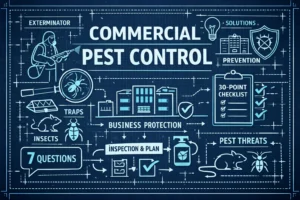
Quick vetting checklist: must‑haves and red flags
First-call triage (copy-ready): ask for a COI, a sample monthly report and the applicator licence numbers. If the rep can’t email those within 24 hours, move them to the “no” pile.
Written IPM approach: A short policy or site plan that explains inspection frequency, monitoring thresholds, exclusion work and a hierarchy of controls (least‑toxic first).
Written service plan: A clear schedule showing visit frequency, monitoring points, proofing tasks and escalation steps for outbreaks.
Applicator licence numbers: Individual licence numbers and expiry dates for the technicians who will work on your site.
Certificate of insurance (COI): General liability (Ontario clients commonly expect $1,000,000+ per incident) and proof of workers’ compensation or equivalent.
Emergency response times: Guaranteed windows for urgent events (on‑site or remote triage) and after‑hours fees documented in writing.
Sample monthly report: A recent example showing photographs, trap counts, service notes, pesticides used (product + registration) and technician sign‑off.
Named account manager and references: A single contact on the vendor side and two or three recent client references in your industry.
Red flags: Vague answers about pesticide use, reluctance to show licences or COIs, no reporting samples, pushy long‑term lock‑ins, or “spray‑first” responses without monitoring or exclusion work.
Example triage line to use on a call: “Please email your COI, a sample monthly report and applicator licence numbers — I need them within 24 hours to keep you in consideration.”
Local note: Bug Managers routinely provides these documents and can share a sample report on request — ask every vendor for the same proof when you vet proposals.
Service types and contract models: what you’re actually buying
Preventive IPM: Inspections, exclusion, sanitation guidance and targeted, least‑toxic treatments to prevent problems. IPM is the compliance and cost‑control backbone for restaurants and multi‑site portfolios; for restaurant operators, follow sanitation and integrated pest management best practices to stay inspection-ready and reduce risks. sanitation and integrated pest management in foodservice establishments.
Reactive treatments: Targeted chemical work, baits or fumigation for active infestations—used when monitoring triggers an action.
Monitoring: Glue boards, bait stations, remote sensors and data logs that detect trends early and provide audit evidence for health inspectors.
One‑off treatments: Single interventions for isolated incidents (bed bugs, wasps, spot rodent work) without ongoing commitment.
Specialty services: Structural rodent exclusion, termite programs, bird control and humane wildlife removal and proofing — typically quoted separately.
Contract models: Recurring/subscription plans offer predictable budgeting and reporting (good for restaurants and regulated sites). Customized ongoing programs fit warehouses and multi‑site clients who need monitoring plus proofing. Pay‑per‑service is flexible but unpredictable. Tiered Good/Better/Best packages make comparisons simple, while per‑sqft and multi‑site volume pricing scale for large facilities.
Frequency guide: Restaurants often need monthly or more frequent visits plus rapid response. Offices commonly do fine on quarterly service. Warehouses and food‑handling facilities require tailored monitoring programs and exclusion work on a schedule set by risk and audit needs.
Bug Managers serves the GTA with local teams and dedicated service pages for nearby markets including Commercial Pest Control Services in Brampton | Bug Managers, Pest Control Oakville, Bug Managers and Pest Control Burlington, Bug Managers.
Deliverables to expect: an initial assessment and written IPM plan, scheduled monitoring and photo evidence of proofing, a digital monthly report and a documented emergency call‑out procedure.
Certifications, licences and insurance: what to request and how to verify
Documentation protects you at inspection time and if something goes wrong. Ask for these items with every proposal and treat missing paperwork as disqualifying.
Applicator certification numbers and expiry dates: Confirms technicians are certified to apply pesticides in your jurisdiction.
Business licence / operator licence: Provincial or municipal business registration for pest services.
Certificate of insurance (COI): General liability (Ontario clients should expect a minimum of $1,000,000 per incident), plus evidence of pollution or professional liability if required.
Workers’ compensation proof: WSIB for Ontario or equivalent coverage for employee claims.
Technician list and training records: Names of personnel who will attend your site and their recent training.
MSDS for active products and voluntary credentials: Material safety data sheets and any voluntary certifications (QualityPro, GreenPro) the company holds.
How to verify: Check provincial registries or ask for certificate screenshots, call the insurer shown on the COI to confirm coverage, and request references. You can also compare requirements against federal standards such as the federal certification standards for pesticide applicators. Require vendors to submit these items with their proposal; if they don’t, move on. Bug Managers includes these documents with proposals as standard.
How to write a short RFP and the exact questions to ask
Keep the RFP to one page where possible: a short scope, performance metrics, pricing terms and a documentation checklist. Below are pasteable lines and the questions to copy into your request.
Scope: Provide integrated pest management services for [Facility Name], including initial assessment, monthly monitoring, exclusion work, emergency response, and audit‑ready reporting.
Visit frequency: Monthly scheduled visits with additional emergency call‑outs within 24 hours for confirmed food‑safety or rodent incidents.
Reporting: Monthly PDF with photos, trap counts, pesticide logs (product + registration number) and technician sign‑off.
Insurance & licences: Attach COI (min. $1,000,000 CGL), applicator licence numbers, WSIB proof, and MSDS for active products.
Termination/SLA: Define remedies for missed SLAs, service credits and termination rights after repeated failures.
Exact questions to paste into vendor replies:
- “Describe your Integrated Pest Management (IPM) approach and attach a sample IPM plan for a facility like ours.”
- “Who will be our account manager and what are their credentials?”
- “What are your guaranteed emergency response times and after‑hours fees?”
- “Provide recent references for comparable sites (restaurant/warehouse/office).”
- “Attach COI, applicator certificate numbers and an example monthly report.”
- “List all pesticides you use (common names + registration/EPA numbers) and provide MSDS.”
- “Explain your escalation process and remedies if SLAs aren’t met.”
Multi‑site prompt: request centralized billing, a single reporting dashboard or weekly consolidated PDF and volume discount tiers. Evaluate proposals by scoring IPM quality, completeness of compliance paperwork, response times, quality of sample reports and total cost.
Estimating costs: ballpark ranges and budgeting scenarios
Price drivers are simple: square footage, industry risk (food facilities cost more), past infestation history, scope of proofing, monitoring hardware and emergency coverage level.
Ballpark guidance: one‑off treatments typically range $75–$3,500 depending on pest and severity. Recurring commercial plans generally run from about $35 to $2,000+ per month depending on scale and industry — restaurants trend toward the high end; warehouses scale by square footage. For additional perspective on how companies set commercial pricing, see this guide on how to set commercial pest control prices.
Sample scenarios: – Small office (~2,000 sq ft): $35–$150/month or $150–$300 per visit. – Medium restaurant: $200–$600/month with monthly visits and monitoring. – Large warehouse (10,000–50,000+ sq ft): $500–$2,000+/month; expect initial rodent setup fees.
Billing models and negotiation tips: choose flat monthly for budget stability or per‑visit for occasional needs. Ask for multi‑year rate caps, annual review clauses and line‑item pricing for proofing/exclusion so capital work can be budgeted separately. Require an itemized initial assessment fee plus the ongoing monthly cost in every proposal.
SLAs, KPIs and audit‑ready records: how to measure success
Vague promises don’t help when an inspector shows up. Insist on measurable SLAs and audit‑ready documentation in the contract.
- Emergency response time: On‑site or triage within 4–24 hours depending on severity.
- Scheduled visit completion: e.g., 95% of planned visits completed each quarter.
- Pest activity trend: Documented month‑over‑month reduction in trap counts or sightings.
- Time‑to‑closure: Active infestation plan executed and re‑check within 14 days.
- Reporting cadence: Monthly PDF with photos, service notes, pesticide records (product + registration), applicator name and certificate.
Record‑keeping checklist for audits: service log, pesticide application records, MSDS, proofing photos, technician sign‑off and corrective‑action history. Remedies should be contractually defined (service credits, vendor-funded corrective work or termination for repeated failures).
Practical test: request a sample monthly report in your RFP and see if the vendor can export data for multiple sites. Bug Managers provides audit‑ready reports and will help assemble documentation for inspections when requested.
Wrap up and next steps
Two things to remember: insist on a written IPM plan plus licences and COI before you sign, and use short RFP lines and SLA metrics to compare apples‑to‑apples. That approach removes guesswork and keeps your facility inspection‑ready.
If you’d like a short RFP checklist copied for your use or a free, no‑pressure inspection for sites in Ontario and the GTA, contact Bug Managers to schedule a review and see an example audit‑ready report.