
9 Essential Questions to Ask Commercial Pest Control Companies
Facilities managers and business owners in the GTA need a reliable way to hire the right commercial pest control company. Choosing a vendor based on gut feeling can lead to compliance issues, recurring infestations, and unexpected downtime. That’s why having a practical, actionable checklist is essential.
At Bug Managers, we guide facilities managers through a transparent vendor screening process. Our checklist helps convert initial impressions into informed decisions, ensuring that any commercial pest control provider you hire is licensed, insured, and compliant with health and safety standards. It’s designed for quick use during the first call, on-site inspection, or RFP evaluation, helping businesses maintain pest-free facilities without disruption.
Whether you manage a restaurant, hotel, warehouse, or hospital, following this structured approach ensures that your pest management plan is safe, effective, and tailored to your facility’s specific needs. Use this guide to ask the right questions, verify credentials, and select a vendor who delivers eco-friendly, documented, and reliable pest control services.
Start with credibility — the immediate litmus test
Trust begins with proof.
Ask for scanned documentation before a site visit. Demand an operator/business licence, technician/exterminator licence numbers, proof of insurance (commercial general liability, environmental/pollution liability where relevant, and workers’ compensation/WSIB), business registration and tax number. If they hesitate, stop the call.
Why? Pesticide use and wildlife controls are provincially regulated. Licences and insurance are not bureaucratic niceties — they show somebody is accountable. No WSIB. No valid insurance. Expired certificates. Those are deal‑stoppers.
Licensing, certifications and how to verify them
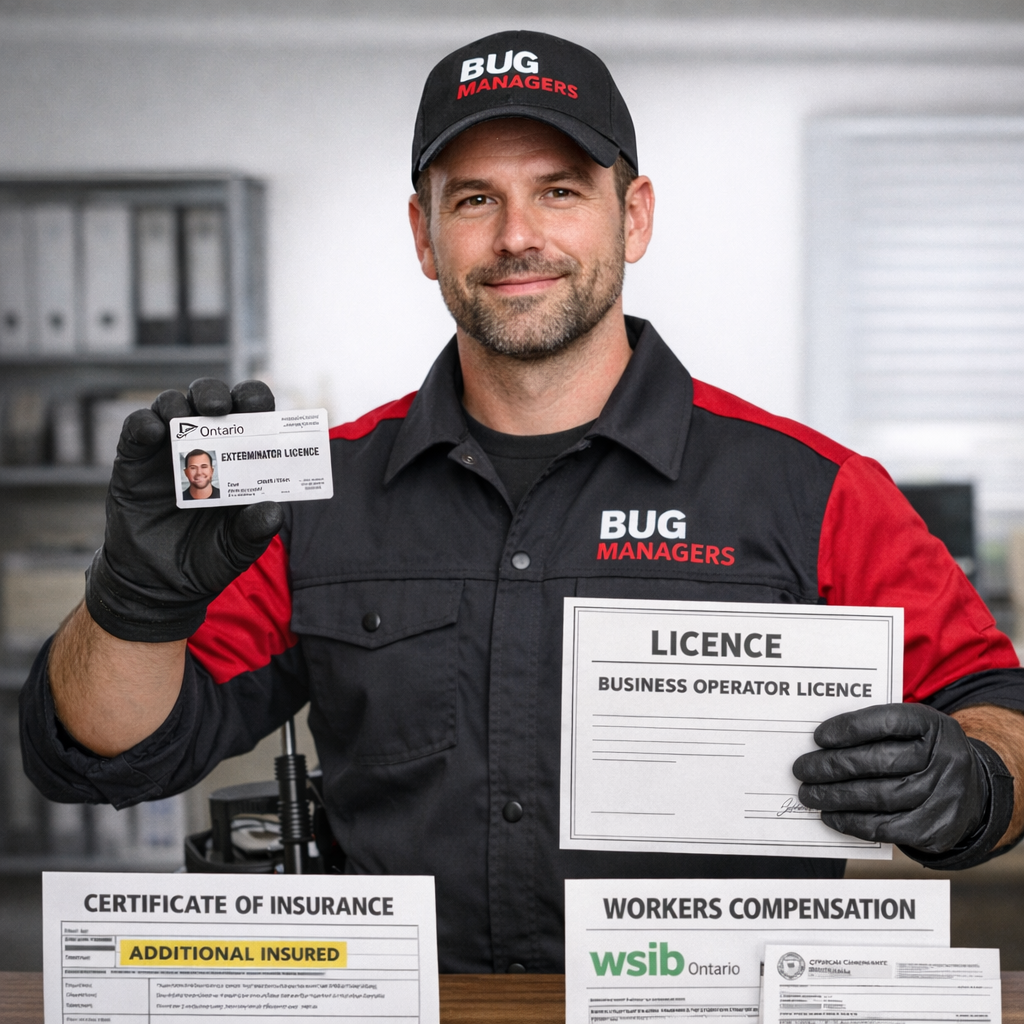
Names on a badge don’t equal competence — documented credentials do.
Expect province‑specific authorizations. In Ontario you should see an operator licence and exterminator licence(s) by category. Quebec uses pesticide application certificates with fixed validity periods. British Columbia issues applicator certificates for restricted products. The federal PMRA registers products, but provinces license applicators. For quick verification in Ontario see the Ontario pesticide licensing guide, and for Quebec consult the provincial certificate information on sale and use of pesticides.
Ask for licence numbers and expiry dates, a technician training matrix, applicator categories, and continuing education records. Ask the vendor to email scans of licence pages and the insurance binder (showing policy limits and effective dates). Insist on insurer contact info so you can verify coverage if needed.
How to verify quickly: call the regulator or insurer. Keep a screenshot or PDF record. If the vendor says “we’ll bring it later,” treat that as a warning flag.
Integrated Pest Management (IPM) and treatment philosophy
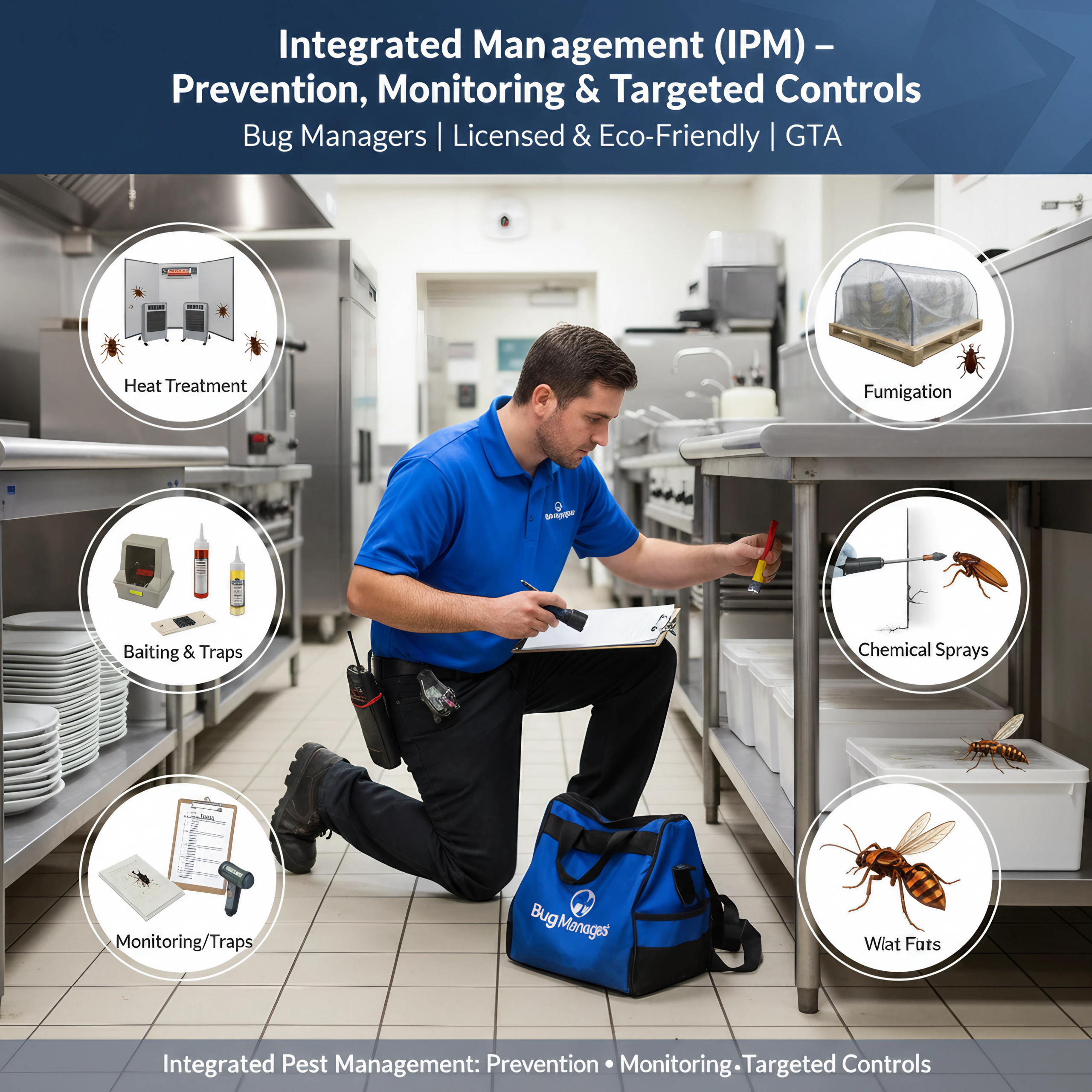
The best pest work prevents the problem. Treatment is the last resort.
IPM is a sequence: inspection → monitoring → prevention/exclusion → targeted treatment when thresholds are met. If a provider talks only about routine spraying, they’re doing chemistry, not management.
Request a written IPM plan tailored to your site. Expect exclusion work (sealing gaps, structural repairs), traps and bait stations, targeted baits and insect growth regulators, heat or steam for bed bugs, and spot treatments rather than broadcast spraying. For targeted rodent programs ask to see their Effective Rodent Control Services in Brampton | Bug Managers examples and monitoring data. Ask to see past IPM plans and photos of monitoring maps or trap placements.
Require product transparency. Get product names, Safety Data Sheets (SDS), occupant notification procedures, PPE protocols, and proof of staff training. If they can’t deliver product lists and SDS sheets on request, walk away.
Contracts, SLAs and reporting every business should insist on
If it isn’t written, it isn’t enforceable. Put service levels and reporting into the contract.
Contract essentials: a clear scope (pests covered, areas included), allowed methods, visit cadence, pricing and extras, warranty/re‑treatment terms, termination and notice periods, responsibilities for both parties, indemnities and a dispute resolution clause. For templates and contract best practices see reputable guides on pest control contracts.
Demand measurable SLAs: emergency response time (for example, 24–48 hours), re‑treatment windows (14–30 days depending on pest), a named account manager and an escalation path. Consider performance credits or termination rights for repeated SLA failures.
Reporting matters. Require a digital service report after every visit with date, technician name, actions taken, trap counts, photos and corrective actions. Ask for a centrally accessible service log for audits and insist on a record retention period (three to seven years). Make audit access clear for regulators and insurers when needed.
Pricing models, typical costs and negotiation levers
Price is a statement — understand what it buys.
Common models: subscription (monthly/quarterly), tiered plans (basic/standard/premium), flat‑rate per service, hourly/pay‑as‑you‑go, and enterprise multi‑site pricing with volume discounts.
Use these planning ranges (local markets and scope drive final numbers): small food outlets and low‑risk sites $100–$500/month; hotels and mid‑sized facilities $150–$1,000+/month; warehouses and large industrial sites $200–$2,000+/month; one‑time specialty treatments (bed bugs) $300–$2,500+/room.
Value drivers: visit frequency, pest risk profile, compliance needs (HACCP/food safety), multi‑site coordination, pest‑proofing/exclusion work, and monitoring/reporting capabilities. Don’t buy price alone — buy deliverables. For practical pricing frameworks and examples see articles on how to set commercial pest control prices.
Negotiation levers: insist on an itemized quote, ask for an annual price cap, include re‑treatments in the warranty, negotiate a pilot period for new locations, and define “out of scope” work and pricing clearly.
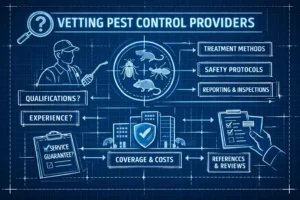
The nine must‑ask questions, scoring guide, RFP checklist and next steps
Questions convert opinion into decision. Ask these every time.
- Can you provide current operator and applicator licence numbers and proof of insurance? (Request scans.)
- What certifications and training do your technicians hold, and how often are they retrained?
- Do you use an Integrated Pest Management approach? Please send a sample IPM plan for a similar facility.
- Which products and methods would you use on our site? Provide product names, SDS and low‑toxicity alternatives.
- What SLAs do you commit to (response times, re‑treatment windows) and how are failures handled?
- How do you document and report work? Can we access service logs and trap counts for audits?
- What pricing models are available and what is included/excluded in each? Provide an itemized sample quote.
- Can you provide references and case studies for similar facilities, plus proof of multi‑site management if needed?
- Do you offerPest & Wildlife Proofing Services, Bug Managersand a warranty or guarantee on prevention work?
Scoring guide: for each question give 0 = fails, 1 = meets, 2 = exceeds. Weight licensing and insurance x2. Maximum score 20. Shortlist vendors scoring ≥14; raise your threshold for high‑risk sites.
RFP checklist — attach these to your email:
- Scanned licences and insurance binder
- Technician training list and CE records
- Sample service report and monitoring map
- Product list + SDS
- Sample contract with SLAs
- Three client references and an itemized quote for a baseline plan
Decision steps: run the scores, interview the top two, request a short pilot or a site survey, and insist on contract edits (audit rights, termination for repeated SLA failures, capped increases). Red flags: refusal to supply documents, vague SLAs, low insurance limits, routine broadcast spraying or no IPM documents.
If you want an example of a vendor who answers these questions clearly, About, Bug Managers shares licences, written IPM plans, inspection reports and clear service agreements with Pest Control in Toronto, Bug Managers clients. Request a no‑obligation site survey and a sample service report to see the level of detail you should expect.
Summary and next move
You won’t avoid every pest — but you can avoid hiring the wrong company.
Use the nine questions, score objectively, run a pilot, and put SLAs and reporting in the contract. If you manage properties in the Greater Toronto Area and want a ready partner that works this way, contact our Commercial Pest Control Services in Brampton | Bug Managers team for a no‑obligation site survey and a sample report. Then sign the vendor who proves credibility in five minutes, not promises over coffee.