At Bug Managers we begin with a notebook, not a sprayer. Measure first. Choose the smallest effective action. Act only when a clear threshold is crossed. This is the habit behind successful integrated pest control. Below: the idea, a memorably simple decision flow, ranked tactics, monitoring essentials, three starter blueprints, and a compact plan you can use tonight to cut sprays and protect yields.
IPM, distilled: what it is and why it matters
IPM is a decision framework that keeps pests below damaging levels using prevention, careful monitoring, knowledge of pest biology, least-disruptive tactics first, and pesticides only as a last, targeted resort. That’s the rulebook used by the EPA and Canadian extension services: prevent, monitor & identify, know the pest, choose low-risk tools, and reserve chemicals.
Prevention. Deny pests food, water and shelter—crop rotation, sanitation, sealed entry points and resistant varieties reduce the chance of a problem before it starts.
Monitoring & identification. Regular scouting, traps and accurate ID turn opinion into data. You cannot manage what you cannot identify.
Pest biology. Life cycles and vulnerable stages decide timing. Treat the right stage, and your effort multiplies.
Least-disruptive tactics. Start with biological, cultural and mechanical methods. They cost less in the long run and spare beneficial insects and soil health.
Judicious pesticide use. When all else fails, choose the narrowest, labelled, targeted option and apply it only where a threshold justifies the cost and risk.
Evidence is short and sharp: programs that adopt this hierarchy reduce routine pesticide use and often preserve or improve yields. Now write your one-line goal for the site. Example: “Keep fruit damage under 5% without routine sprays.”
The simple IPM decision flow you can memorize
“Thresholds tell you when to move from watching to acting.” Memorize four steps: set action thresholds → monitor & identify → prevent → control (least-risk first).
Set action thresholds. Decide the level of damage or trap count that makes treatment worthwhile for your crop and context. For practical guidance on setting trigger points, see resources on establishing treatment thresholds.
Monitor & identify. Count, photograph, and confirm life stage. Mis-ID wastes every following step.
Prevent. Use cultural or physical measures to stop the problem from spreading.
Control. If thresholds are met, use biological or mechanical controls first; use targeted chemicals only when necessary.
Tiny decision tree in prose: if trap counts fall below your threshold, keep preventing and check on schedule; if counts hit the threshold, deploy biological or mechanical options and isolate hot spots; if counts remain above threshold and the crop is at a critical stage, apply a targeted rescue treatment, then increase monitoring cadence until numbers fall. Re-check intervals: weekly as a baseline, every 2–3 days when pests rise, daily for fast-breeding outbreaks or pre-harvest risk.
Two practical thresholds: for aesthetic home gardens, act when visible fruit damage exceeds about 5% of harvestable fruit; for some vegetable moths, a common guideline is 2–5 male moths in pheromone traps over three consecutive nights as a signal to act. Thresholds change with crop value and growth stage—fewer pests are acceptable on ripening fruit than on seedlings.
Nudge: draft one clear threshold for a pest in your patch tonight—write it in the notebook you already have.
Tactics, ranked by risk—and how to combine them
Treat tactics like tools in a toolbox—pick the least harmful that works. Use one, then another, not everything at once.
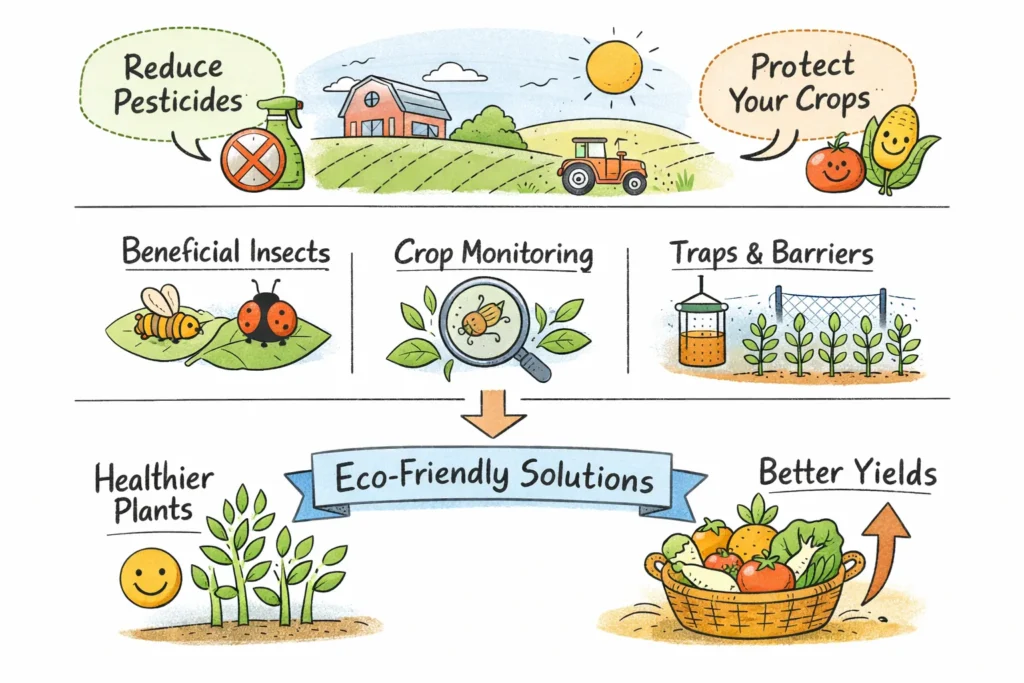
Biological controls. Predators, parasitoids and microbial agents (lady beetles for aphids, parasitic wasps, Bacillus thuringiensis for caterpillars) are targeted and sustainable. They need timing and sometimes repeat releases; they don’t work as a one-off rescue once an outbreak is massive. For practical examples of biological approaches in protected environments, see research on biological control in high tunnels.
Cultural controls. Sanitation, crop rotation, resistant varieties and irrigation timing change the environment so pests cannot thrive. These steps are inexpensive and reduce workload later.
Mechanical/physical. Netting, exclusion screens, traps, and hand removal stop pests immediately at small scales. For gardens and estates, they are the fastest low-risk wins.
Chemical options. Use pheromones and spot treatments as rescue tools. Avoid broadcast spraying. Follow labels, rotate modes of action to slow resistance, and apply only where monitoring shows need. For species-specific approaches such as baiting and targeted treatments for household pests, see Ant Control, Bug Managers for examples of spot-treatment strategies.
Cost vs. effectiveness: biological and cultural approaches are low-cost defenders; mechanical methods give immediate relief but can be labor-intensive; chemicals are high-efficacy rescue tools with higher risk and cost. The real power comes when tactics are combined—cultural steps lower pressure, biological agents suppress growth, and spot chemicals finish the job when necessary.
Nudge: pick one biological (e.g., release predatory lady beetles) and one cultural (e.g., clear crop residue) you can do this week.
Monitoring, thresholds and recordkeeping — the IPM backbone
If you don’t count it, you’re guessing. Make a simple monitoring routine and keep it honest.
Monitoring methods. Baseline scouting weekly. Increase checks near bloom, transplanting or forecast risk. Use pheromone and sticky traps at canopy height for moths and whiteflies, pitfall traps for ground beetles, and place a few traps in a grid to map distribution. Track simple weather cues—temperature, rain, and humidity—to anticipate disease windows.
Recordkeeping essentials. A single table row should answer: date, location/plot, crop and growth stage, pest ID and life stage, count or % damage, weather notes, threshold for that pest, action taken (method and material), result and reviewer initials. That one row must justify your next move.
Micro-example entry in prose: 2026-06-12 | Bed 3, tomatoes (flowering) | Aphids (adults/nymphs) | 25 plants with colonies (avg 6 per plant) | Threshold: 10 plants with colonies | Action: released 250 lady beetles + removed heavily infested leaves | Next check: 3 days. Because the count exceeded the threshold, biological release and targeted sanitation followed—no chemical used.
Tools. A field notebook, hand lens, colored flagging, and your phone camera are enough. Simple spreadsheets or free farm IPM apps can store logs and map traps.
Nudge: write one-line monitoring instructions for your site—who checks what, and when. For common monitoring templates and pest recordkeeping examples, consider starter forms such as the recordkeeping toolkit.
Three starter IPM blueprints you can copy
A plan is a set of small habits. Choose the blueprint that matches your site and start a 30-day measurement trial.
Home garden (weekend start). Identify three likely pests. Place one sticky or pheromone trap per major bed. Scout every 7–10 days, looking for damage above an aesthetic threshold (e.g., >5% fruit damage). Use hand-picking, netting and companion planting; release or encourage predators. Escalate to a targeted microbial spray only if monitoring shows thresholds crossed. Do this in the first 30 days: map beds, set traps, log counts weekly. If a threshold is reached, isolate affected plants, remove heavily infested tissue, and deploy a biological control.
Orchard (seasonal cadence). Map trap locations across the block before bud break. Use bloom-to-harvest threshold windows—tighter near harvest. Monitor with pheromone traps and weather-based disease forecasts. Use pruning, sanitation and pheromone mating disruption first; use spot treatments only for hotspots. First 30 days: install traps, clean beneath trees, log biofix and first catches. If threshold exceeded, apply targeted exclusion and a spot treatment timed to the pest’s vulnerable stage.
Small vegetable farm (scalable plan). Set a grid of pheromone traps across fields and run weekly scouting transects. Use forecasting tools for disease risk and economic thresholds for crop value. Rotate crops and plant cover crops between seasons. First 30 days: establish trap grid, scout and record, plant cover crop where possible. If threshold is reached, deploy trap-based or biological suppression and isolate the block if needed; resort to targeted chemistry as a last, temporary measure.
Nudge: pick the blueprint closest to you and commit to a 30-day monitoring trial.
A compact starter IPM plan (template) — and how Bug Managers helps you scale it
Plans are maps; we help you walk them. The starter template contains a site description, prioritized pest list, monitoring map, example trap log, threshold table, a simple decision tree and scheduled review dates. It’s a framework: fill it, watch, act. This framework aligns with authoritative guidance such as the EPA’s IPM principles.
- List your pests and the value of each crop or plant.
- Place traps and set a monitoring cadence (weekly baseline; more often if counts rise).
- Record for 30 days—dates, counts, actions, weather.
- Review results against thresholds and act with the least-disruptive effective measure.
- Adjust thresholds and tactics seasonally based on outcomes.
Busy schedule? Let Bug Managers, Mississauga’s #1 ranked pest control company, handle the problem with fast, reliable pest control services. Check our FAQ section where Bug Managers explains the available options and answers the most common questions. Bug Managers can perform an IPM audit, install monitoring traps, provide humane wildlife removal and exclusion work via our Pest & Wildlife Proofing Services, Bug Managers, deliver eco-friendly targeted treatments (see Ant Control, Bug Managers for treatment examples), and run ongoing monitoring contracts across the GTA—learn about local support on our Pest Control Services in Milton by Experts | Bug Managers page. We translate data into action so you don’t have to guess. The scientific case for measured, reduced-spray strategies is growing; see a recent review for more background at this open-access study.
Soft CTA: download the starter plan template, run the 30‑day measurement, and call Bug Managers for an IPM audit or monitoring set‑up if you want help turning data into reliable results.
Measure. Choose the smallest effective action. Repeat. For quick answers before you call, check our FAQ, Bug Managers.