Intro
You found a nest. Breathe. This is not a horror story. It’s a task: identify, judge risk, act sensibly.
The guide below walks you from “what is that?” to “handled.” Read the identification clues first. If you’d rather not climb a ladder, Bug Managers covers the GTA with licensed, eco‑friendly removal and fast, free quotes.
Spot one quickly: what paper‑wasp nests look like and when they’re active
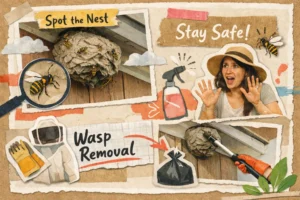
Paper‑wasp nests are open, umbrella‑shaped combs hanging from a single stalk. You’ll see exposed hexagonal cells. The material looks like thin cardboard — chewed wood fibres mixed with saliva.
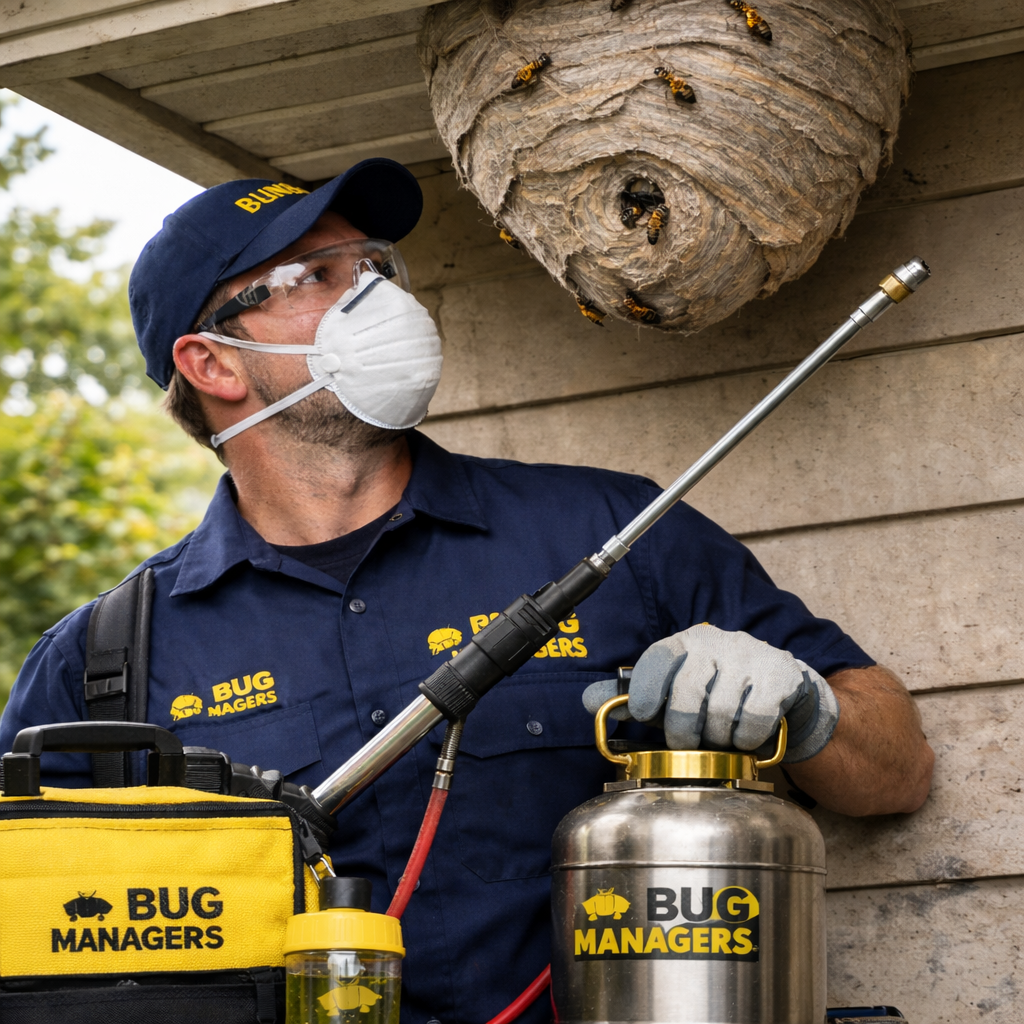
Typical spots: eaves and porch ceilings, rafters, behind shutters, under gutters, light fixtures, and tree branches. Queens start these nests in spring. The colony grows through summer and winds down in fall.
Quick ID checklist (use it on the spot):
- Do you see open comb and hexagonal cells?
- Is it hanging from a narrow stalk on a sheltered, horizontal surface?
- Are wasps slender with legs that dangle in flight (Polistes look different from stocky yellowjackets)?
If you answered yes to those, you’re almost certainly looking at a Polistes or “umbrella” wasp nest — not an enclosed yellowjacket or hornet paper envelope.
How risky is it? A plain checklist to decide what to do
Not every nest is an emergency. Use simple criteria and treat any one high‑risk factor as a reason to call a pro.
High‑risk indicators: the nest is large and busy; it sits over a door, play area, or where people gather; it’s reachable by hand or ladder; someone at the property is allergic. Any of those equals professional help.
Lower‑risk signs: a tiny spring nest (pea‑ to golf‑ball size), high up in a tree, few workers, and no regular foot traffic below. Low risk can be a candidate for cautious DIY removal at dusk or dawn.
DIY removal that actually works — step‑by‑step and what to avoid
If you choose DIY, do it only when risk is low and you have the right gear. Treat at dusk or dawn when wasps are least active. One wrong move can provoke a swarm.
Essential PPE and tools:
- Long sleeves and pants, thick gloves, closed shoes, eye protection or a mesh veil, and a hat.
- A long‑range aerosol wasp spray (15–20 ft / 4–6 m reach), a flashlight with red filter, a long pole or broom, a heavy plastic bag, and a stable ladder only if you’re comfortable using one.
- Pick a calm evening or early morning. Dress in full PPE. Position yourself to the side, not directly under the nest.
- From 6–15 feet away, apply a long‑range wasp spray, saturating the comb. Aim at the center and follow the product label — distance and dwell time matter.
- Wait 24 hours. Observe from a safe distance. If wasps are still active, reapply once or stop and call a professional.
- If there’s no activity, use a long pole to knock the nest down, seal it immediately in a heavy bag, and dispose with household waste.
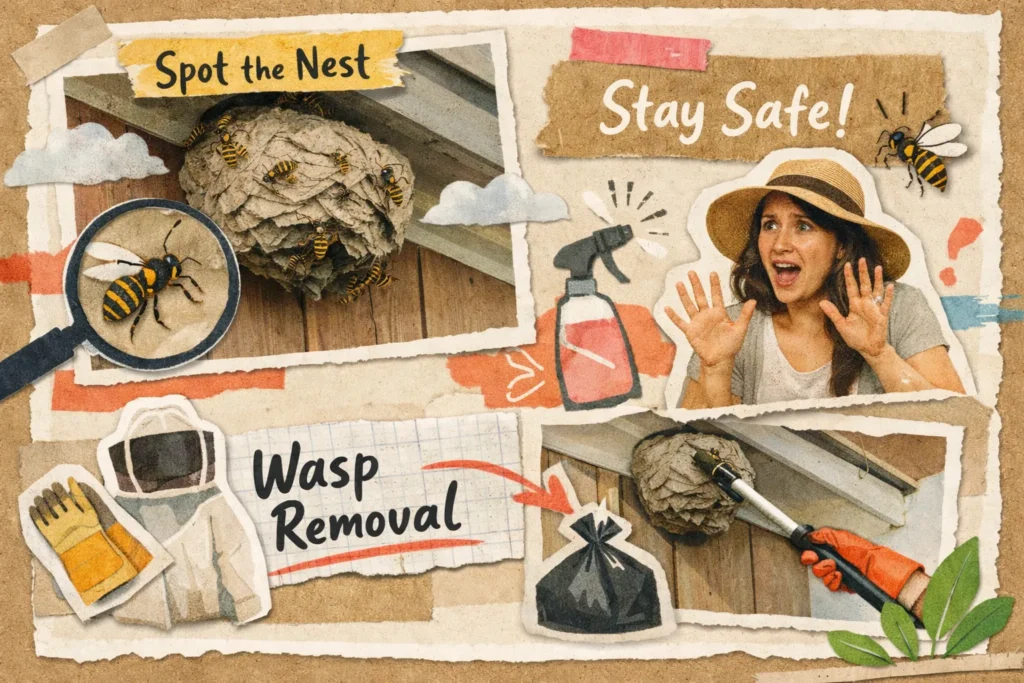
What not to do: don’t use fire. Don’t stand on unstable ladders. Don’t pour boiling water from height. Don’t rely on soapy water or folk remedies as your sole plan; these methods are unreliable and can provoke attacks. If the nest is in a wall void, attic, or other hidden cavity, dust treatments by a licensed technician are safer and more effective.
For additional DIY guidance on safe nest removal techniques, this practical walkthrough is a helpful read: DIY on properly removing a paper wasp nest.
Non‑lethal management and prevention — keep them away without killing everything
Paper wasps are useful predators. The goal is prevention, not slaughter. Start by denying them sheltered sites and easy food.
Seal small gaps and cracks around eaves, vents, and soffits. Repair or add screens to vents and chimneys, and keep garage and shed doors closed when not in use. Scrape away old attachment points and caulk or repaint them; a clean surface is less attractive for re‑nesting.
Sanitation matters. Secure garbage lids, pick up fallen fruit, store pet food indoors, and eliminate standing water. Trim branches and overhangs that provide sheltered staging points for nest builders. If you use traps, put them well away from the house so you’re not drawing wasps toward people.
Early action is the simplest long‑term fix: remove small spring nests before workers mature. That prevents a summer colony and keeps your property wasp‑free without routine poison.
For help with other common pests around the home, including targeted removal and exclusion methods, see Spider Control, Bug Managers.
When to call a pro — what to expect and how Bug Managers helps
Call a licensed technician when safety or complexity is high: large or multiple nests, nests in attics/wall voids, nests over high‑traffic areas, anyone allergic, or nests that are hard to reach.
A professional will inspect the site, treat the colony at night if needed, apply targeted dust into voids, remove and dispose of nests safely, and advise on proofing to prevent returns. Pricing varies with access and urgency, so expect a clear estimate before work begins.
Bug Managers provides licensed, insured technicians across Ontario and the GTA. We offer eco‑minded treatment options, free quotes and inspections, and emergency response. Expect a straightforward estimate, a warranty option where appropriate, and clean disposal — not guesswork.
Learn more about our dedicated wasp services by contacting our Skilled Wasp Removal Specialists in Brampton | Bug Managers.
We serve many local communities; if you’re in the area, see our pages for Pest Control Caledon, Bug Managers, Pest Control Burlington, Bug Managers, or Pest Control Vaughan, Bug Managers for specifics and local contact details.
For a general primer on how professionals classify and treat wasp nests, Orkin’s overview of wasp nests is a useful reference.
After the nest: cleanup, follow‑up, and treating stings
Don’t leave the attachment point as a welcome mat. Scrape away residue, caulk gaps, and repaint if needed. Mark the spot and check it early next season — most re‑nests are prevented by simple exclusion and surface cleanup.
If someone is stung: remove the stinger if present (paper wasps usually don’t leave one), wash with soap and water, apply ice to reduce swelling, and consider an antihistamine for itching. Watch closely for signs of anaphylaxis — hives, throat tightness, difficulty breathing, dizziness. If those appear, call emergency services immediately.
Multiple stings or severe reactions deserve immediate medical attention. If you felt uneasy during removal or the nest felt riskier than you expected, call Bug Managers. It’s what we do.
For more on paper‑wasp behaviour around structures, see the informative extension article from NC State: Paper‑wasp swarming around structures.
Summary and next step
Two points to remember: identify first, act second. If the nest is small and out of the way, a cautious DIY at dusk with proper PPE can work. If it’s large, near people, in a void, or someone’s allergic, get a licensed pro.
Want help now? Bug Managers serves the GTA with licensed, eco‑friendly removal, free quotes, and emergency response. Reach out for a clear estimate and a safe solution.
For a quick guide on spotting typical paper‑wasp nests if you want an extra reference before deciding, this identification article is clear and practical: how to identify paper wasp nests.