If there’s a raccoon in your attic, the clock starts.
Don’t guess. Call a licensed pro. In Ontario and the GTA, Bug Managers offers same-day inspections, humane methods, and full attic cleanup—this article tells you what to expect, what you’ll likely pay, and exactly what to ask when you call.
Act now: safety first and the call you should make
Safety is the immediate priority. Keep people and pets away from the area where you hear or see activity. Raccoons carry parasites and rabies, and stressed animals can act aggressively.
In the first 10–60 minutes: close interior attic doors, don’t climb into the attic, and don’t block or stuff holes from the outside. Blocking exits can trap babies and make the problem worse. Photograph damage and noises for the estimator. Seal trash and pet food.
Call a licensed local wildlife removal company. If you’re in the GTA, Bug Managers can usually inspect same day. Ask about emergency response times and whether they handle attic decontamination and proofing.
When you call, have this ready: your address, where you hear or see activity, visible signs (droppings, shredded insulation, chewed vents), photos, and whether you suspect infants. Expect an inspection to take 30–90 minutes. Be prepared for a same-day recommendation or scheduling within 24–48 hours.
What a proper raccoon removal job actually looks like
One-off trapping without sealing or cleanup is not a full fix. Professionals follow a four-step process that protects your home and your family.
Inspection
Technicians locate all entry points, nesting sites, and contamination. They check for safety hazards such as chewed wiring and compromised structural elements. The inspection determines scope and cost.
Trapping and eviction
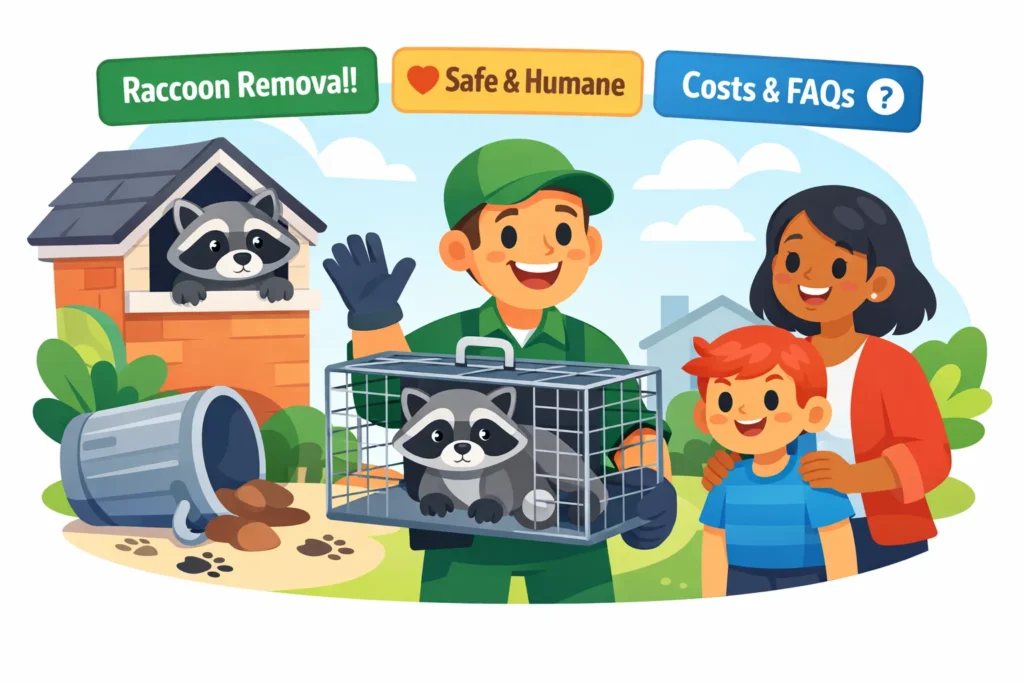
Expect humane capture methods: live traps or one-way doors that let animals leave but not return. If kits are present, techs use timed exclusions or eviction-and-reunion techniques so young animals aren’t orphaned. No poison. No smoke.
Exclusion and sealing
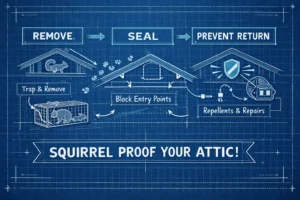
Permanent patches matter. Good crews use heavy-gauge wire mesh, metal flashing, chimney caps, and animal-proof vent guards. Proper exclusion removes the scent trails and physical access that draw other raccoons. For long-term vent and chimney protection consider professional bird proofing services to keep multiple species out.
Attic cleanup and restoration
Soiled insulation is removed and replaced. Technicians sanitize, apply odor- and pathogen-control treatments, and treat for fleas, ticks, and mites. If wiring or framing is damaged, they document repairs you’ll need. Cleanup reduces disease risk—particularly from raccoon roundworm (Baylisascaris).
Timeline reality: trapping can take days to a week because raccoons are cautious. Exclusion work usually takes a day or two. Cleanup and repairs vary with damage.
Costs you’ll actually pay — realistic ranges and why they vary
There’s no single price. Get an itemized estimate. Use these ranges as a sanity check.
| Service | Typical Range (CAD) |
|---|---|
| Inspection | $80–$150 |
| Simple yard/roof removal | $150–$300 |
| Single-raccoon trap-and-remove | $150–$300 |
| Nest removal / attic job (some cleanup) | $300–$750 |
| Full attic decontamination & repair | $350–$3,500 |
| Dead raccoon removal | $150–$350 |
Cost drivers: number of animals, attic vs. yard work, contamination and insulation replacement, structural repairs, access difficulty, and urgency (after-hours fees). Regional labour rates matter too.
How to compare quotes: demand an itemized estimate listing inspection, trapping/exclusion, cleanup, and repairs. Beware low flat “per animal” prices without an inspection. If an attic job is offered for under $200, it probably skips sealing or cleanup—and you’ll pay again. For broader cost comparisons see the HomeAdvisor raccoon removal cost guide and HomeGuide’s removal cost breakdowns.
How to vet and shortlist local pros — credentials, guarantees, and the exact questions to ask
Your first phone call should separate competent companies from shortcuts. Ask for proof and stop if they stall.
Require: proof of liability insurance and workers’ compensation, a municipal business licence where applicable, documented training or certifications ( NWCOA Certified Wildlife Control Professional or equivalent), references or recent job photos, and a written warranty on exclusion work.
Read these questions aloud on the first call:
- Are you licensed and insured? Can you email proof?
- Do you perform a full inspection before quoting?
- What methods do you use — live capture, one-way doors, or lethal traps?
- Will you reunite mothers and kits if present?
- Do you include exclusion/sealing in the price or is that extra?
- Do you provide attic cleanup and sanitization? Itemize that cost.
- What guarantees or re-entry warranties do you offer, and how long?
- Can you provide 2–3 local references or photos of similar jobs?
- What is the earliest you can start, and are there emergency fees?
- How do you handle disposal and permits (if applicable)?
Good answers mean emailed insurance, a written itemized quote after an inspection, humane methods, exclusion included or clearly priced, and a 30–90 day re-entry warranty (confirm specifics when you call). Red flags include “no inspection — $X per animal,” relocation far away, “no cleanup needed,” or cash-only requests.
If you want a local option, Bug Managers is a trusted wildlife removal company serving Mississauga and the GTA and can provide written estimates after inspection.
Red flags, common scams, and DIY mistakes to avoid
If it sounds like a shortcut, it usually is. Watch for trap-only operators who won’t seal the hole. Avoid companies that promise to relocate raccoons miles away. That’s often illegal and spreads disease. Never accept smoke, poison, or fire-based “evictions.”
Common homeowner mistakes: sealing openings while kits are inside; blocking exterior holes and trapping animals; attempting to handle raccoons (rabies risk); and skipping attic cleanup. Spring and early summer are breeding seasons—professionals will change the plan when infants are likely. For practical, humane guidance on what to do when you find raccoons on your property see this humane advice resource.
Prevent it happening again — simple proofing, follow-up, and the local option
The job isn’t finished until entry points are sealed and attractants removed. Practical fixes you can do today: install chimney caps, replace torn vent covers with metal screens, trim branches away from the roof, secure garbage and compost, and remove outdoor pet food at night.
Ask about maintenance. A one-time trap without proofing is a gamble. Good companies offer yearly inspections or maintenance plans to keep problems from returning.
Why Bug Managers: for homeowners across Ontario and the GTA, Bug Managers provides licensed technicians, humane removal methods, full attic decontamination, and proofing packages with written warranties and free quotes. Expect a clear, itemized estimate, same-day inspections in many cases, and maintenance plans to reduce future risk. They also provide squirrel removal and control and professional skunk removal when other species become a problem. Ask about their warranty window (typically 30–90 days) when you call.
Next step: get an inspection. If you’re local to the GTA, call Bug Managers for a free quote. If you call another local pro, use the vetting script above.
Raccoons are fixable — quickly, humanely, and permanently — if you call the right pro and insist on inspection, sealing, and cleanup.