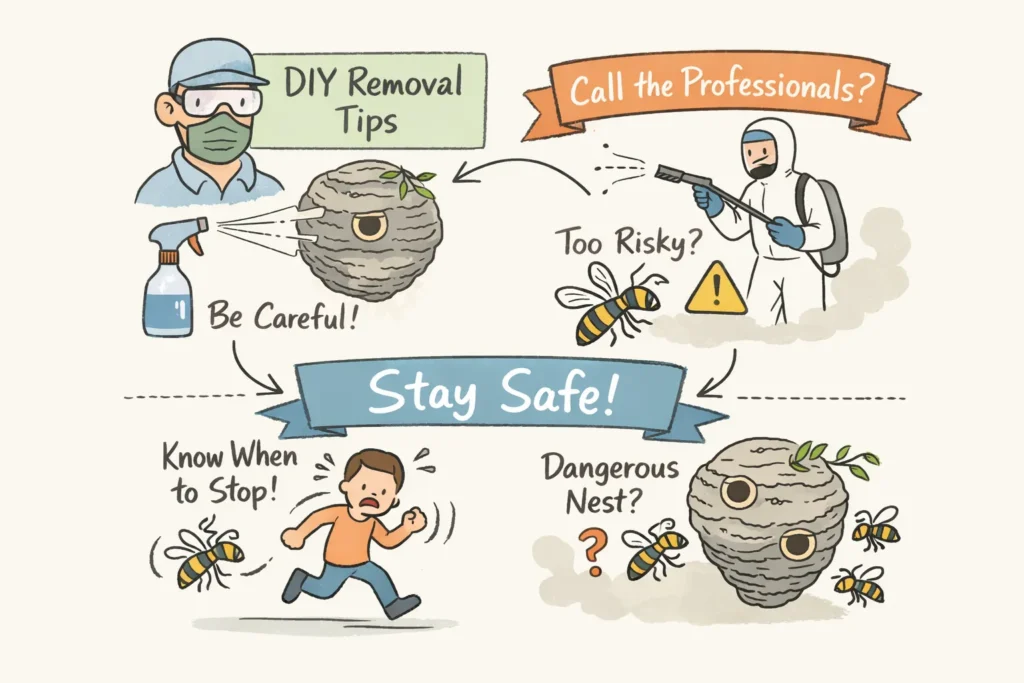
Don’t pick a fight if you can’t outrun it.
This is not bravado. It’s a test. Judge the nest. Act safely. Know when to hand it off. Quick three-question test from Bug Managers: (1) Is anyone on site allergic to stings? (2) Is the nest large, hidden, or close to daily activity zones? (3) Is the colony inside walls, attic voids, or underground? If you answer yes to any of these, call a licensed professional.
Spot the nest and size up the risk
Species and nest form set the danger level. Paper wasps build open, umbrella-shaped combs under eaves. Hornets and bald-faced hornets build round, enclosed nests that hang from branches or rafters. Yellowjackets often nest in the ground or inside voids and are fast to defend. Mud daubers leave neat little tubular mud cells and rarely behave aggressively.
Wasps vs bees: wasps are smooth, narrow-waisted, and fly with legs tucked; honeybees are fuzzy and more rotund. Nests differ: papery combs, waxy hive, or hidden burrows. If you see a honeybee cluster or honeycomb, stop. Bees are often worth rescuing — call a beekeeper or a pro who relocates.
Do a simple activity check at dusk or dawn: watch the entrance for one minute and count flights. Note behaviour — do insects just pass or do they dive aggressively at movement? Location matters. A fist-sized nest with steady traffic under a doorway is high risk. A tiny early-season comb on a low branch is low risk.
Suit up: PPE, tools, timing, and escape planning
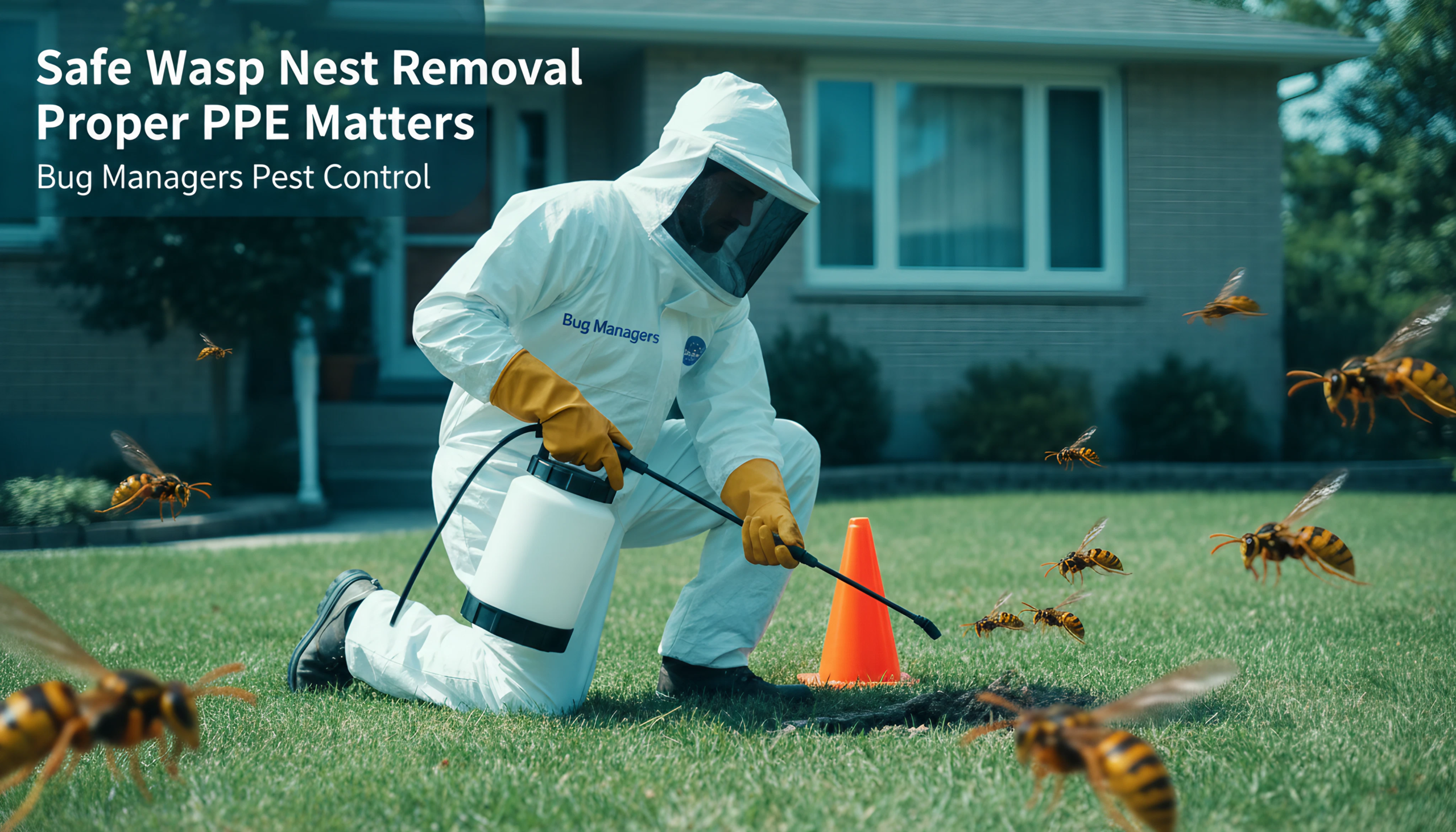
Dress to deny a sting a target. Wear thick long sleeves and pants, sturdy closed-toe boots, leather or heavy gloves that cover wrists, eye protection, and a hat with a veil or beekeeper veil. For attic work or tight access, use a one-piece suit with elastic cuffs. If anyone is allergic, have an EpiPen immediately available and do not attempt removal yourself.
Tools that keep you at distance are the real safety gear: a long-handled pole or scraper, a long-range aerosol or foam applicator, a hand duster for labeled insecticidal dusts, a telescoping inspection mirror or flashlight for voids, and a stable ladder with a helper to steady it. Always plan an escape route. Operate at dusk or dawn with the wind at your back. If you can’t retreat fast, don’t try.
Three safe DIY plans — eaves, attic, underground
Three common locations. Three compact plans. Each follows assess → gear → treat → wait → remove → seal → monitor. Stop immediately if any “don’t do” triggers appear.
Eaves (exposed, overhead nests)
- Assess: Confirm the nest is small (about the size of a closed fist), low activity, and not above doorways or play areas. If it’s bigger or there’s heavy foot traffic below, stop.
- Gear: At dusk put on full protection, have a helper on the ground, and place your ladder so you can retreat down and away.
- Treat: From 15–20 feet use a long-range aerosol or foaming wasp spray aimed at the nest opening. Saturate the entrance until wet. For very small, exposed nests, a hose-end mix of dish soap and water can work as a low-toxicity option.
- Wait: Observe from a safe distance for 24–48 hours. Look for returning flights or activity.
- Remove and seal: If inactive, knock down with a long pole, bag the nest, seal gaps, and repair soffits.
Stop trigger: nest larger than a fist, steady traffic below, or an aggressive species on approach.
Attic and wall-void nests (enclosed)
- Treat as higher risk. If the nest is in a living space cavity, inside walls, or chimney — call a pro unless it’s tiny and immediately accessible.
- If you proceed: test access at night with a flashlight; ventilate the space; wear a full suit and eye protection.
- Use indirect methods first: apply a soapy spray into the access point, set traps at entry holes, then wait and monitor. Do not work alone in confined attic spaces.
- If activity persists, stop and hire professionals who use vacuums, extraction tools, and containment — safer, cleaner, and less likely to leave survivors in walls.
Underground nests (yellowjackets and ground wasps)
- Assume high risk. Observe at dusk when most workers have returned. Approach quietly and in full protection.
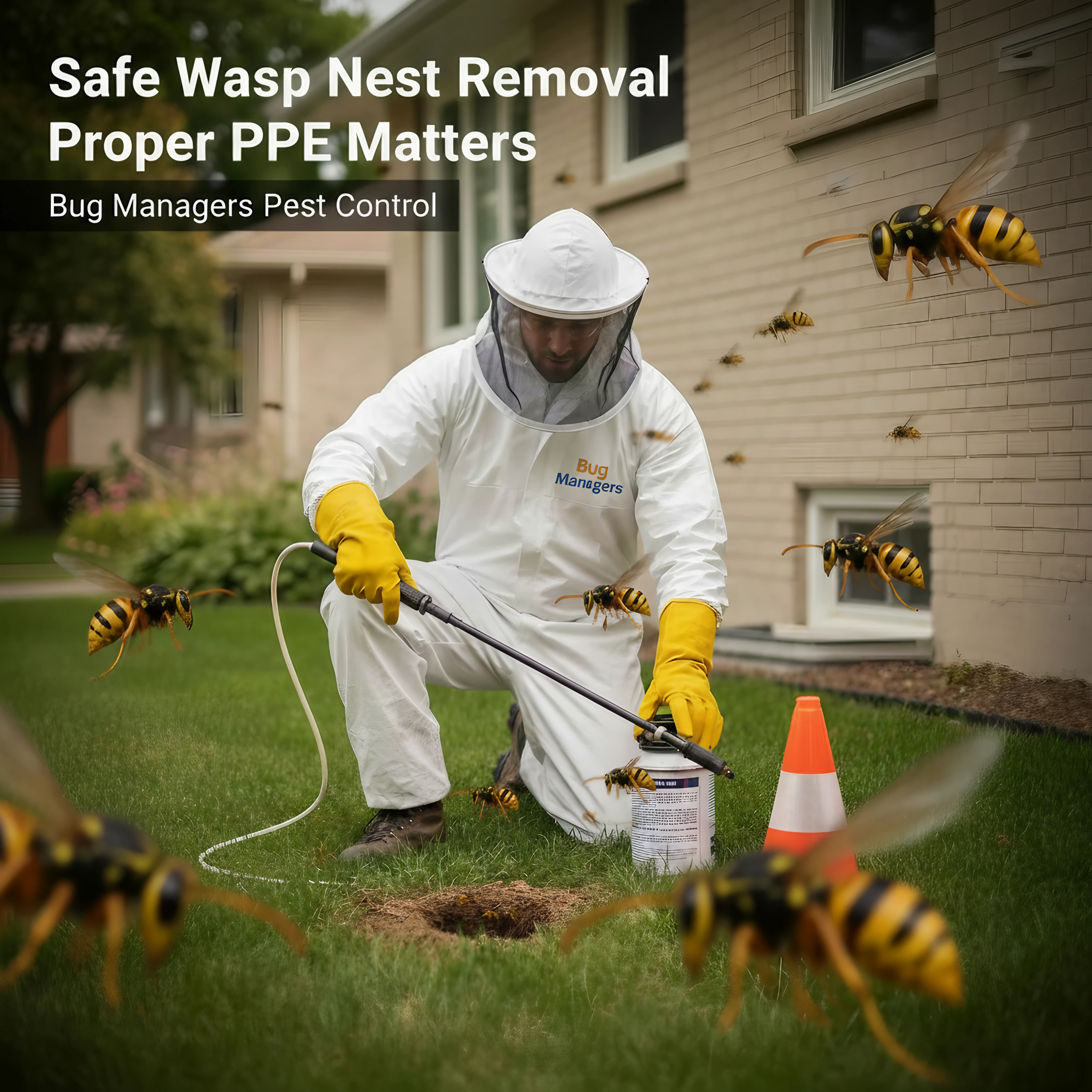
- Reduce foragers first: bait traps (plastic bottle traps with sugar and a small amount of borax or vinegar) left for several days can lower numbers. For baiting strategies and trap design ideas, seeAnt Control, Bug Managers.
- Treat the entrance according to label: apply an approved insecticidal dust into the hole or pour thick soapy water if the opening is small and you accept limited success.
- After 48 hours of inactivity, cover the hole lightly and monitor. If you find multiple openings or aggressive responses, call a pro.
Stop trigger: multiple holes, a large visible colony, or repeated failures after baiting and treatment.
What works: sprays, dusts, traps and how to use them safely
Tools fall into four groups: contact aerosols and foams for immediate knockdown; residual sprays for barriers; dusts for voids and burrows; and bait traps to reduce foragers. Examples: long-range aerosols and foams that reach 15–25 feet allow distance; tempo-style dusts are applied with a hand duster into holes; bottle traps with sweet bait reduce numbers over days.
Technique matters more than brand. Stand with wind at your back, maintain recommended distance, spray until the nest is saturated, then retreat. Never spray aerosols inside tight, unventilated spaces. Dusts work because workers carry them into the nest — use a bulb duster and follow label directions. A soap-and-water spray (dish soap + water) clogs breathing and is an eco-friendly option for tiny, exposed nests, but it rarely kills a large colony.
Environmental note: avoid treating flowers or hedges that attract pollinators. If bees are present, stop and contact a beekeeper or a pro who will relocate rather than exterminate.
Costs, red flags, and when to call the pros — Bug Managers can help
Typical price bands: small, easy outdoor jobs $100–$350; medium or attic/wall work $300–$700; complex ground or hornet jobs $500–$1,300. Price depends on species, size, access, and whether follow-up or exclusion work is needed. For additional cost context see wasp and hornet nest removal cost estimates.
Call a professional if any of these apply: anyone allergic to stings; the nest is inside walls, attic, or chimney; nests are underground with multiple holes; the colony is larger than a fist or clearly >100 workers; nests sit near daily living areas, children, or HVAC intakes; multiple nests or a failed DIY attempt.
What pros do: thorough inspection, protective suits, vacuum or foam extraction, humane relocation for bees when possible, and pest-proofing like steel mesh and sealing. They also provide warranties and follow-up visits. For step-by-step removal approaches and safe techniques see safe and effective wasp nest removal techniques.
Skilled Wasp Removal Specialists in Brampton | Bug Managers offers licensed, humane wasp and hornet removal across the GTA. We specialize in attic extractions, hard-to-reach nests, and long-term exclusion for luxury and lakefront properties using eco-conscious methods and backed guarantees. If a red flag applies, request a same-day estimate or a free inspection — licensed pros will advise, not pressure.
Aftercare, legal/bee-protection issues, and stopping a return
After removal, seal entry points, repair soffits and vents, and apply a targeted perimeter barrier where advised. Monitor weekly through the season. Honeybees and some solitary bees are often protected by local practice — do not destroy a suspected hive; contact a beekeeper or professional who relocates.
If birds are nesting near vents or eaves, or you need humane removal of nesting birds, contact Bird Control, Bug Managers or Bird Removal, Bug Managers. Winter is the safest time for non-urgent outdoor removals; most colonies die off and nests can be removed cleanly — learn more about where wasps go when it’s cold out. Prevent return by trimming branches away from eaves, securing garbage and compost, removing fallen fruit, installing mesh on vents, and scheduling a seasonal inspection.
Small care prevents big fights. If doubt or danger appears, hand it over to licensed pros. Need a second opinion? Bug Managers will inspect and tell you whether it’s DIY-safe or time to call someone with a suit and a plan — we also provide local services such as Pest Control Caledon, Bug Managers.