Bird nests can feel harmless at first.
Then the problems start. Noise at 5 a.m. Droppings on the porch. Blocked vents. A messy balcony. Or birds trying the same spot every spring.
In Canada, bird nest removal is not just a “clean up” job.
You also need to think about safety and the law. Many birds are protected, especially during nesting.
This guide explains humane options that work in Canada. It also explains when you should not remove a nest, and how to stop birds from coming back.
Why Birds Build Nests on Homes and Buildings
Birds pick places that feel safe and sheltered. Many homes offer perfect spots, like:
- Under eaves and soffits
- On light fixtures or security cameras
- Inside bathroom or dryer vents
- On balconies and ledges
- In warehouse bays and signs
- In chimneys and exhaust outlets
Birds also return to areas that worked before. If a nest site was successful once, they may try it again next season.
Common Bird Nest Problems Canadians Deal With
Here are the issues people report most often:
- Droppings on walkways, patios, balconies, cars, and storefronts
- Blocked vents that reduce airflow or create moisture problems
- Birds entering attics or wall spaces through gaps near the roofline
- Noise and aggressive “dive-bombing” during nesting season
- Mites and insects linked to nesting materials
- Property damage from acidic droppings and nesting debris
For many businesses, the biggest concerns are slip risks, hygiene, and customer complaints.
The Legal Part: When Bird Nest Removal Is Not Allowed
This is the part many homeowners miss.
Canada protects migratory birds under federal law. The Migratory Birds Convention Act, 1994 includes prohibitions around taking nests or eggs.
More recently, the Migratory Birds Regulations, 2022 changed how nest protection is applied. Since July 30, 2022, it is prohibited to damage, destroy, disturb, or remove a migratory bird nest when it contains a live bird or a viable egg.
Environment and Climate Change Canada (ECCC) also explains that unoccupied nests of most migratory bird species may be removed when they do not contain a bird or viable egg.
Simple takeaway:
If the nest is active, do not touch it. If it is clearly inactive, removal may be allowed, but you still need to be careful.
Also, some birds can be protected under provincial rules too. For example, British Columbia has permits for taking or destroying nests of certain raptors and other birds in special circumstances.
If you are unsure which bird it is, treat it as protected and choose the safe route.
What Counts as an “Active” Nest
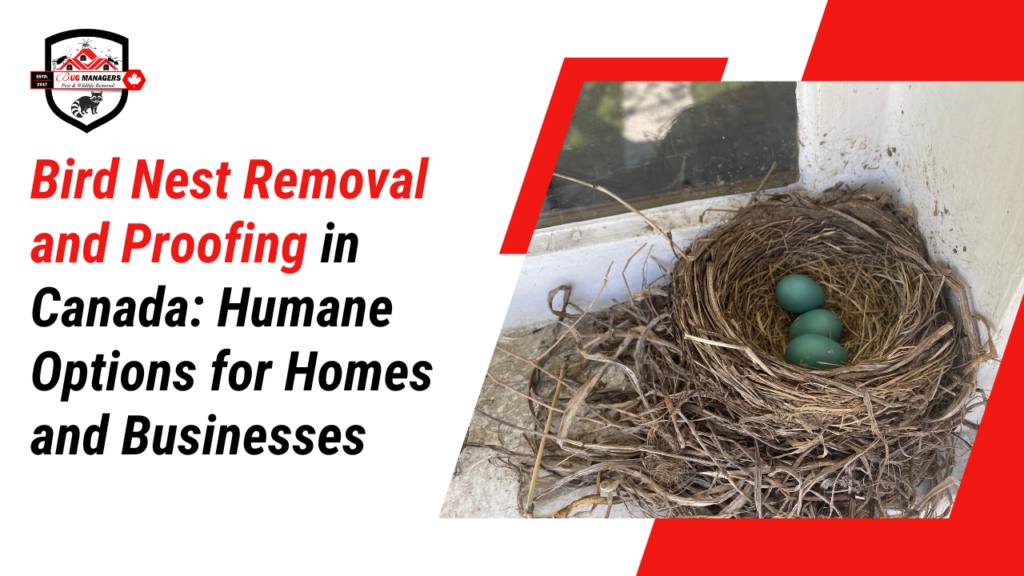
An active nest usually means at least one of these is true:
- Eggs are present
- Chicks are present
- An adult bird is sitting on the nest for long periods
- You see frequent feeding trips to the nest
If you see eggs or chicks, it is active.
Even if the parents fly away when you come close, it can still be active.
Humane Options When the Nest Is Active
If the nest is active, humane removal usually means one thing.
Wait until the nesting cycle is done.
That might feel frustrating, but it is often the safest legal choice.
Here are practical steps you can take while you wait:
- Keep distance from the nest area
- Use a different door if possible
- Put temporary ground coverings under droppings (like a tarp you can remove later)
- Keep pets on a short leash near the nest zone
- For balconies, block access to the balcony until the birds leave
Do not use loud noises, sprays, or pressure washers on an active nest.
These can injure birds and can also make the situation worse.
If the nest creates a real danger, like a blocked vent or a hazard near moving equipment, a permit may be needed. ECCC explains that a “damage or danger” permit can authorize actions involving nests or eggs in specific cases.
Humane Options When the Nest Is Inactive
Once you are confident the nest is inactive, the best time to act is right away.
If you leave the empty nest in place, some species will reuse the area.
A humane inactive-nest plan often looks like this:
- Remove the nest material carefully
- Bag and dispose of it properly
- Clean the surface safely (more on safety below)
- Install proofing so birds cannot rebuild in the same spot
ECCC notes unoccupied nests of most migratory birds may be removed when there is no bird or viable egg.
Proofing Methods That Work in Canada
Proofing means stopping access. It is the long-term fix.
For eaves, soffits, and roof edges
- Repair loose soffits and fascia boards
- Seal gaps that lead into attic spaces
- Add proper vent covers where needed
For vents and exhaust outlets
- Install bird-safe vent covers (especially dryer vents and bathroom vents)
- Check that airflow is still correct after installation
- Remove lint build-up often, because lint can also attract nesting
For balconies and ledges
- Use balcony netting where appropriate
- Reduce “flat shelf” spaces by adding ledge protection
- Remove food sources and standing water
For commercial buildings
- Close gaps in signage, canopies, and loading dock structures
- Use netting in open bay roof areas where birds roost
- Use ledge deterrents on high ledges where droppings build up
The key is to proof the full area, not just one corner. Birds often shift a few feet and try again.
Is It Safe to Clean Bird Droppings
Bird droppings are not just a mess. They can be a health risk, especially when dried droppings are disturbed and become airborne dust.
In Canada, workplace safety resources warn that exposure around bird and bat droppings can be linked to fungal infections like histoplasmosis.
Canada’s public health pathogen sheet also notes bird droppings can enrich soils and be associated with environments contaminated with Histoplasma capsulatum.
You do not need to panic, but you should clean safely.
Safer cleaning basics
- Wear gloves
- Avoid dry sweeping that creates dust
- Lightly wet droppings before wiping
- Use a proper mask if you are dealing with heavy buildup, especially in enclosed areas
If droppings are heavy in an attic, warehouse, or HVAC area, treat it as higher risk and use stronger precautions, as occupational guidance suggests.
What Not to Do
These actions often cause bigger problems:
- Do not remove an active nest with eggs or chicks
- Do not block an entry point if birds are still inside (especially vents)
- Do not use poison for birds
- Do not use glue traps
- Do not pressure-wash dry droppings without controlling dust
Also, avoid DIY methods that harm birds or break rules. If you are unsure, pause and get proper guidance.
A Simple Homeowner Checklist
If you want a simple “do this first” list, use this:
- Identify where the nest is and how birds reach it
- Confirm if it is active or inactive
- If active, avoid contact and wait it out when possible
- If inactive, remove safely and clean carefully
- Proof the exact nesting spot and nearby ledges
- Re-check the area weekly during spring and early summer
Conclusion
Humane bird nest removal in Canada is really about two things. Timing and proofing. If a nest is active, it is usually protected, and disturbing it can be illegal under federal rules for migratory birds.
Once the nest is inactive, removal and thorough proofing can prevent the same problem from repeating next season.
If you want help deciding what is safe to remove and how to proof the area properly, Bug Manager can be contacted for guidance.