Intro — a practical checklist for business owners and facility managers
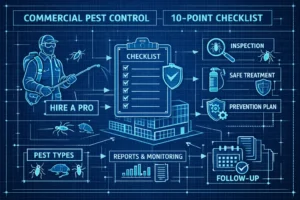
If you run a restaurant, manage a warehouse, oversee a hotel, or care for a healthcare facility, hiring the right pest partner is a business decision — not a commodity. Below is a usable checklist you can apply immediately to evaluate commercial pest control vendors and contracts. At Bug Managers we’ve audited dozens of commercial agreements across the GTA; this guide focuses on what actually affects compliance, costs, and long-term results. Read on for straight answers: integrated pest management basics, industry expectations, realistic price guidance, contract red flags, and a 12‑question interview checklist you can use on vendor calls or site visits.
Why the right pest partner matters (and the cost of cutting corners)
Poor pest service is expensive in ways a low price tag can’t show. The stakes include failed health inspections, angry customers, lost bookings, regulatory fines and the recurring cost of repeat treatments that never address the root cause. Consider this anonymized scenario: a busy neighbourhood restaurant chose a cheap quarterly spray plan. Weeks later, a health inspector requested service logs the company couldn’t produce. The business failed the audit and paid for emergency treatments plus renovations — costs far higher than a compliant, prevention-first program would have been.
Every business should expect a handful of non-negotiables from a commercial provider: licensed and certified technicians, commercial liability insurance, a written integrated pest management (IPM) plan tailored to the site, consistent digital or paper reporting, and clear recommendations for proofing or exclusion work. That’s why clients across the GTA rely on Bug Managers for licensed techs, compliance-ready documentation, digital reporting and proofing proposals that stop repeat visits.
IPM decoded: what a modern commercial pest program must include
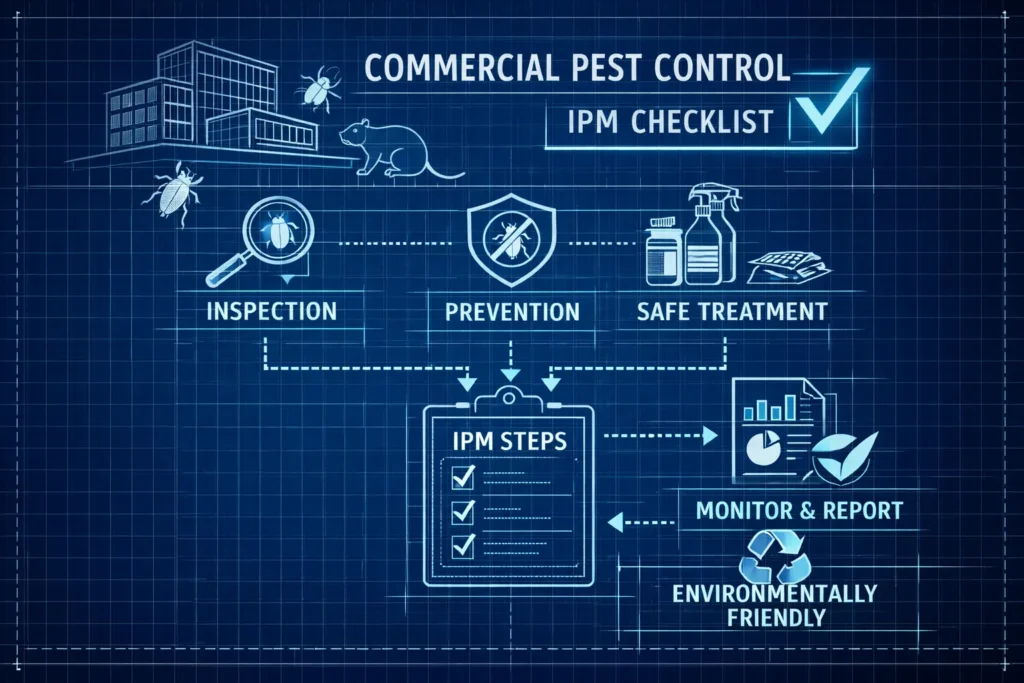
Integrated pest management (IPM) is prevention-first, data-driven pest control that reduces chemical use and focuses on long-term results. For commercial facilities it’s the standard because it aligns pest work with operational goals and regulatory requirements.
Think of IPM as a cycle: inspect the site to identify pests and vulnerabilities; monitor with traps and records to measure activity; improve sanitation and seal entry points to remove attractants; apply targeted, low-toxicity treatments only when thresholds are met; then evaluate outcomes and update records. That cycle keeps pest populations below action levels without unnecessary sprays.
Concrete signals a vendor truly runs IPM include written action thresholds for common pests, trap counts and mapped placement, MSDS and pesticide labels kept on file, documented staff training, and a proofing/exclusion proposal instead of a “spray-on-schedule” quote. Ask to see one sample service report and the IPM plan — that tells you if they walk the talk. For more background on our company and experience, see About, Bug Managers.
What to expect by industry: restaurants, warehouses, hotels and healthcare
Restaurants
Typical pests: rodents, cockroaches, flies (including drain flies) and ants. Priority prevention focuses on sanitation, drain maintenance, waste management and tight food storage. A strong plan includes sticky traps and baits in key zones, regular monitoring, and weekly or biweekly visits for high-risk kitchens. The first inspection should identify entry points, drain sources, refuse positioning and hot spots under equipment.
For a practical overview of the common pests in restaurants and mitigation steps that auditors expect, use that guidance alongside your vendor’s IPM plan. If you operate in the GTA, our Commercial Pest Control Services in Brampton | Bug Managers page outlines typical restaurant programs and visit cadences.
Warehouses
Typical pests: stored-product insects, rodents and birds. Prevention centers on perimeter monitoring, pallet and dock-door controls, and inventory inspection procedures. Expect pheromone traps for stored-product pests and a clear plan for dock and pallet management. The first visit should locate pest-prone storage zones, damaged packaging, and unsecured loading doors.
Hotels
Typical pests: bed bugs, transient cockroaches and ants brought in by guests. Programs must be guest-safe and discreet, with fast-response protocols for bed bugs and protocols for room isolation and heat treatments when needed. The initial inspection should identify entry points from service areas, housekeeping procedures that may spread pests, and high-risk common areas.
Healthcare facilities
Pests and protocols mirror hospitality but with stricter chemical-use limits: cockroaches, rodents and flies are common, and control must integrate with infection-control policies. Expect minimal-residue products, certified applicators, and detailed documentation for audits. The first inspection should highlight sanitation gaps, food-service intersections, and structural weaknesses that require exclusion work.
Pricing models and how to make quotes comparable
Commercial pricing comes in several styles: flat-rate contracts with predictable monthly fees, per-visit billing, hourly charges for specialty work, tiered plans (good/better/best), and multi-site pricing that scales. One-time treatments commonly range from the low hundreds to a few thousand dollars depending on severity; recurring commercial contracts vary from modest monthly fees for low-risk offices to several hundred or more per month for high-risk foodservice operations or large warehouses — local conditions and regulatory demands change the math.
To compare proposals, ask vendors to break quotes down by square footage and visit frequency, list the number and type of devices included (bait stations, traps), spell out the proofing/exclusion scope, disclose emergency or after-hours fees, and provide a sample service report. That creates apples-to-apples comparisons rather than sticker shock.
Quick ROI example: if exclusion work costs $2,000 and your current program runs $300/month in repeat treatments, the exclusion pays for itself in roughly seven months (2,000 ÷ 300 ≈ 6.7). After that point you reduce recurring treatment costs and regulatory risk — a common financial rationale for investing in proofing up front.
SLA and contract essentials you should insist on
Contract language creates accountability. A clear agreement keeps service consistent, protects audits and prevents surprise fees.
Make sure the contract specifies the scope of services: which pests are covered and which zones (interior, exterior, storage, roof lines). It should state visit frequency, scheduled days and what a typical inspection includes. Define response times with measurable targets — for example, 24 hours for rodents or wildlife issues, 48 hours for high-priority insect problems, and 3–5 business days for non-urgent requests.
Documentation requirements must be explicit: an on-site IPM logbook plus emailed service reports within seven days, trap maps, and copies of MSDS and pesticide labels. Proofing and exclusion responsibilities should be spelled out: who estimates and who pays for structural repairs, and what warranty applies to exclusion work. Confirm the provider’s insurance and certifications, request warranty/re-treatment terms, and watch for auto-renewal or onerous cancellation clauses.
For guidance on reasonable SLA response time expectations and how to phrase response targets in contracts, use industry-standard response-time guidance as a baseline when negotiating.
Red flags include vague scopes like “spray as needed,” no MSDSs or labels on file, missing technician credentials, or heavy automatic renewal language that hides price increases.
Hiring checklist: 12 interview questions, scoring shortcut, and next steps
Use these questions on discovery calls and during on-site visits. Record answers and request written follow-ups.
- Are you licensed and insured to provide commercial pest services in our jurisdiction?
- Can you show pesticide applicator certifications and technician credentials for staff assigned to our account?
- Do you operate on an IPM model? Please describe a recent IPM plan you implemented for a similar facility.
- What pests are included in our contract and which require extra billing?
- What is your guaranteed response time for urgent infestations?
- How do you document visits and how quickly will we receive service reports?
- Do you offer proofing/exclusion work and how is it billed or warranted?
- Can you provide references from similar businesses and at least one case study?
- What products do you use (brands/active ingredients) and can we get MSDS and labels?
- How do you handle multi-site account management and billing?
- What are your warranty/re-treatment terms and any performance guarantees?
- How are price increases handled and what are the contract cancellation terms?
Scoring shortcut: weight Compliance & credentials 30%, IPM approach 25%, reporting/technology 15%, references 10%, response times/warranty 10%, price 10%. Score each vendor out of 10 in each category, multiply by the weight, and compare totals — the highest score should balance compliance and IPM, not just the lowest price.
After you select a vendor, require a pilot visit, insist on a written IPM plan for your facility, set a 90‑day review to confirm results, and schedule quarterly performance reviews. Professional Pest and Wildlife Removal Services | Bug Managers offers free commercial inspections and sample IPM plans to help buyers compare quotes and make informed choices. After the inspection you’ll receive a follow-up and documentation — see our Thank You, Bug Managers page for a typical follow-up package.
Conclusion — hire to reduce risk, not just costs
Choosing the right commercial pest partner protects your brand, your bottom line and your compliance record. Prioritize IPM, documented reporting, clear SLAs and proofing over the cheapest sticker price. Download the checklist, run the 12-question script on your top candidates, and if you’d like a second opinion, Contact, Bug Managers for a free site inspection and a compliance-ready IPM proposal tailored to your facility.