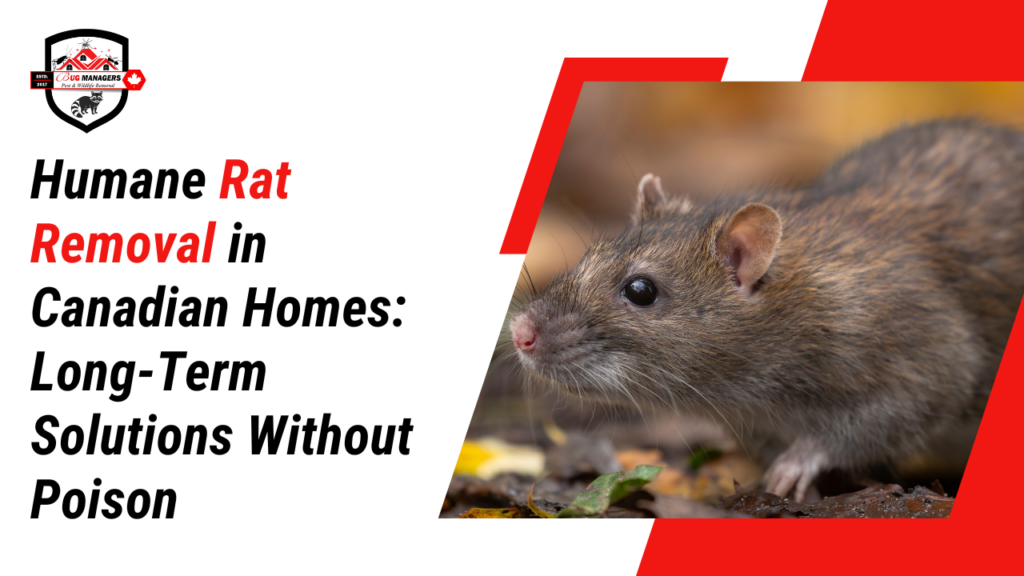
Rats in a home do not start as a “big problem.”
They usually start as a small access point and an easy food source. Then the rat learns your home is safe. And it keeps returning.
Many people reach for poison first.
But poison often creates new problems. It can harm pets and wildlife. It can leave dead rats in walls. And it does not fix how rats got inside.
A long-term, humane plan is different.
It focuses on removing what rats need to survive, blocking entry points, and using safer control tools when needed.
Why Rats Move Into Canadian Homes
Rats only need three things:
- Food
- Water
- Shelter
In cities, those three things are easy to find.
Garbage, compost, bird seed, pet food, and clutter all help rats.
Homes also have hidden paths in:
- Foundation cracks
- Gaps under doors
- Openings around pipes and vents
- Garage corners and broken weather stripping
Ottawa Public Health notes rats can squeeze through cracks and holes as small as about 1.27 cm (½ inch), which surprises many homeowners.
Signs You May Have Rats (Not Just Mice)
Rats leave different clues than mice. Common signs include:
- Droppings that are larger than mouse droppings
- Scratching or gnawing sounds at night
- Greasy rub marks along walls or baseboards
- Chewed holes near pipes, vents, or doors
- A strong ammonia-like smell in enclosed areas
- Pet attention to one wall, cabinet, or floor corner
If you are unsure, treat it as “unknown rodent” and focus on prevention first.
Why Poison Is a Bad Long-Term Choice
Poison can seem easy. But it often causes these issues.
It can harm pets, kids, and wildlife
Health Canada has strict risk controls for rodenticides. For example, it notes domestic-class products must be used in bait stations, and domestic-class products containing certain second-generation anticoagulants are prohibited.
That tells you how seriously the safety risk is treated.
British Columbia also brought in strong restrictions on second-generation anticoagulant rodenticides to reduce wildlife poisoning risk.
It can create a “dead rat in the wall” problem
A poisoned rat may die in a wall, attic, or crawlspace. That can lead to:
- Strong odours
- Flies
- A difficult cleanup
It does not fix the real cause
If rats still have:
- Easy food
- Easy shelter
- Easy entry points
Then new rats can replace the old ones.
The Humane, No-Poison Method That Actually Works
Think of this as a simple order of operations.
You do not need fancy products. You need the right steps in the right order.
Step 1: Remove Food and Water Sources
This is the fastest way to make your home less attractive.
Do these today:
- Keep all food in hard containers (not thin bags or cardboard)
- Clean crumbs under the stove and fridge
- Do not leave pet food out overnight
- Keep garbage in animal-resistant containers with tight lids
- Keep compost secure and closed
- Pick up fallen fruit if you have trees
This is not “extra cleaning.”
This is taking away the reward that keeps rats coming back.
Step 2: Remove Hiding Places
Rats love clutter because it protects them.
Focus on:
- Cardboard piles in basements and garages
- Wood piles stacked against the house
- Storage directly on the floor (move items up and into hard bins)
- Overgrown shrubs touching the house
Even one messy corner can become a nest zone.
Step 3: Seal Entry Points (This Is the Real Long-Term Fix)
If you do only one thing, do this.
Ottawa Public Health highlights sealing holes and cracks in foundations, walls, floors, underneath doors, and around windows as a key way to keep rats out for good.
Common places to seal:
- Gaps under exterior doors (add a door sweep)
- Openings around pipes under sinks and in basements
- Cracks in foundation walls
- Gaps where siding meets the foundation
- Garage corners and edges
A practical rule is simple.
If you can fit the tip of your finger into a gap, treat it as a risk.
Step 4: Use Traps, Not Poison (When Control Is Needed)
If rats are already inside, prevention alone may not be enough.
That is when traps come in.
British Columbia’s guidance says the best way to get rid of rats or mice is by using traps. It also explains snap or electronic traps are the best option because they are effective and kill quickly, while live traps and glue traps can cause major stress and suffering.
BC also provides a public-facing IPM guide that says snap traps are the best choice when control is necessary, and it reminds people to protect children, pets, and wildlife by enclosing traps in tamper-proof stations or placing them in inaccessible areas.
Where to place rat traps (simple placement rules)
- Place traps along walls, not in open spaces
- Put them where you see droppings, rub marks, or gnawing
- Focus on hidden travel routes: behind appliances, beside cabinets, along basement walls
- Use tamper-resistant boxes if pets or kids are present
If you set a trap “in the middle of the room,” rats often ignore it.
They prefer edges and cover.
Step 5: Clean Droppings Safely
Rodent droppings are not just “gross.”
They can carry germs.
The Government of Canada says you should not sweep or vacuum rodent droppings because it can release particles into the air. It also recommends spraying droppings with disinfectant (or a bleach-water mix) and letting it soak before wiping up.
A safe cleanup checklist:
- Wear gloves
- Ventilate the area if possible
- Do not dry sweep or vacuum droppings
- Spray first, wait, then wipe and bag waste
- Wash hands after cleanup
For heavy contamination, workplace guidance recommends stronger respiratory protection.
A Simple 7-Day “No Poison” Rat Plan
If you want a clear action plan, use this.
Day 1–2
- Remove food sources and secure garbage/compost
- Declutter nesting areas
Day 3–4
- Inspect and seal entry points (doors, pipes, foundation)
Day 5
- Place snap or electronic traps along walls and runways
Day 6–7
- Continue sealing any missed gaps
- Clean droppings safely
- Keep monitoring for new signs
The key is doing prevention and control together.
If you trap but do not seal, new rats can move in later.
When You Should Get Professional Help
Consider expert help if:
- You see rat activity in multiple areas
- You suspect rats are coming from a wall void or ceiling
- You cannot find entry points
- The infestation is in a shared building (townhome or apartment)
- There is heavy droppings or strong odours
In multi-unit settings, one unit alone often cannot solve it.
Rats move through shared spaces.
Conclusion
Humane rat removal without poison is very possible in Canada.
The core idea is simple. Remove food and shelter, seal entry points, and use traps when needed. This aligns with public guidance that emphasizes prevention and trapping over poison, and it avoids the safety risks that rodenticides can create.
If you want a structured inspection and a prevention-first plan for your home, you can consider Bug Manager in the final step.