Squirrels in the attic are noisy, messy and a real fire risk when they chew wires. Don’t panic. Do act fast. Bug Managers has handled hundreds of attic squirrel jobs across the GTA. The steps below are what actually works — not theory. Follow them and you’ll either fix it yourself or know exactly when to call for help.
Immediate checks and safety (first 24 hours)
Three priorities right away: keep people safe, confirm what you have, and don’t make the problem worse.
Keep kids and pets away from attic access. That’s not drama — it’s common sense. If you see exposed or chewed electrical wiring in the attic, shut off the circuit and call an electrician before you do anything else. Chewed wires are a fire hazard.
Do a quick observation without disturbing the space. Listen for noises during daylight — squirrels are active by day. Look at the attic access, the hatch, and the roofline for fresh droppings or nesting debris. Walk around outside and check rooflines and nearby trees for obvious holes or chew marks.
If you see chewed electrical, find more than one animal, or smell a strong, musty odor, call a professional right away. These are signs the job is more than a simple exclusion.
- Do: document noises and entry points (phone video helps).
- Don’t: seal holes or stuff gaps yet — you could trap animals inside.
- Do: call a licensed service if wiring is chewed or you find multiple entry points.
How to be sure it’s squirrels — reliable signs and quick tests
Look for daytime scratching, scampering or chewing noises coming from the attic or roof. Squirrels are diurnal. Rodents that are active at night are usually something else.
Check for small oblong droppings about 3/8″ to 1/2″ long. Compare sizes before blaming rats. Nests are typically messy piles of leaves, twigs and shredded insulation. Find a 1–2″ chew hole and you’ve probably found the entry.
Outside, acorn shells and stripped bark are a giveaway. Rub marks — greasy or fur-dark stains — often appear around frequently used gaps.
Quick confirmation tests: prop a sheet of newspaper or shake a little flour under suspected exit holes and watch for tracks. Set a motion camera or watch the hole during daylight. If you open the attic, wear an N95, gloves and eye protection — don’t stir debris without protection. If you’re not comfortable in dusty, insulation-filled attics, hand the inspection to a pro.
Decide: If you have daytime sounds, droppings and a chew hole, consider the presence “confirmed.” If you only have scattered yard evidence or distant noise, consider it “suspected” and inspect more carefully before acting.
For a quick checklist of common attic signs to compare with your own observations, see a short guide on signs you have squirrels in the attic.
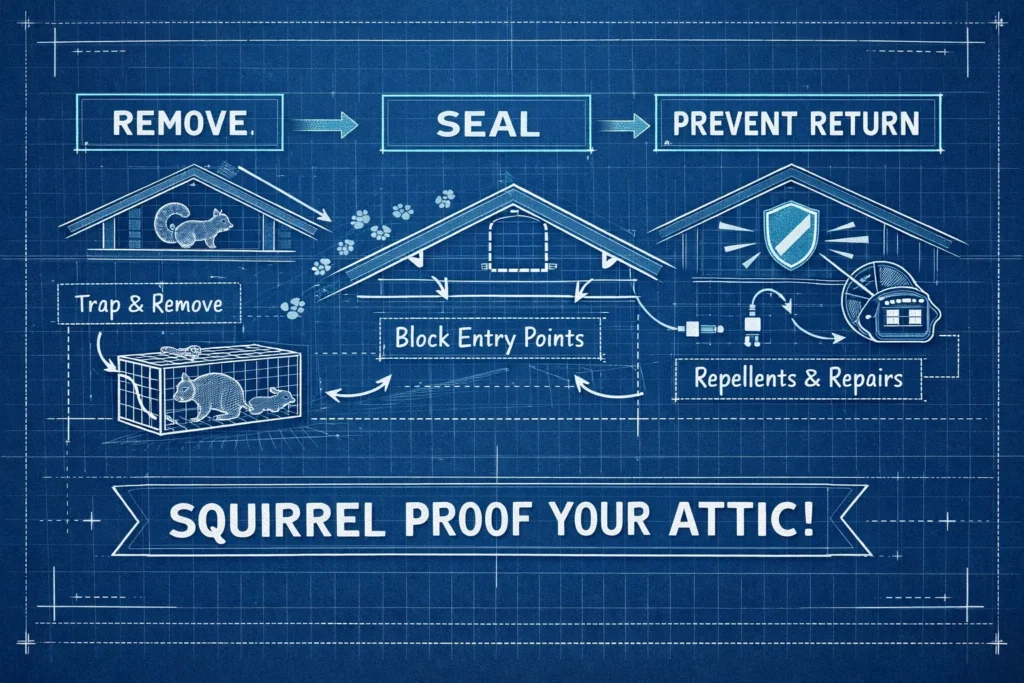
The humane, step-by-step eviction plan you can follow
Legal and timing note: don’t permanently seal openings if you suspect dependent young inside. In many regions, including the GTA, breeding and denning seasons mean kits may be present in spring and early summer. Check local laws and regulations or defer to a licensed technician during those months.
Workflow that works:
First, map every possible hole from the outside. Squirrels will exploit the smallest gap. Don’t rely on the one hole you saw; they use several.
Temporarily block secondary openings so there’s only one active exit. Use light materials for temporary blocks — you want to funnel animals to one place, not trap them.
Install a one-way exclusion device over the primary hole. It’s simple: the flap lets a squirrel push out and then closes behind it. Best practice is to mount the unit on solid material, seal obvious gaps, and monitor daily. Most squirrels leave within hours to a few days. Keep the device in place until you get three to seven days with no activity, then remove it and permanently seal the hole. For more on one-way doors, consult a practical overview of one-way doors for squirrels.
If a one-way door is impractical, use a live-capture cage trap at the active run. Bait with peanut butter or nuts. Check traps often. Handle a trapped animal with a towel and gloves and follow local relocation rules — relocation beyond permitted distances can be illegal and ineffective.
Haze the attic to speed exits: bright work lights, a radio on talk or rock stations, and commercial repellents placed outside the entry make the space uncomfortable. Avoid poisons, smoke bombs or stuffing animals inside — those methods are cruel and unsafe.
When to stop and call Bug Managers:
- If you find baby squirrels or suspect an active nest with kits.
- If you find chewed electrical wiring or structural damage.
- If there are multiple or hard-to-find access points.
- If you’ve tried humane exclusion and see no progress after a week.
Seal it right: materials and techniques that last
Squirrels will chew through weak materials. Don’t waste time with flimsy screens or foam as your primary barrier. Use metal and fasten it properly.
Recommended materials: 1/4″ galvanized hardware cloth, stainless steel mesh, heavy-gauge galvanized flashing, chimney caps, and screened vent guards. Fasten with exterior-grade screws and washers so the patch stays tight. Use silicone or exterior sealant only as a finishing touch — not as the structural barrier.
Technique in brief: clean and trim ragged edges so your patch sits flush. Make the patch at least twice the size of the hole, overlap the surrounding surface, and screw the patch down with washers every few inches. For vents and chimneys, install caps or screens that allow airflow but block access. If you prefer a full-service solution, our Pest & Wildlife Proofing Services cover permanent metal-based exclusion and cap installation.
Common weak spots: soffits, ridge and gable vents, dryer vents and rooflines where branches meet the eaves. Keep trees trimmed so no branch comes within 6–10 feet of the roof — that distance removes the squirrel highway.
Materials checklist to take to the hardware store:
- 1/4″ galvanized hardware cloth or stainless-steel mesh
- Galvanized metal flashing
- Exterior screws and washers
- Chimney cap and screened vent guards
- Silicone exterior sealant
Clean, repair, and make the attic safe again
After removal, treat the attic as a potential biohazard. Wear an N95 or better, gloves, and coveralls. Ventilate the space before you start.
Decide on insulation: spot-treat small, dry contamination with disinfectant and HEPA vacuuming. Remove and bag insulation that’s heavily soiled, damp, odorous or contains nesting material. Double-bag and dispose per local rules.
Sanitation basics: saturate droppings and contaminated surfaces with disinfectant, wait the contact time, then remove waste gently — don’t sweep or dry-vacuum untreated waste. Follow with enzyme cleaners for lingering odors. Any chewed wiring needs an electrician; do not attempt to repair electrical damage yourself. For step-by-step cleanup safety and procedures, consult a detailed guide to safe rodent dropping and urine cleanup.
Cost reality: removal and exclusion work commonly runs from a few hundred dollars to over a thousand, depending on scope. Expect smaller jobs roughly $300–$600 and attic-specific cleanup or insulation replacement often in the $500–$1,500 range or more for large contamination or wiring repairs. Factors that drive price include attic size, amount of contaminated insulation, access difficulty, and electrical repairs.
Call a professional for large contamination, strong odors, extensive insulation replacement, or any dead animals.
Stop them coming back — prevention, timing, and when to hire a pro
Prevention is straightforward: cap chimneys and vents, screen soffits and dryer vents with metal mesh, patch gaps with hardware cloth, cap plumbing stacks, move bird feeders away from the house, store pet food indoors, and keep tree branches trimmed 6–10 feet from the roof.
When you move bird feeders or need to limit attraction points near your home, our Bird Control, Bug Managers options and advice can help reduce visits and keep wildlife from learning your roof is an easy stop.
Timing matters. Squirrels commonly breed in late winter and may have a second litter later in the year. If you’re unsure whether young are present, wait until young are mobile or call a licensed technician to inspect.
DIY or professional? If there’s wiring damage, multiple entry points, heavy insulation contamination, legal uncertainty, or you simply don’t have time — call a pro. Squirrel Removal and Control in Brampton | Bug Managers offers free inspections and quotes, humane eviction and one-way door installation when appropriate, permanent exclusion using metal materials, attic cleanup and insulation repair, licensed technicians, eco-friendly methods and a written guarantee on work. We also handle other nuisance animals — for secure options on different species see our Safe Raccoon Removal Services in Brampton | Bug Managers and specialized Bird Proofing Services, Bug Managers.
If the job looks bigger than you want to handle, contact Bug Managers for a fast, humane, guaranteed fix. We’ll assess, remove, seal and clean — and leave the attic safe and quiet.
Two takeaways: don’t seal holes blindly, and don’t ignore damaged wiring. Fixing entry without proper cleanup and sealing simply delays the problem. Act deliberately, use metal barriers, and call licensed help when the risks are high.