Noticed a strange, unpleasant dead animal smell in house Mississauga coming from your walls, ceiling or attic? Could a dead mouse, rat or other animal be hidden inside your home? Learn the warning signs, possible risks and when to call professional dead animal removal experts in Mississauga
The reliable way to get rid of a dead animal smell in house Mississauga is to locate and remove the carcass, clean affected material, then ventilate the space. A carcass may be hidden behind a wall, above a ceiling or in an attic, beyond easy reach. The smell can make it hard to focus on anything else, but a careful approach can help you avoid unsafe contact and unnecessary damage.
This guide covers practical next steps, cleanup and when professional help may be appropriate. A bad smell does not always mean an animal has died inside the house. Drains, outdoor wildlife and other household sources can also affect indoor air.
The first practical step is to identify whether the odour is coming from a carcass or another household source.
Key Takeaways
- Remove the carcass before relying on odour-control products.
- Do not cut into a wall to investigate a smell.
- Leave immediately if the odour suggests a possible gas leak.
- Keep children and pets away from visible remains.
- Clean affected surfaces and ventilate after removal.
- Request a professional assessment when the source is concealed or access is unsafe.
Dead Animal Smell in House Mississauga: Causes and First Steps
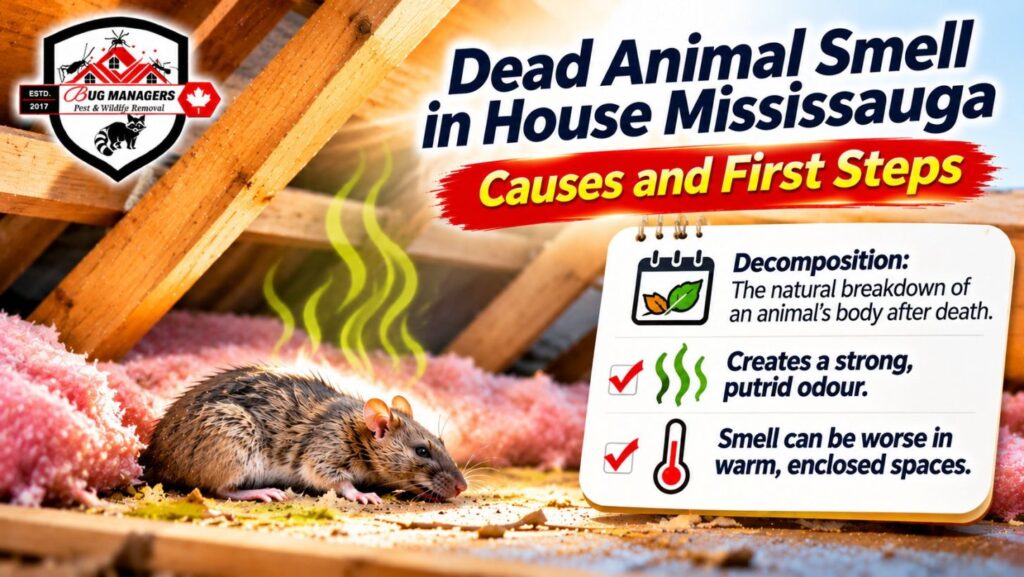
A dead animal can create a strong, putrid odour as its body breaks down. Decomposition is the natural breakdown of an animal’s body after death. The smell can range from unpleasant to overpowering, especially when the carcass sits in a warm, enclosed space.
What Affects Dead Animal Smell in Your Home?
Warm temperatures and humidity can accelerate decomposition, making odours more noticeable. Airflow also plays a role, carrying unpleasant smells through wall cavities, ventilation openings and other connected spaces.
The size of the animal can influence the intensity and duration of the odour. Even a small dead mouse hidden inside a wall can produce a strong smell, while a larger animal, such as a raccoon, may cause more extensive contamination and staining.
A dead rat often produces a strong, unpleasant decaying odour that some homeowners describe as sewer-like. However, smell alone cannot confirm a dead animal. Plumbing problems, moisture and other building issues can produce similar odours.
For homeowners in Mississauga, Brampton and Toronto, professional pest inspection can help identify the source, assess possible contamination and determine whether dead animal removal or additional cleanup is necessary.
For more information about safely cleaning areas affected by rodents, consult the CDC’s official guidance on cleaning up after rodents.
A carcass odour may last from a few days to a few months, depending on the animal’s size and environmental conditions. A larger animal can leave more material to clean, and a warm, humid space may affect how quickly the body breaks down. Odour can also remain in nearby materials after the carcass is gone.
Begin by treating the smell as a clue, not a diagnosis. A dead rat smell, a sewer-like odour or a sudden change in indoor air can have more than one cause. Look for other evidence before deciding where to investigate, and avoid opening a surface based on smell alone.
Stagnant water in a drain or a sewer problem can also produce a rotten smell indoors. A drain issue may be more likely when the odour is strongest near plumbing, but smell alone still cannot establish the cause.
Treat a sewer-like or rotten smell as a clue to investigate, not proof of a dead animal.
Warning Signs Beyond the Odour
A sudden change in smell paired with activity or a stain in one spot is more useful than odour alone. A dead mouse can cause an unpleasant smell even when its body is out of sight. Flies or maggots gathering in one area, a new stain, or a sudden stop in scratching can strengthen the possibility of a hidden carcass.
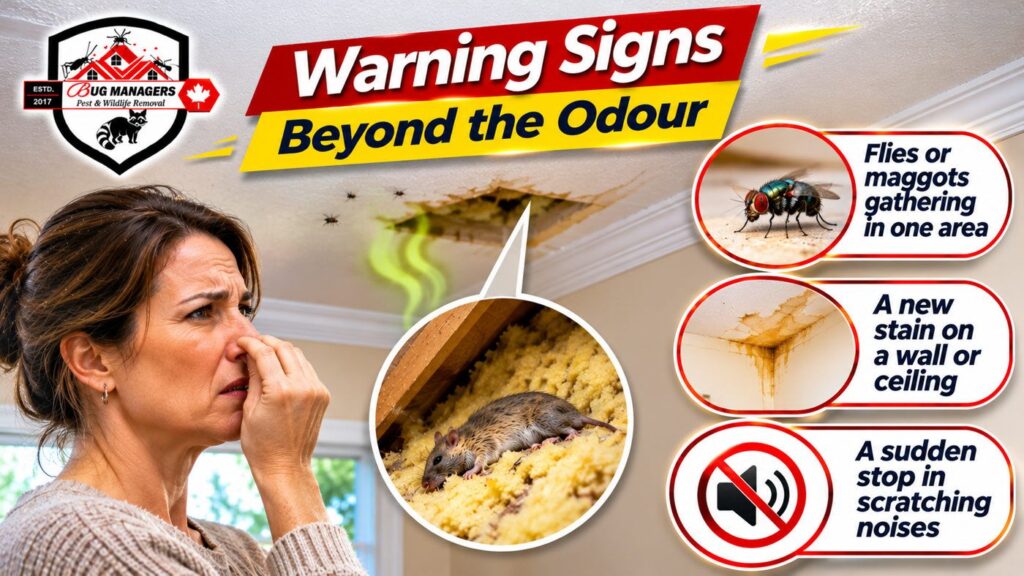
None of these clues identifies the source with certainty. A stain might have another cause, and insects can gather around food or other organic material. Still, several clues in the same area can help narrow down where a closer assessment may be useful.
| Clue | Possible location | What to check |
|---|---|---|
| Concentrated flies or maggots | Window, vent or ceiling edge | Whether insects gather repeatedly in one spot |
| Localized stain | Wall or ceiling | Whether discoloration is new or spreading |
| Scratching suddenly stops | Wall void or attic | Whether sounds stopped in the same area |
| Odour strongest near one area | Wall or ceiling section | Whether the smell is concentrated there |
Keep track of where a clue appears and whether it changes. A dead mouse can create a noticeable smell in a small room, but odour intensity does not reveal the animal’s size. Stains may be more apparent with a larger animal, but they do not prove what is behind a surface.
A cluster of clues is more useful than one sign by itself. The house may also have an unrelated issue, such as a plumbing leak or insects entering from outdoors. Avoid treating a suspected carcass as confirmed until you have a safe way to assess the area.
Treat a cluster of clues as a reason to investigate carefully, not to cut into a wall.
Can a Dead Animal Smell Like a Gas Leak?
If the odour is like rotten eggs or sulfur, leave the building before investigating anything else. A rotten-egg or sulfur smell can signal a natural gas leak, which is more urgent than a suspected carcass. Leave immediately and call 911 or the gas utility from a safe location.
A hissing or whistling sound near a gas meter, pipe or appliance can be another warning sign. Dead or dying plants near a gas line may also deserve attention. The smell itself cannot tell you whether the cause is gas, decomposition or another source.
Do not operate a phone, switch or electronic device inside or near the suspected leak. Do not smoke, start a vehicle nearby, or search for and try to repair the leak. Even an attempt to pinpoint the smell can bring you closer to danger.
Call only once you are safely away from the building and the suspected area. If you are outside, move farther away before using a phone. Follow instructions from emergency responders or the gas utility instead of returning to inspect the home.
A dead animal may produce a foul smell, but a rotten-egg cue must be treated differently. Do not assume it is an animal because the odour is strongest in one room, near a wall or around an appliance. A possible gas leak takes priority over finding a carcass.
The same caution applies if someone else reports a sulfur smell inside the house. Keep everyone away from the suspected area and do not ask another person to check it for you. A safe location is the place to make the call.
Do not re-enter to collect belongings or inspect the suspected leak.
Health and Hygiene Risks Around a Carcass
Finding a dead mouse, rat or other animal inside your home can raise concerns about hygiene and contamination. However, simply noticing an unpleasant odour does not automatically mean you will become ill. The primary concern is direct contact with animal remains, bodily fluids or contaminated materials.
Possible Health and Hygiene Concerns
Dead animals may attract flies and other insects. Depending on the animal and surrounding conditions, fleas, mites or ticks may also be present.
Avoid touching a carcass with bare hands, and keep children and pets away from affected areas.
The Government of Canada’s guidance on preventing hantavirus infection explains important precautions when dealing with rodents and potentially contaminated environments.
Why Safe Cleanup Matters
Animal remains and contaminated insulation may be hidden inside walls, attics, ceilings or crawl spaces.
Avoid sweeping, vacuuming or disturbing suspected rodent contamination before assessing the appropriate cleanup method.
The CDC’s official rodent cleanup guidelines provide practical information about protective equipment, disinfection and handling dead rodents.
When to Request Professional Help
If a carcass is hidden behind drywall, beneath insulation or inside an inaccessible space, avoid reaching blindly into the area. Sharp materials, damaged structures and contaminated debris may create additional hazards.
Homeowners in Mississauga, Brampton and Toronto can request a professional pest control inspection in Mississauga to help locate suspected animal remains and determine appropriate removal and cleanup steps.
Bug Managers Pest Control & Wildlife Removal provides professional pest inspections, rodent control, wildlife removal, attic cleanup and pest prevention services for residential and commercial properties.
If you discover a dead animal or suspect contaminated materials inside your property, contact Bug Managers Pest Control for a FREE estimate and professional guidance.
Call 647-326-4888 to discuss your pest control or wildlife removal concerns.
How to Narrow Down the Source Safely
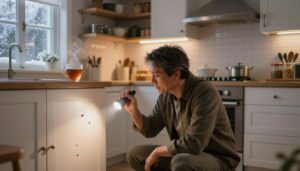
Start by identifying the room and surface where the smell is strongest, rather than searching the whole house at once. A recurring dead-animal smell can mean the source remains, air is carrying odour from elsewhere, or another household source is responsible.
The smell may seem strongest near a wall, vent, attic or basement. A change when the HVAC runs can show that airflow is carrying odour, but it does not prove where the carcass is. A skunk, stagnant drain or sewer problem can also create an unpleasant indoor smell.
| Where the odour is strongest | Possible nearby space | Safe check | What the clue can tell you |
|---|---|---|---|
| Baseboards | Wall cavity or floor edge | Compare nearby rooms | Whether the smell is localized |
| Vents | Duct or connected room | Note changes with airflow | Whether air may be carrying odour |
| Attic or basement | Insulation or storage area | Observe from an accessible spot | Whether one level is more affected |
| Wall or ceiling | Concealed space | Note the strongest surface area | Where a professional assessment may focus |
Use a few simple checks to compare the pattern without disturbing a surface:
- Compare the smell in different rooms.
- Note the area where it is strongest.
- Check whether HVAC airflow changes the odour.
- Stop if further inspection means opening a surface or entering an unsafe space.
A smell trail can shift as air moves through the home. A vent may carry odour from another room, and a wall can seem responsible when the source sits above it. Record what changes instead of treating one observation as proof.
Do not use a smell trail as a reason to open electrical outlets or cut a wall.
Common Places Animals Die Inside a Home
Small, sheltered spaces are easy to overlook when an animal gets inside a home. Mice and rats may be found in wall voids, attics or basements, where a carcass can remain out of sight. These are possible locations, not guaranteed hiding places.
Attic insulation can hide small animals, while a wall cavity may be hard to see without opening the wall. A basement can offer dark storage areas and gaps around the home’s structure. A crawlspace may also conceal remains, especially where access is limited.
Squirrels and bats may be found around homes, along with raccoons, skunks and opossums. Stray cats or dogs may also be found near a property. Species cannot be identified by smell alone, so do not use the odour to decide which animal is present.
Under a porch or in a yard, sheltered corners can conceal animal remains. A smell near a door or foundation does not necessarily come from inside the house. Outdoor sources may affect indoor air when windows or vents are nearby.
The odour may appear to come from one room even when the animal is in a connected space. Air movement, gaps and building features can make the source hard to pinpoint. A strong smell near an attic hatch, for example, does not establish that the carcass is directly above it.
Inaccessible spaces call for a safer assessment rather than a blind search. Avoid reaching into an unseen cavity or disturbing insulation just to confirm a suspicion. A professional can assess whether access is safe and what inspection method is suitable.
Check only spaces you can access without disturbing a carcass or damaging the property.
When Does a Dead Mouse in a Wall Need Professional Help?
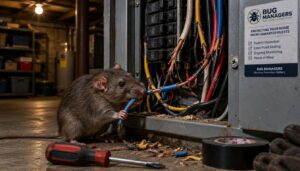
A dead mouse suspected inside a wall should be assessed before opening drywall. Hidden carcasses can be difficult to locate, and cutting into walls without knowing what is behind them may damage electrical wiring, plumbing or structural materials.
Professional inspection can help identify possible rodent activity, locate suspected contamination and determine whether further investigation is necessary.
If you notice an unpleasant smell, scratching noises or droppings, consider arranging a professional pest inspection in Mississauga before attempting repairs.
Why Professional Rodent Inspection Matters
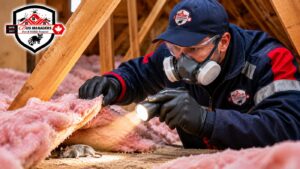
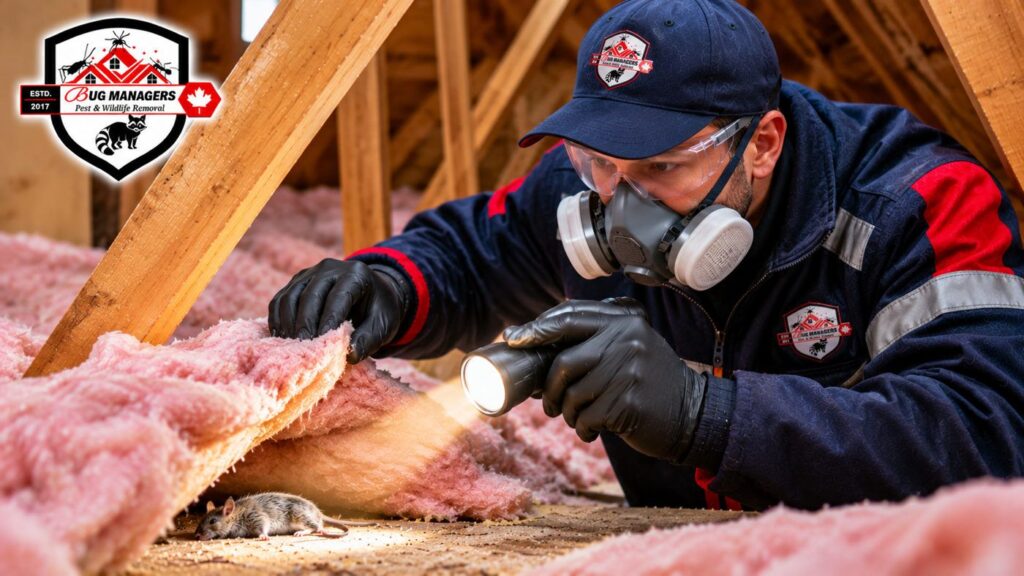
Dead mice and rats may remain hidden inside wall cavities, ceilings, basements or attic insulation. An inspection can help narrow down the possible source and identify conditions contributing to rodent activity.
Bug Managers provides pest control and wildlife removal services, including rodent control, wildlife inspections, attic cleanup and exclusion recommendations.
Not every unusual smell indicates a dead animal. Plumbing problems, moisture and other building conditions can produce similar odours.
When Should You Contact Bug Managers?
If the smell persists, becomes stronger or is accompanied by flies, stains or evidence of rodents, professional assistance may be appropriate.
Our licensed and insured team serves homeowners and businesses throughout Mississauga, Brampton, Toronto and surrounding GTA communities.
Before opening walls or disturbing insulation, request an assessment to determine the safest next steps.
Contact Bug Managers Pest Control for a FREE estimate or call 647-326-4888.
Dead Animal Removal on Private Property in Peel Region
On private property in Peel Region, the safest option is to avoid handling the animal when you can. If pickup is necessary, use gloves, seal the carcass in a doubled plastic bag and wash your hands thoroughly. A private business or pest control agency can also be hired for removal.
If the carcass is accessible and you decide to pick it up, follow these steps:
- Avoid handling the animal if possible.
- Wear gloves if pickup is necessary.
- Place it in a doubled plastic bag and tie the bag closed.
- Wash your hands thoroughly after handling the bag.
Once sealed, the doubled bag may be buried or placed in garbage. Do not put it in recycling or organics. Keep the bag closed while you choose one of those disposal options.
Do not pick up an animal if access requires reaching into an enclosed space or disturbing materials. A carcass in an attic or wall may be better handled by a private removal service. The same applies when the animal’s condition or the surrounding area makes pickup feel unsafe.
A private business or pest control agency can be hired when you prefer not to handle the remains. This option is also useful when the carcass is difficult to reach or residue needs attention. The right choice depends on access and what is affected around the animal.
Keep a doubled bag out of recycling and organics.
Who Handles a Dead Animal on Public Property in Mississauga?
For a dead bird or animal on public property in Mississauga or Brampton, call 311. Public-property reporting is separate from removal of a carcass inside a private home. Use the municipal contact for the location where the animal is found.
| Location | Contact | When to use it |
|---|---|---|
| Mississauga | 311 | Dead bird or animal on public property |
| Brampton | 311 | Dead bird or animal on public property |
| Caledon | 905-584-2272 | Dead bird or animal in Caledon |
| Canadian Wildlife Health Cooperative | 1-866-673-4781 | Listed contact option for a dead bird or animal |
The municipal route applies to a carcass on public property, not one inside your house or elsewhere on private property. A dead animal in a yard follows a different route from one on a public sidewalk or road. Be clear about the location when you report it.
Mississauga and Brampton use 311 for dead birds or animals on public property. Caledon has a different listed contact, 905-584-2272. The Canadian Wildlife Health Cooperative number is 1-866-673-4781.
Do not assume that a contact for public property handles removal inside a private home. A concealed carcass also differs from one visible in a public place. The location determines which route makes sense.
If the animal lies close to a property boundary, confirm whether it is on public land before reporting it as a municipal pickup. A clear location helps prevent confusion about who should handle the report.
Check that the animal is on public property before using the municipal reporting route.
What Wildlife Removal Services Can and Cannot Do
A dead-animal service and a call about live wildlife are not the same request. A dead animal removal service may be able to locate an accessible carcass, remove it, advise on affected material and identify an entry point. The available work depends on access and site conditions.
Possible service tasks may include:
- Assessing an accessible space for a carcass.
- Removing the carcass when access allows.
- Advising whether nearby material needs attention.
- Identifying a possible animal entry point.
A concealed space may need a separate assessment before anyone can reach the animal. The service scope can change if a wall, ceiling or built-in must be opened. Do not assume every job includes repairs or cleaning; those tasks depend on the site.
Live wildlife needs a different response. Mississauga Animal Services says not to approach an animal in distress. Residents can call 905-896-5858 for that situation.
Mississauga Animal Services does not remove or relocate healthy wildlife from its home territory. That does not mean a distressed animal should be approached or handled by a homeowner. A live animal’s condition matters when deciding whom to contact.
Wildlife removal, animal removal and pest control can describe different needs. Be specific about whether you have found a carcass, seen a live animal in distress or noticed signs of activity. This helps set a suitable scope without assuming that every animal problem calls for the same service.
Do not approach a live animal in distress while deciding whom to call.
Cleaning Contaminated Attic and Wall Areas
Removing the carcass is only part of cleanup if fluids or residue reached nearby material. Porous surfaces such as insulation and drywall can retain residue, so surface deodorizing alone may not be enough. Fluids from a decomposing body can seep into materials and leave stains that spread.
Cleanup may involve these four tasks:
- Remove the carcass and visible residue.
- Assess affected insulation and other porous material.
- Clean and disinfect with products suited to the surface.
- Repair access openings or animal damage.
The amount of work depends on what the residue touched. Insulation may retain material that cannot be removed through surface cleaning. Drywall and other porous surfaces can also need further attention if fluids reached them.
Flies and maggots may be attracted to an unattended carcass. Their presence can add cleanup needs around the affected area. Addressing visible residue and any affected surfaces matters more than covering a stain with paint or fragrance.
An attic cleanup does not always require replacing all the insulation. A careful assessment can identify whether material is affected and what can be cleaned. Avoid covering an area until the residue and any staining have been assessed.
Repairs may be needed after access or animal damage is addressed. A wall opening, damaged screen or disturbed insulation can require separate work. The cleanup plan should account for both the carcass and the material around it.
Have affected insulation and porous surfaces assessed before covering them again.
How to Control Lingering Odour After Removal
A lingering odour can remain after removal, especially if residue reached nearby material. Odour may linger for up to two weeks after the source is removed. That period applies after removal, not to the time a carcass may remain inside a home.
Air the area when it is safe to do so. Clean remaining residue with a product suitable for the affected surface. An enzyme cleaner may help where residue remains, but check that the product is appropriate for the material before applying it.
Activated charcoal, baking soda or a suitable commercial odour absorber can help reduce a lingering smell. Use these as supporting measures after the source has been removed. An air freshener may cover an odour without addressing residue or contaminated material.
Odour can persist when nearby material still holds residue. A treated room may smell better for a while, then worsen as air moves through it. If that happens, consider whether the affected surface needs another assessment rather than adding more fragrance.
Ventilation and cleaning work together, but neither replaces removal of the source. If residue remains, an absorber can reduce the smell without removing what causes it. Choose a cleaning method suited to the surface and avoid mixing products.
A lingering odour is not always proof that the carcass is still present. It may come from material affected before removal. Check the area for remaining residue or staining before deciding what to do next.
If the smell persists, revisit the affected surface rather than adding more fragrance.
When Waiting Is Better Than Opening a Wall
A wall is not the first thing to open when the source of a bad smell is uncertain. Waiting may be reasonable when the suspected source is inaccessible and the odour is fading. Opening drywall can create repair work and may disturb wiring or plumbing.
A strong smell does not confirm that an animal has died inside the wall. A stagnant drain or skunk activity near the home can also create an unpleasant indoor odour. Consider these alternatives before assuming a concealed carcass.
If the smell is persistent or worsening, or if stains or insects appear, arrange further assessment. These changes are more useful than odour alone when deciding whether a concealed source needs attention. Do not make a test hole to check your suspicion.
A concealed source that cannot be accessed safely is a reason to arrange a professional assessment. That approach can help avoid damage while identifying a suitable way to inspect the area. The same caution applies to a ceiling or built-in that hides wiring, plumbing or other materials.
There is no fixed point when an inaccessible carcass will stop smelling. The odour can be affected by the animal, the space and nearby materials. A fading smell may support waiting, but a worsening pattern calls for a closer assessment.
Consider whether a drain or outdoor source could be affecting the room. If those possibilities do not fit and the smell continues, professional assessment is safer than trial-and-error demolition.
Choose an assessment over trial-and-error demolition when the likely source is concealed.
Preventing Another Animal from Entering the Home
Closing entry points is more useful than masking the smell after an animal gets inside. Caulk cracks, repair screens, cover chimney openings with mesh and limit access to rooflines. These measures reduce opportunities for mice, rats and other animals to enter.
| Potential entry or attractant | Prevention measure | What to check |
|---|---|---|
| Cracks and gaps | Caulk openings | Gaps around the home’s exterior |
| Damaged screens or chimney openings | Replace screens and add mesh | Broken window or door screens |
| Garbage and roof access | Fit bin lids tightly and trim overhanging branches | Loose lids and branches above the roof |
| Cluttered attic or basement storage | Clear stored clutter | Dark, crowded storage areas |
Routine maintenance can catch small openings before they become easy entry points. Check screens, garbage-bin lids and stored areas as part of that work:
- Inspect door and window screens for damage.
- Verify garbage-bin lids fit tightly.
- Clear stored clutter from the attic and basement.
Branches that hang over the roof can make access easier for animals. Trimming them is one part of reducing access, alongside keeping chimney openings protected with mesh. No single measure guarantees that wildlife will stay away.
Residential rodent poison can leave a rodent dead inside a wall or another inaccessible space. Poison is not a way to avoid odour, and it may create a carcass problem that is harder to reach. Consider exclusion measures rather than relying on poison to prevent a hidden smell.
Check repaired gaps and screens again as the home’s exterior changes. A screen can tear, caulking can fail and a previously closed gap can reopen. Regular checks help keep the work effective.
Recheck repaired openings and screens as part of routine home maintenance.
Dead Animal Removal Service Areas Across the GTA
Bug Managers serves homeowners in Mississauga and other listed GTA communities. Service-area information does not promise a particular arrival time or availability. Ask whether your address is covered when you request an estimate.
The listed communities are:
A homeowner in one of these communities can ask whether the address falls within the service area. Coverage can depend on the exact location, so the city name alone may not settle the question.
Dead animal removal may be relevant when the source is hidden, access feels unsafe or affected material needs assessment. A homeowner can describe the location and the signs noticed when asking about coverage. That gives the service provider useful context without assuming that every odour comes from a carcass.
The listed GTA communities include both urban and suburban properties. The possible animal and access conditions can differ from one home to another. An estimate request can establish whether your location is covered and what kind of assessment may be suitable.
Confirm address coverage when requesting an estimate.
Book a Free Dead Animal Removal Estimate
If the source is hidden or cleanup feels unsafe, request a free estimate from Bug Managers Pest Control & Wildlife Removal. Bug Managers offers licensed and insured services and a free estimate. No price, arrival time or availability is promised here.
Call 647-326-4888 or visit Bug Managers Pest Control & Wildlife Removal to ask about service. You can describe where the smell is strongest, how long it has been present and whether you have noticed stains or insects.
Those details can help explain what you need assessed. Mention whether the likely source is in a wall, ceiling, attic or another space. If you have not seen a carcass, say that clearly rather than presenting a suspicion as confirmed.
Ask what the estimate covers and whether the suspected area can be assessed without opening a surface. Access and site conditions affect the possible work. A clear description can help set expectations before anyone visits.
If the smell could indicate a gas leak, leave and contact emergency help from a safe place instead. A removal estimate is for a suspected animal-related issue, not an urgent gas concern. Put immediate safety ahead of booking any service.
For the estimate request, be ready to share the home’s location and the observations you have made. The licensed and insured service description and free estimate offer do not establish a particular price or response time.
Call 647-326-4888 or visit bugmanagers.com to request your free estimate.
Conclusion
A hidden carcass is solvable, but masking the odour does not remove its source. Lasting odour control starts with removing the carcass, then cleaning affected material and ventilating the space. Avoid opening a wall based on smell alone, especially when the source is uncertain or access may be unsafe.
A rotten-egg or sulfur smell can signal a gas leak, not an animal-removal problem. Treat that cue as an urgent safety concern rather than continuing an indoor search.
For help assessing a concealed source, request a free estimate at bugmanagers.com.