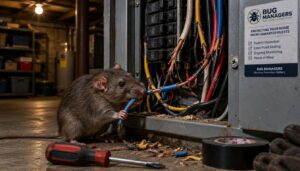
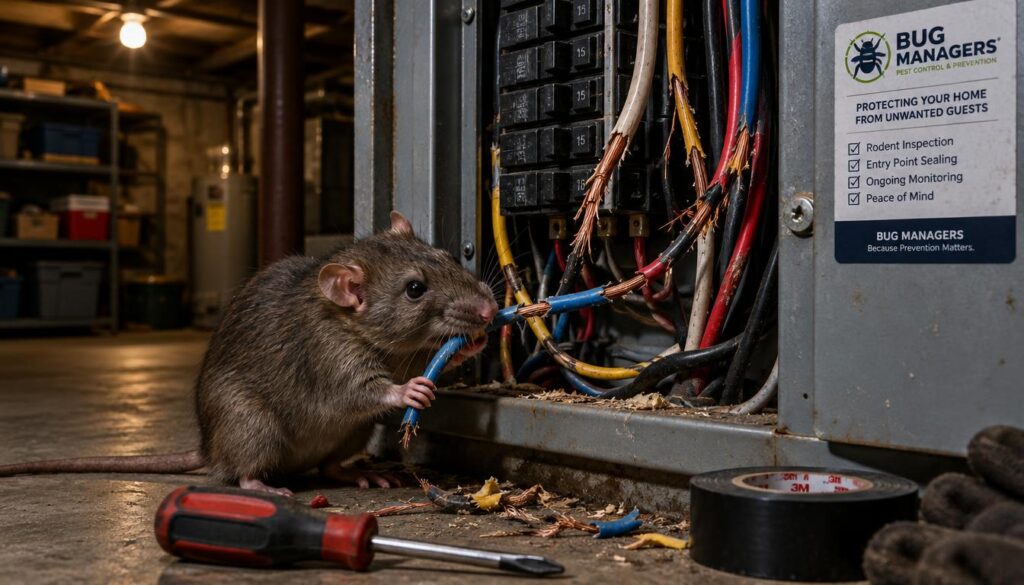
A small patch of missing insulation from rats chewing electrical wires can turn a hidden rodent problem into an electrical safety concern. An arc is an electrical discharge across a gap between conductors that can produce heat and ignite nearby combustible material.
Visible signs of rodent activity do not prove that wiring has been damaged. Still, a fault hidden in a home, vehicle or business can create safety risks and costly repairs.
This guide explains why rodents gnaw cables, which signs may point to damage, what to do safely and how to prevent access across Canada. Treat suspected wiring damage as an electrical issue first, not a do-it-yourself repair.
Key Takeaways
- Gnawed insulation can expose conductors and create a fire risk.
- Electrical symptoms can have causes other than rodents.
- Keep clear of suspected damage and arrange a professional assessment.
- Pair exclusion with a response to active rodent activity.
- Use traps or baits only as their labels allow, away from children and pets.
Why Are Rats Chewing Electrical Wires a Fire Risk?
Rats and mice chew because their incisors keep growing, and the soft covering around a cable can be easy to gnaw. They may also shred material for nesting. Chewing can damage insulation even when a cable still appears mostly covered.
If enough insulation is removed to expose two nearby copper wires, an arc can occur and ignite wood, insulation or stored items. Ontario’s Electrical Safety Authority (ESA) is the electrical safety regulator in Ontario. The Ontario government explains that rodent-damaged barn wiring can expose adjacent conductors and create this fire risk.
Damaged wiring can also interrupt a circuit or cause other electrical faults. A fault may produce heat without an obvious flame, and fires can begin near combustible material before anyone sees the damaged cable.
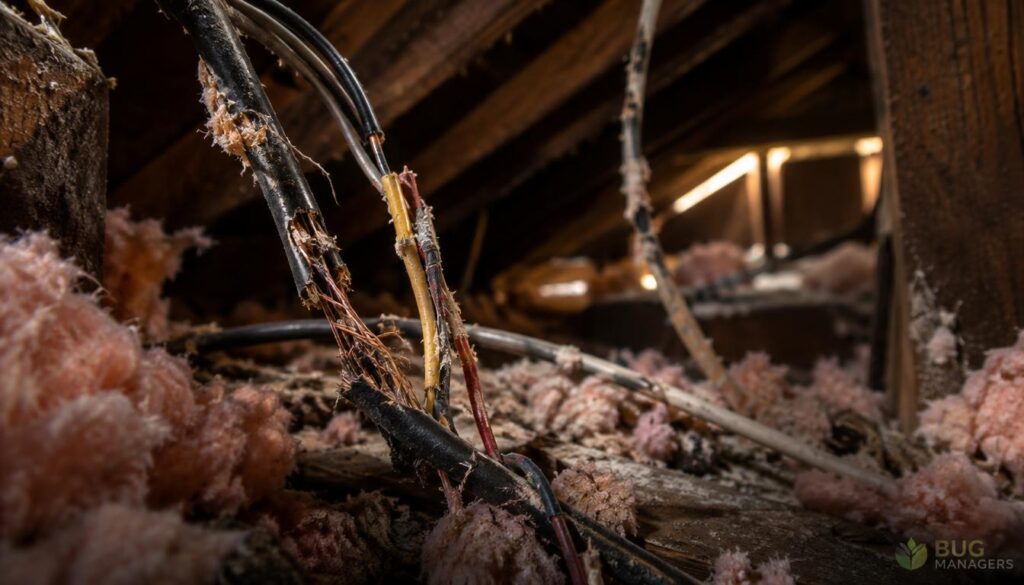
Rats chewing electrical wires in a house can go unnoticed because cables often run behind walls, through attics or around appliances. The same routes can conceal damage in a basement or crawl space.
Rats do not need to remove the full cable covering to create a hazard. Exposed adjacent copper wires can allow arcing, but a qualified professional must assess the wiring. A wire can be dangerous even when most of its outer insulation still looks intact.
How Can You Spot Rodent Activity and Wire Damage?
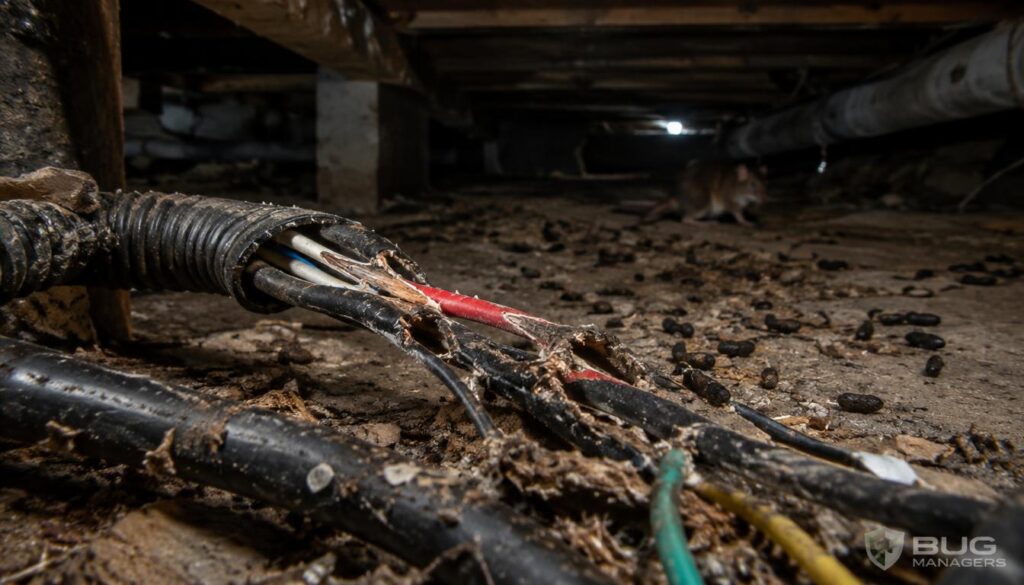
Droppings or gnaw marks near a room’s electrical problems raise suspicion, but neither confirms the cause. Flickering lights, dead outlets and tripped circuits can signal an electrical fault, but they do not prove rodents caused it.
Clues may appear in attics, walls, crawl spaces and near appliances. Hidden cables cannot be safely assessed by opening walls; an electrical professional can inspect suspected damage without asking you to expose wiring.
| Sign | What it may indicate | What to do |
|---|---|---|
| Gnaw marks or damaged insulation | Rodent activity or exposed wiring | Keep clear and arrange an electrical assessment |
| Droppings or nesting material | Rodent activity nearby | Keep people and pets away until safe cleanup |
| Scratching or chewing noises | Possible movement in a wall or ceiling | Note where and when you hear it |
| Flickering lights, dead outlets, tripped circuits or burnt smell | An electrical fault with an unknown cause | Arrange a qualified inspection |
Marks on cable coverings are not the only signs to notice. Droppings, nests and sounds can help locate rodent activity, but they cannot show whether wiring behind a surface is safe.
The Canadian Centre for Occupational Health and Safety says hantavirus can be present in the urine, saliva or droppings of infected deer mice and some other wild rodents. Exposure can occur through contaminated particles or surfaces, so avoid stirring up debris.
Keep people and pets away from droppings until the area can be cleaned safely.
What Should You Do After Finding Chewed Wiring?
If you suspect a live wire is exposed, do not touch it and keep others out of the area. In Ontario, electrical work must be done by a licensed electrical contractor, and an ESA permit is required.
Take these steps without trying to inspect or repair exposed wiring yourself:
- Keep clear. Switch off the affected circuit only if you can do so safely without approaching damaged wiring.
- Arrange an assessment and repair by a licensed electrical contractor. In Ontario, ask for the Certificate of Inspection after the work; it confirms compliance with the Ontario Electrical Safety Code.
- Ventilate a rodent-contaminated space for at least 30 minutes before cleaning, and keep it ventilated. Wear a fit-tested disposable N95 respirator and disposable gloves. Wet contamination with one part household bleach to nine parts water, or household disinfectant, for about 10 minutes. Scoop it into a sealed double plastic bag; do not dry sweep.
- Address the rodent problem and ask your insurer how your policy treats the damage. In October 2026, standard Canadian home policies generally excluded direct rodent damage and pest removal, while fire damage may fall under fire coverage.
Coverage for animal damage depends on your specific policy wording, including any exclusions and limits. Keep photographs of damage and repair records for the insurer, but do not approach a hazardous area to take pictures.
Heavy contamination may need a HEPA vacuum and a powered air-purifying respirator with P100 filters. Wet-cleaning precautions for droppings reduce the chance of spreading contaminated particles during cleanup.
Stop and get professional help if contamination is extensive or a cleanup would disturb hidden material.
Where Do Rats Enter Garages, Attics and HVAC Systems?
A gap around a garage door or service line can provide a route into a space where cables are hidden. Mice can typically squeeze through openings about 6 mm wide, while rats can use openings about 12 mm wide.
These sizes are practical guidance, not a guarantee for every animal; species and body size affect what opening it can pass through. Food, water, shelter and quiet nesting places can make a building more attractive to pests.
- Garage-door edges and utility penetrations can connect a garage with outdoor spaces and concealed wall routes.
- Rooflines, attic vents and wall voids offer shelter and access to cables, insulation and nesting material.
- Kitchen gaps near food, water and stored packaging can attract rodents looking for resources.
- HVAC openings and spaces around air-conditioning lines can lead into sheltered areas with wiring.
Check where a service line passes through a wall, floor or foundation. A narrow gap around a pipe or cable may be easier to miss than a large hole, yet still provide a route indoors.
Garages can provide shelter and connect to attics or wall voids through utility routes. Keep stored food and packaging in sealed containers, and avoid leaving clutter that provides undisturbed nesting sites.
Check the edges and service penetrations that connect outdoor areas to sheltered indoor spaces.
How Can You Seal Rodent Entry Points?
A durable barrier at the entry point is more reliable than relying on a scent or a loose patch. For gaps up to about 2 cm (3/4 in) around pipes, cables and air-conditioning lines, pack copper mesh or stainless-steel wool tightly, then seal around it with exterior-grade sealant.
Use suitable materials for the opening and the building part. The BC SPCA’s rodent-proofing guidance also stresses removing food and shelter attractants and checking repairs over time.
- Pack and seal small service gaps with copper mesh or stainless-steel wool and exterior-grade sealant.
- Screen vents that must remain open with 1/4-inch galvanized hardware cloth, while keeping each vent flap functional.
- Choose screening suited to the animal: rats need 19-gauge, 1/2-inch mesh; mice need 24-gauge, 1/4-inch mesh.
- Protect brick weep holes with weep-hole covers, copper mesh or hardware cloth, not caulk, so drainage stays open.
- Cover larger holes, foundation cracks and openings over 2 cm with hardware cloth, galvanized sheet metal at least 24 gauge or cement.
Mississauga advises heavy wire mesh over vents and metal sheeting over holes that could admit rats. Use a durable fit around the opening, rather than leaving loose edges that can be pulled aside.
To help prevent damage from rats chewing wires, combine exclusion with removing access to food and responding to active rodent activity. A sealed gap alone does not deal with animals already inside.
After sealing, recheck the repair and confirm that every vent and weep hole still serves its intended function.
How Do Rodents Damage Cars, Businesses and Food?
In a car, one damaged cable can affect a component far from the place where the rodent entered. A rat-chewed car wire needs assessment and repair by a qualified mechanic, not an improvised patch.
Gnawing can affect engine cables and air-conditioning wiring, causing vehicle faults and repair needs. In a workplace, damaged building insulation and wiring can disrupt equipment or create hazards around stored goods.
Rodents can chew food packaging and leave contamination on nearby surfaces. In food-storage areas, check packages and the surrounding storage space before using food that may have been exposed.
Ontario barn requirements apply to barns, not ordinary homes or every business. Rodent damage to barn electrical systems can increase fire risk. Non-armoured cables cannot be installed behind barn walls, floors or ceiling panels unless they are in conduit.
Concealed cables without mechanical protection can be vulnerable to rodent damage and cannot be inspected for condition. Livestock-housing areas require NMW or NMWU cable, and only copper cable is acceptable within the barn.
Discard food with packaging that rodents have chewed or contaminated.
Which Rodent Control Methods Are Safe Around Children and Pets?
A bait’s active ingredient and label restrictions determine whether it is appropriate for a particular setting. Domestic rodenticide products must be used in bait stations, and every product’s label governs safe placement and use.
Health Canada’s PMRA database listed domestic-class baits with several active ingredients on October 23, 2026. That class information does not mean every product or placement is suitable for every household.
| Bait or class | Active ingredient/status | Labelled use or legal rule | Safety detail |
|---|---|---|---|
| Domestic-class ingredients listed | Warfarin, chlorophacinone, diphacinone, bromethalin, cholecalciferol and corn-cellulose baits | Domestic products must be used in bait stations | Keep stations away from children, pets and livestock |
| Tomcat Rat Killer Disposable Bait Station | Bromethalin, registration 31970 | Indoor use and outdoor use within 15 metres of buildings | Label says rats usually eat a lethal dose in one night; death may take two or more days, and no antidote is listed |
| BASF TC 413 | Cholecalciferol | Registered June 25, 2026; indoor use only | Station is not tamper resistant; use only where children and pets cannot reach it |
| Prohibited domestic-class second-generation anticoagulants | Brodifacoum, bromadiolone and difethialone | Not permitted in domestic-class products | Do not use a product that is prohibited for domestic use |
The TC 413 label prohibits outdoor use. First-generation anticoagulants such as warfarin generally need several days of feeding for a lethal dose; second-generation anticoagulants generally act after one feeding, with death usually delayed 5 to 10 days.
Scent-based home remedies do not reliably exclude rodents. Combine exclusion, monitoring and appropriately placed traps or professional pest control; no method guarantees immediate removal.
Keep every bait station and trap inaccessible to children and pets, and follow the product label exactly.
Conclusion
Protect Your Property from Costly Rodent Damage
Protecting your home or business means addressing both the damage rodents cause and the entry points they use to get inside. Chewed electrical wires, damaged AC cables, vehicle wiring and contaminated food can lead to expensive repairs and safety concerns.
Suspected electrical damage should always be assessed and repaired by a qualified electrical professional. Long-term rodent prevention requires proper inspections, targeted control, entry-point sealing and ongoing monitoring.
🛡️ Bug Managers Pest Control & Wildlife Removal provides licensed and insured rodent control, mice and rat extermination, rodent-proofing and commercial pest management services.
📍 Proudly serving Mississauga, Brampton, Toronto, Oakville, Burlington, Vaughan and surrounding GTA communities.
🏠 Don’t wait until rodents cause expensive damage to your home, vehicle or business!
📞 Call or Text: 647-326-4888
🌐 Website: BugManagers.com
✅ Contact Bug Managers today for a FREE estimate and professional rodent control solutions!
Important Safety Disclaimer
Rodenticides and pesticides must be used by appropriately licensed professionals where required by law, in accordance with Health Canada regulations and approved product label instructions. Electrical repairs should only be performed by qualified electrical professionals.