

Yes, mice in a garage can enter the house through openings that connect the two spaces. A garage is not a reliable barrier if gaps allow access to your home, even when the garage doors are closed. Rodent exclusion means closing openings rodents could use to enter a building.
A mouse may follow a route from a crawl space or garage into a room with food, water or shelter. You can reduce the risk by finding access, closing it, limiting attractants and responding safely to rodent evidence. This approach helps you deal with a possible problem before it spreads through more of the building.
Key Takeaways
- Mice can move from a garage into a house through connected openings.
- Check both the exterior boundary and the door between the garage and living space.
- Close entry routes and reduce available food, water and shelter.
- One sign does not reveal how many mice are present.
- Ventilate before cleaning rodent waste, and never sweep or vacuum it.
- Ask for local or professional help when activity persists or an area is hard to reach.
Start by treating the garage and house as connected spaces, not separate ones.
Mice Enter House Through Garage Gaps
A mouse needs an opening only about pencil-width wide to get through a building’s barrier. In 2024, mice could fit through a hole about 1/4 inch (6 millimetres) wide, so a small gap can provide meaningful access. Two boundaries matter: the one between outdoors and the garage, and the one between the garage and living space.
An exterior garage door may leave a gap where its bottom seal no longer meets the floor. Openings around utility lines can also connect the outside to the garage. Rodent exclusion is the practice of closing routes that mice could use to enter. The CDC’s 2024 guidance recommends sealing garages and outbuildings as well as the home.
Check both boundaries: a garage can admit mice from outside, and an interior opening can let them reach the house.
Garage doors and exterior openings
Look at the full length of the garage-door seal, especially the corners and the point where the door meets the floor. A damaged seal, loose trim or a gap around an exterior pipe can make a route that is easy to miss from inside. Check the closed door in daylight for visible slivers of light.
Routes from the garage into living space
Mice getting through the garage’s outer wall are only part of the concern. Gaps around the door or service penetrations between the garage and house can give them a second route. Begin with these three checks:
- Inspect the garage-door seal along its full length.
- Look along the shared wall and ceiling for gaps or openings.
- Check the interior door, frame and threshold for spaces around the edges.
Check the door between the garage and living space as carefully as the large garage door.
What Draws Mice Into a House
Mice enter buildings looking for food, water or shelter, and a protected nesting spot can be just as appealing as a meal. A tidy room can still offer a dark, warm, undisturbed place to rest or nest. Food is not the only draw, so a clean counter does not tell you whether a space is suitable for a mouse.
Consider all three needs: food, water and shelter. Food sources may be in one part of the building while a quiet nesting place is somewhere else. A mouse may find a sheltered nook behind stored belongings, inside an undisturbed corner or near a wall, then travel elsewhere to find what it needs.
- Food: accessible crumbs, packages or other food sources.
- Water: a source available inside or around the building.
- Shelter: a dark, warm and protected place where a mouse can hide or nest.
Cleaning can reduce one attraction by removing accessible food, but it does not close an entry route or remove every sheltered place. A neat kitchen may still connect to a protected space behind a cabinet, and a clean garage may still contain quiet corners. Look at the room’s layout as well as its cleanliness when you consider what could attract mice.
Even when food is stored away, a mouse may have shelter nearby and access to water elsewhere in the building. That is why one tidy room cannot rule out activity in another area. Think about what each space offers, rather than assuming that cleanliness alone will solve the problem.
A clean room can still offer a mouse shelter or an entry route.
Where to Look for Mouse Entry Points
Entry points can sit low at a foundation or high near an attic, so inspect the whole building envelope. Mice can use openings where two building materials meet or where a pipe passes through a wall. Professional rodent control services can help identify hidden access routes and signs of infestation.
A complete check includes doors, windows, utility lines, vents, the foundation, attic and crawl space. Walk around the outside as well as through the interior, since an opening on one side may connect to a different room. Check the garage and outbuildings as part of the same inspection.
Professional pest and wildlife proofing services can help address vulnerable openings and reduce the risk of recurring infestations.
Homeowners looking for reliable pest control in Mississauga or pest control in Brampton can contact Bug Managers for a customized inspection and prevention plan.
| Area | Where to inspect | Examples |
|---|---|---|
| Doors and windows | Frames and weather stripping | Gaps at edges |
| Utility penetrations | Pipes and electrical, water, gas or sewer lines | Openings around lines |
| Vents | Attic, crawl space and floor vents | Loose or damaged covers |
| Building envelope | Foundation, attic and crawl space | Gaps where materials meet |
Use the table to keep the inspection broad, not to assume every listed area has a problem. A line entering a wall may be well fitted, while a small opening beside it may deserve a closer look. Check whether a vent cover sits securely and whether the edges around frames meet the surrounding surface.
The inside and outside checks complement each other. A gap may be obvious from outdoors but hidden behind an interior fixture, or the reverse. If you see rodent evidence in one room, widen the search to the rest of the building rather than treating that room as the only possible location.
Include the garage and outbuildings in the same exterior check.
How to Inspect the House for Hidden Openings
A slow, close inspection often reveals openings hidden behind appliances, stored items or trim. Move through the house at a steady pace and use a flashlight to see into narrow spaces. Keep the check safe: do not enter an unsafe crawl space or climb onto a roof to inspect it.
Record each suspected opening and its exact location before arranging a repair. A note such as “gap under sink beside the drain pipe” is more useful than “hole in kitchen.” Drains and sewer-line penetrations deserve attention too, since a space around a fitting can create a route through a floor or wall.

- Clear a narrow viewing path along the walls, moving stored items only when safe.
- Use a flashlight to inspect under sinks and behind appliances.
- Check closet corners, fireplaces and floor-wall junctions.
- From a safe position, inspect accessible roofline and vent areas.
- Write down each suspected opening and its exact location before sealing it.
Under and behind kitchen cabinets can conceal small spaces that are difficult to spot during an ordinary room check. Look behind appliances where they meet the wall, and scan the floor in closet corners. Around fireplaces, pay attention to the junction between the floor and wall, where trim can hide an irregular edge.
For exterior areas, look from the ground for openings around roof rafters, gables, eaves and soffits. Do not climb onto a roof to get a closer view. If an opening appears to lead into an unsafe crawl space or another area you cannot reach, note its location and get appropriate help.
Mark each suspected opening so the repair addresses the actual route rather than a nearby crack.
Seal Small and Large Holes With the Right Materials
Choose the repair material according to the size and function of the opening. Small holes need a different repair from larger openings, and a vent must still work after you finish. Fit matters as much as material: a patch that leaves a gap around a pipe may leave the route open.
For small holes, the CDC’s 2024 guidance recommends steel wool secured with caulk or spray foam. The CDC’s rodent-control guidance also covers sealing openings and reducing conditions that support rodents. The repair should hold firmly at the edges and meet the surface around it.
Repairing small holes
Pack steel wool into a small opening, then secure it with caulk or spray foam. Take care around pipes and other service lines, where the material should fit closely without leaving a ring-shaped gap. Use an appropriate product for the location and follow its label, especially where the surface needs to remain accessible.
Repairing larger openings
For larger holes, options include lath screen, metal, cement, hardware cloth or metal sheeting. Choose a patch that covers the full opening and can be fixed securely to the surrounding surface. If the hole is irregular, measure the whole damaged area instead of covering only its most visible part.
Some openings serve an intended purpose. A vent needs airflow, so do not block it indiscriminately with a solid patch. Use a repair that keeps the vent’s function while closing a route mice could use. A pipe opening should still allow for the line and any needed access, but the surrounding gap should not remain open.
After the repair, check the boundary where the material meets the building. A patch that seems solid in the middle can still have a loose edge or a space beside a penetration. Recheck the edge of each repair for a continuous, secure seal.
Remove Food and Shelter Around the Home
Removing easy food and shelter complements sealing the routes mice could use. Keep food in containers with tight lids, and clear up spills before they attract attention. Small routines help: leaving pet food or water out overnight can give a mouse an easy resource inside the home.
Put pet food away after use and leave no food or water bowls out overnight. Wash used dishes and clean spills soon after they happen. Outdoors, maintain a trimmed perimeter and remove sheltered clutter near the house. These steps reduce the conditions that can make the property attractive to rodents.
| Source | Action | Key detail |
|---|---|---|
| Stored food | Use a tight-lidded thick plastic, metal or glass container | Seal it |
| Spills and dishes | Clean spills promptly and wash used dishes | Do it soon after use |
| Pet food and bowls | Put pet food away after use | Leave no food or water bowls out overnight |
| Yard and wood | Maintain a trimmed perimeter and move woodpiles | At least 100 feet from home, with wood raised at least one foot |
Choose containers made of thick plastic, metal or glass, and make sure each lid fits tightly. An open bag can spill or be chewed, while a sealed container keeps its contents less accessible. Store pet supplies in closed containers too, rather than leaving a bag open between feedings.
Keep compost bins at least 100 feet from the house. Move woodpiles 100 feet or more away and raise them at least one foot off the ground. Trim grass and shrubbery within 100 feet of the home, and clear brush and weeds around the building so the perimeter is less sheltered.
Keep stored food and pet supplies in closed containers rather than open bags.
What Droppings and Other Signs Can Tell You
Droppings are a useful clue, but they are not a head count. Mice can produce 50 to 60 droppings per day, and droppings alone do not prove a full-blown infestation. One sign has limits: it may show activity nearby without revealing how many mice are present.
Repeated signs in several locations deserve attention, but one sign does not establish the extent of a problem. Look at what the evidence may suggest and what it cannot tell you. Gnaw marks and damaged packaging can show that a mouse reached materials or food, but they do not identify the route it used.
| Evidence | What it may indicate | What it cannot establish |
|---|---|---|
| Droppings | Rodent activity nearby | Infestation size |
| Gnaw marks or damaged packaging | Access to materials or food | The exact entry point |
| Shredded paper or fabric | Possible nesting activity | How many mice are present |
Check whether signs appear in one isolated area or in several parts of the home. Repeated evidence can point to ongoing activity and a need to investigate further. Still, the amount of visible evidence does not provide a reliable count of mice or show exactly where they entered.
Shredded paper or fabric may be connected to nesting activity, while gnawing may show access to a material. Neither sign confirms that a nest is present or tells you how many mice are involved. Treat each clue as a reason to examine the situation, not as a diagnosis by itself.
Treat repeated or widespread evidence as a reason to investigate further, not as a precise estimate of the population.
What to Do When Mice Are Already Inside
Trapping can address mice already inside, while sealing entry routes helps prevent new ones from following. These are two different tasks: professional mice and rat removal services address existing rodent activity, while pest and wildlife proofing helps reduce future access. Sanitation can make food and water less available, but it does not replace either response.
Use the response that matches the problem, rather than expecting one action to do everything. The table separates the purpose and limitations of each approach.
Persistent rodent activity, inaccessible nesting areas or uncertainty about the infestation are reasons to seek professional rodent control services.
Bug Managers provides customized rodent inspections, targeted treatments and prevention solutions for homeowners across Mississauga, Brampton, Toronto and the GTA. Request a free estimate to discuss your property’s pest control needs.
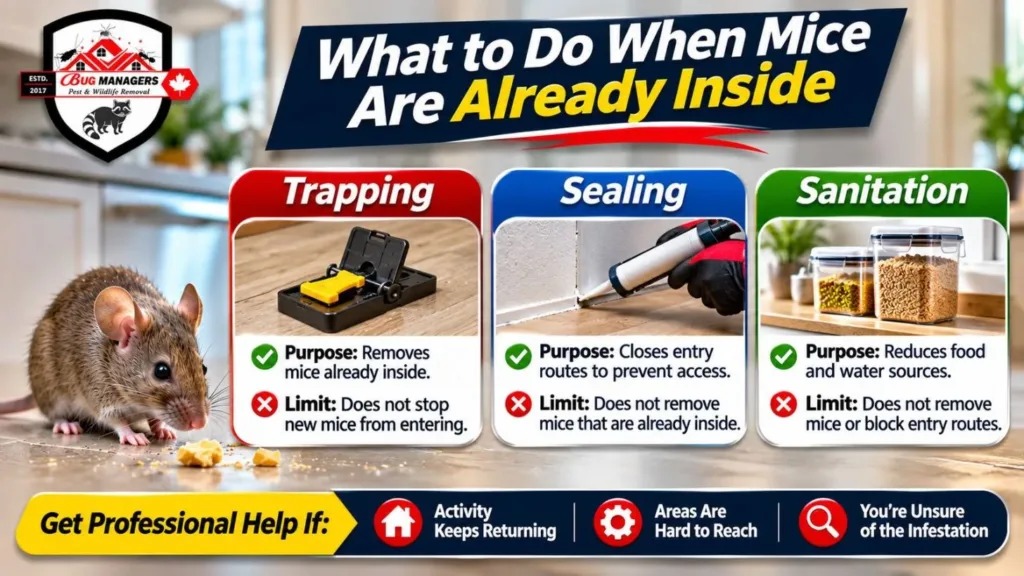
| Action | What it addresses | Limit |
|---|---|---|
| Trapping | Mice already inside | Does not close an entry point |
| Exclusion | Routes into the building | Does not remove mice already indoors |
| Sanitation | Accessible food and water | Does not replace exclusion or cleanup |
Traps are a way to address mice already in an accessible area, but they do not repair the route that allowed entry. Rodent exclusion helps limit further access, while sanitation reduces resources that mice could reach. Keeping those roles clear helps you avoid relying on one measure as a complete solution.
If activity continues or appears in an area you cannot access, consider a pest-control specialist. You can also contact a local or state health department if you are concerned about an infestation. Get local guidance when you are uncertain about the extent of the problem or how to respond safely.
Ask a local or state health department for guidance if you are concerned about the infestation.
Clean Rodent Droppings and Nesting Material Safely
Do not sweep or vacuum rodent waste, because disturbed material can put contaminated particles into the air. Hantavirus can spread when you breathe contaminated air after fresh urine, droppings or nesting materials are stirred up. Avoid stirring it by following a wet-cleaning method.
Ventilate a home or outbuilding for 30 minutes before cleaning, and leave the area during that time. Then wet urine and droppings with disinfectant, let it soak for five minutes or follow the product label, and wipe with paper towels. The CDC’s guidance warns against sweeping or vacuuming rodent droppings, urine or nesting materials.
- Open doors and windows, then leave the home or outbuilding for 30 minutes.
- Wet urine and droppings with disinfectant.
- Let the disinfectant soak for five minutes or follow the product label.
- Wipe the wet material with paper towels.
- Do not sweep or vacuum droppings, urine or nesting materials.
Airborne particles are the reason a dry cleanup method can be unsafe. Sweeping can disturb dried waste, while a vacuum can draw contaminated material into the air. Wetting the area with disinfectant first helps avoid stirring the waste up as you clean.
Use the disinfectant according to its label, including the stated contact time if it differs from five minutes. Avoid handling nesting materials in a way that scatters them. An inaccessible crawl space or other hard-to-reach area may need professional attention rather than an attempt to clean it yourself.
If the contamination is in an area you cannot reach safely, contact a pest-control specialist.
When Mouse Problems Keep Returning
Recurring mouse activity may indicate that hidden entry points remain open or that rodents are accessing your home through connected spaces. In condominiums, townhouses and apartment buildings, mice can travel through wall cavities, shared ceilings, plumbing openings and utility passages.
Treating only the area where mice are visible may not address the underlying problem.
What Research Reveals About Mouse Infestations
A 2022 scientific study published in the journal Animals examined mouse infestations across four high-rise residential buildings in New Jersey. Researchers found that apartments neighbouring infested units were generally more likely to experience mouse activity themselves.
Although the findings do not establish that one apartment directly caused another’s infestation, they highlight the importance of coordinated inspections and rodent management in multi-unit properties.
Preventing Recurring Rodent Infestations
An effective rodent management strategy should include:
- Thorough interior and exterior property inspections.
- Identification of hidden rodent entry points.
- Inspection of neighbouring or connected spaces where appropriate.
- Targeted rodent control and exclusion.
- Ongoing monitoring and sanitation recommendations.
At Bug Managers Pest Control & Wildlife Removal, our professional rodent control services and pest proofing solutions focus on addressing existing activity and reducing the risk of reinfestation.
For condominium owners and property managers in Mississauga, Brampton and Toronto, our condominium pest control programs can help develop a coordinated approach to rodent monitoring and prevention.
Research reference: Sked et al. (2022). The Spatial Distribution of the House Mouse, Mus musculus domesticus, in Multi-Family Dwellings. Animals, 12(2), 197.
Read the full scientific study
Recurring signs may reflect an opening that remains active or a route connected to another part of the building. In a multi-unit home, activity may involve shared walls, ceilings or floors. Look beyond one room when the problem keeps returning, especially if nearby spaces also show signs.
A 2022 study of four low-income high-rise apartment buildings in three New Jersey cities found an association: apartments with mouse infestations were more likely to share a wall or ceiling-floor with another infested apartment. That finding describes an association in those four buildings, not proof that one apartment caused another’s infestation.
Shared walls and floors
In a multi-unit building, mice may use routes that extend beyond a single home. Check whether signs cluster near shared walls, floors or utility routes, and note the locations rather than guessing where mice began. A building manager may be able to coordinate checks across connected spaces.
Start with these practical checks:
- Document where activity appears and when you notice it.
- Inspect shared walls and utility routes where it is safe to do so.
- Notify the landlord or building manager in a multi-unit home.
Reproduction and prompt follow-up
Mice usually have an 18-21 day gestation period and can reproduce year-round. A short gestation period and ongoing reproduction make persistent access worth addressing promptly. The longer signs continue, the more important it is to understand whether the route is local or connected to another part of the building.
In a shared building, a recurring mouse problem may need a building-wide response, not attention to one unit alone.
Keep your notes factual: record where evidence appears and when, then share that pattern with the person responsible for the building. This can help distinguish a repeated issue in one area from activity appearing across connected homes.
In a multi-unit building, share the locations and timing of signs with the building manager.
Conclusion
A mouse in the garage can be a sign that the barrier between the garage and house needs attention. Mice can travel through small gaps, damaged door seals and openings around utility lines.
Long-term prevention combines rodent exclusion with reducing available food, water and shelter.
Sealing entry points and reducing attractants work together. However, neither step guarantees that mice already inside have been removed.
If you notice rodent droppings, gnaw marks or recurring mouse activity, consider arranging a professional inspection.
Bug Managers Pest Control & Wildlife Removal Services provides professional mice and rat control, targeted treatments, entry-point inspections and rodent proofing solutions to help protect your property and reduce the risk of recurring infestations.
Our licensed and insured exterminators serve Mississauga, Brampton, Toronto, Oakville, Burlington and surrounding GTA communities.
Contact Bug Managers today for a FREE estimate.
Phone: 647-326-4888
Website: www.bugmanagers.com
Online Enquiries: Request Your FREE Estimate
Protecting Homes. Preventing Infestations. Delivering Peace of Mind.