

That faint scratching above your ceiling at 2 a.m. is not your imagination. Dark, rice-sized specks behind cleaning supplies under your sink are real, too. Both signs point to mice in house Mississauga homes.
House mice (Mus musculus) and deer mice are common residential pests across Peel Region. One female can raise five to ten litters in a single year, turning a quiet problem into a loud one. Early action helps with house mouse removal Mississauga homeowners can trust.
Mice can slip through gaps about the width of a pencil, or 6 mm. Newer homes in Erin Mills and Churchill Meadows face the same risk as older Port Credit homes. Weep vents, dryer exhausts, and garage door corners provide easy access.
This guide helps you spot warning signs, find entry points, and understand autumn’s call surge. It explains when DIY traps are enough and when professional help is needed.
Bug Managers pest control sends licensed, Ministry-certified technicians across Mississauga and Oakville. Its health guidance follows Health Canada and Public Health Ontario recommendations about rodent-borne risks.
Searching “mice exterminator near me” at midnight? Contact us for a FREE quote and a clear answer about your problem.
Key Takeaways
- Scratching sounds at night, droppings, gnaw marks, and a musky odour are the earliest signals of mice in house Mississauga properties.
- A gap the size of a pencil is wide enough for a mouse, so even recently built homes need sealing.
- One breeding pair can multiply into dozens of mice within a few months.
- Autumn cold drives rodents indoors, making September through November the busiest stretch for pest control Mississauga crews.
- Droppings and nesting material carry health risks flagged by Health Canada and Public Health Ontario.
- Traps alone rarely solve it — proper house mouse removal Mississauga work pairs treatment with exclusion.
- Professional inspection finds the entry points most homeowners walk past every day.
Mice in House Mississauga: Why Rodents Choose Your Home
Mice need three things: food, water and a warm nesting place. Mississauga homes can provide all three without their owners realizing it. A house mouse needs only about 3 grams of food daily, so crumbs or spilled birdseed can feed a family.
Older housing stock helps explain mice in house Mississauga calls. Century and mid-century properties in Lorne Park, Mineola, Port Credit and Lakeview often have fieldstone foundations. Their mortar may have settled and cracked over decades. Unsealed crawl spaces create open doors.
Demand for pest control Lorne Park and pest control Mineola services often rises after renovations expose these old gaps.

Location matters too. Ravine and creek corridors along the Credit River and Etobicoke Creek give rodents natural routes into backyards. Mature trees with branches touching the roofline offer easy climbing routes.
Infill construction and teardowns push established populations into nearby homes. Therefore, mice control Port Credit and pest control Lakeview requests rise during busy building seasons.
Backyard attractants often include:
- Bird feeders and scattered seed
- Open compost and green bins
- Pet food stored in garages or sheds
- Fallen fruit from apple and pear trees
Mice are cautious around new objects but highly adaptable. They travel just 3 to 9 metres from their nest, making wall voids beside kitchens prime real estate.
Here is the reassuring part: an infestation is not a cleanliness problem. It is a building-access problem, and effective rodent control Mississauga work starts by sealing openings. Residential rodent control succeeds when exclusion comes first.
Signs of Mice in the House You Should Never Ignore
Mice are quiet tenants, but they leave many clues. Spotting the early signs of mice can save money, stress and a larger cleanup later.
These are the mouse infestation signs homeowners spot most often:
- Scratching, scurrying or squeaking about 30 minutes after dark, usually from mice in walls or ceilings
- Dark, rice-sized droppings along baseboards, under sinks and inside cupboards
- Gnaw marks on food boxes, trim, plastic containers and electrical wiring
- Shredded paper, fabric or torn insulation pulled into nests
- Greasy smudge marks where mice brush the same route nightly
- A musky, ammonia-like smell that lingers in closed rooms
- Pets staring at a vent, wall or the back of the fridge
- Tiny footprints and tail drag lines across dusty floors
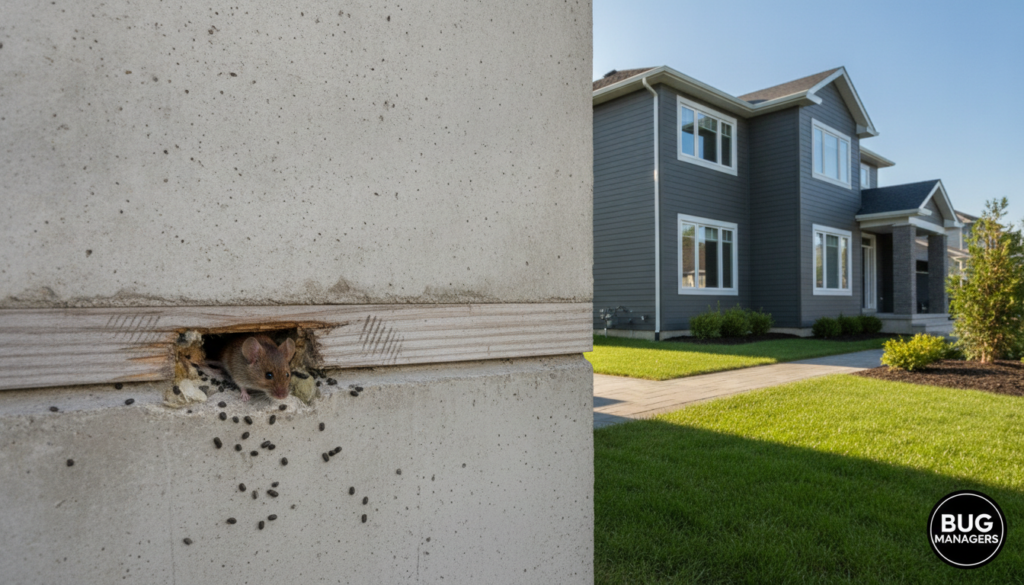
Mice are nocturnal, so a mouse in your kitchen at noon usually means crowding. The population has outgrown its hiding spots.
| Clue | Where You’ll Find It | What It Means |
|---|---|---|
| Fresh, shiny droppings | Pantry shelves, drawer corners | Active feeding within 24 hours |
| Night-time scratching | Wall cavities, attic joists | Mice in attic or wall voids nesting |
| Rub marks | Baseboards, pipe openings | Established travel route, ongoing traffic |
| Daytime sighting | Kitchen, basement, garage | Larger colony, immediate action needed |
Call a mouse exterminator Mississauga residents trust when droppings appear in more than one room. Also call when sounds come from two or more walls, or you see a mouse twice in one week. Homeowners booking mice control Streetsville or rodent control Sheridan services can stop the problem before it spreads.
Mouse Droppings Identification: Reading the Evidence Correctly
Droppings reveal more than almost any other clue. Basic mouse droppings identification can confirm what’s sharing your home before you buy traps.
House mouse droppings measure roughly 3–6 mm, look dark, and resemble grains of rice with pointed ends. Other pests leave very different evidence.
| Source | Size | Shape & Texture |
|---|---|---|
| House mouse | 3–6 mm | Dark pellets, pointed tips, smooth |
| Norway rat | 12–19 mm | Capsule-shaped, blunt ends, thick |
| Cockroach | 1–2 mm | Ridged sides, blunt ends, pepper-like |
| Bat guano | 6–12 mm | Crumbles easily, sparkles with insect wings |
Age matters too: fresh mouse droppings are soft, shiny and black, while older ones turn grey, dry and crumble under pressure. A single mouse leaves 50–75 droppings daily, so heavy scattering across several rooms suggests a growing family, not a lone visitor.
Never sweep or vacuum droppings. Stirred-up dust can carry hantavirus, salmonella and LCMV. Health Canada and Public Health Ontario recommend this approach instead:
- Air out the space for 30 minutes before entering.
- Wear rubber gloves and an N95 respirator.
- Mist the area with a 1:10 bleach solution or registered disinfectant.
- Wipe with paper towel, double-bag the waste, wash your hands well.
Widespread droppings are among the clearest mouse infestation signs and call for a full rodent inspection. Bug Managers offers sanitization and droppings clean-up with pest control Gordon Woods homeowners trust. Families can rely on mice control Credit Mills each season.
Common Mouse Entry Points Around Mississauga Houses
House mice can squeeze through gaps about 6 mm wide, roughly the width of a pencil. If a pencil fits, a mouse can follow. This rule guides every inspection.
Start outside with a flashlight. Walk slowly around the foundation and look for daylight coming through from inside.
- Foundation cracks, crumbling parging and open weep holes in brick
- Gaps around gas lines, hydro masts, cable runs and AC line-set penetrations
- Garage door corners and worn rubber bottom seals
- Unscreened dryer, bathroom and kitchen exhaust vents
- Soffit-to-fascia junctions, roof vents, plumbing stacks and gable vents
- Window wells, basement window frames and tired door sweeps
Inside, check under-sink pipe chases, behind your dishwasher and stove, floor registers, and laundry lines. Older stone foundations across Clarkson and Rattray Marsh hide dozens of mortar voids. Erin Mills townhomes share walls and utility chases, letting mice travel between units.
The garage remains the number-one overlooked zone. Homeowners booking pest control Erin Mills, rodent control Clarkson, or pest control Rattray Marsh are often surprised the trail starts there.
| Entry Point | Typical Gap Size | Exclusion Fix |
|---|---|---|
| Garage door corner | 10–25 mm | Corner seals plus a new bottom gasket |
| Brick weep hole | 10 mm | Stainless weep-hole covers |
| AC line-set gap | 15–40 mm | Copper mesh with exterior sealant |
| Soffit–fascia join | 6–20 mm | Galvanized flashing and screws |
| Dryer vent | 50 mm+ | Rodent-proof vent damper |
Mark each gap you find and photograph it. Seal mouse entry points properly; solid rodent exclusion and mouse proofing beat traps every time.
Where Mice Hide: Attics, Walls, Basements, Garages and Kitchens
After mice slip through these entry points, they seek warm, quiet places to nest. Knowing these spots helps you find the problem faster.
Mice in attic spaces tunnel through blown-in and batt insulation. They leave trails and droppings along the top plates. Chewed wiring creates a real fire hazard, while cardboard boxes become shredded nesting material.
Mice in walls are harder to spot. Scratching or scurrying may travel between floors, usually after dark. A sour, musky odour can mean a mouse died inside a wall void.
Mice in basement areas favour cold rooms, sump pump pits, drop ceilings and cluttered storage. Mice in garage settings seek pet food, birdseed and BBQ covers. They may nest in engine bays or cabin air filters, chewing wiring harnesses that cost hundreds to repair.
Mice in kitchen zones stay close to food: behind the fridge, under the stove, inside toe-kicks, along pantry shelving and in dishwasher cavities.
| Hiding Spot | What to Look For | Risk Level |
|---|---|---|
| Attic | Insulation tunnels, gnawed wires | High — fire risk |
| Wall voids | Night scratching, odour | Moderate |
| Basement | Droppings near sump pit, shredded cardboard | Moderate |
| Garage | Spilled seed, chewed vehicle wiring | High — repair cost |
| Kitchen | Grease marks, droppings in drawers | High — food safety |
Heritage and estate homes served by pest control Meadowvale Village often include detached garages and outbuildings. Treating only the kitchen can miss the nest. That is why proper house mouse removal Mississauga starts with a full-structure inspection.
Seasonal Causes: Fall Pressure and Winter Mouse Prevention in Mississauga
Mice follow a regular calendar in Peel and Halton. Knowing this pattern makes mice prevention easier. You can seal gaps before the rush, not after hearing scratching overhead.
The biggest wave starts when overnight temperatures fall below 10 °C. Outdoor seeds and insects vanish, while warm wall voids become prime real estate.
| Season | What Mice Are Doing | Your Best Move |
|---|---|---|
| Late September – November | Heavy push indoors; peak call season for rodent control Mississauga | Seal gaps, book a pre-winter inspection |
| December – March | Breeding year-round in heated wall voids; snow hides exterior openings | Interior trapping and monitoring |
| April – June | Nesting and new litters; snowmelt reveals fresh foundation cracks | Re-inspect the foundation and repair |
| July – August | Populations grow in ravines, gardens and woodpiles | Tidy landscaping, remove harbourage |
Use this fall checklist to prevent mice in home spaces before the first frost:
- Replace worn door sweeps before Thanksgiving weekend
- Rake leaf litter and move woodpiles away from the foundation
- Trim branches back 1.5 m from the roofline
- Store birdseed and pet food in metal or thick plastic bins
- Book a pre-winter inspection while gaps are still visible
The same pressure crosses into Halton. Winter mouse prevention matters just as much to mice control Oakville clients. It also matters to homeowners seeking pest control Bronte or pest control Glen Abbey after the first cold snap.
How to Get Rid of Mice: Inspection, Treatment and Professional Rodent Control
Getting rid of mice works best after a rodent inspection and planned sequence, not one quick fix. Rushing to traps leaves open entry points, the real problem, untreated.
- Inspect first. A thorough rodent inspection maps droppings, rub marks, nests and gaps, confirms the species and estimates how many mice you’re dealing with.
- Remove attractants. Store food in airtight containers, wipe counters nightly, repair plumbing leaks and clear cluttered storage boxes.
- Trap strategically. Set snap traps perpendicular to walls with the trigger touching the baseboard, spaced 2–3 metres apart along runways. Peanut butter, chocolate or a cotton ball works well. Skip ultrasonic repellers — research shows they don’t move mice out.
- Use rodenticides responsibly. Bait belongs in locked, tamper-resistant stations only, away from kids, pets and wildlife, following Health Canada PMRA rules.
- Seal every opening. Exclusion work is covered in the next part.
- Monitor. Follow-up checks confirm the activity has truly stopped.
DIY methods have limits. One female mouse can produce dozens of offspring a year, outpacing a handful of traps. Without sealed entry points, homes can become reinfested within weeks.
| Approach | DIY Attempt | Professional Residential Rodent Control |
|---|---|---|
| Inspection | Visual check of obvious areas | Full interior, exterior and roofline rodent inspection with written report |
| Treatment | Store-bought traps | Targeted trapping plus secured bait stations |
| Sealing | Foam or steel wool patches | Steel mesh and sealant exclusion on all gaps |
| Follow-up | None | Scheduled return visits and warranty |
Bug Managers offers free inspections, clear reports, treatment, residential rodent control, exclusion and follow-up. Homeowners can book same-day and emergency mouse removal Mississauga services quickly. Searching for a mice exterminator near me? Our mouse exterminator Mississauga team also serves Oakville, including pest control Joshua Creek.
Call for your FREE quote today or request one through our online form.
Mouse Proofing and Rodent Exclusion: Keeping Mice Out for Good
Traps solve today’s problem, but mouse proofing solves next winter’s. Rodent exclusion offers the only permanent fix: a properly sealed home stops new mice from entering.
Materials matter more than effort. A gap packed with the wrong product can reopen within one season.
| Works Long-Term | Fails Quickly |
|---|---|
| 19-gauge galvanized hardware cloth (6 mm mesh) | Steel wool on its own — it rusts and crumbles |
| Copper mesh or stainless wool packed tight into gaps | Expanding foam used alone — mice chew straight through |
| Sheet metal flashing over chewed wood edges | Duct tape or caulk across open holes |
| Mortar and concrete patch for foundation cracks | Thin plastic vent covers |
- Screening dryer vents, roof vents and chimney caps
- Sealing soffit gaps and roof-line junctions
- Brush seals and corner gaskets on garage doors
- Door sweeps on entry and basement doors
- Weep hole guards in brick veneer
- Collars around pipe, gas and cable penetrations
- Window well repair and covers
Yard habits help, too. Keep a gravel border by the foundation, leave 30 cm under decks, and store raised woodpiles 6 m away. These small changes quietly support mice prevention all year.
Older homes shift and settle, so we suggest annual audits for mice control Lorne Park and pest control Streetsville customers. Bug Managers backs its work with a service warranty when we seal mouse entry points. The same sealing helps prevent mice in home spaces and blocks rats, squirrels, chipmunks, and crawling insects.
Conclusion
Spotting mice in house Mississauga situations early makes a major difference. Watch for droppings along baseboards, scratching sounds after dark, gnaw marks on food packaging, and greasy smudges near gaps. Identify the evidence properly, clean it safely with disinfectant instead of a broom, and gain a solid head start.
The plan is simple: find every entry point around the foundation, vents, garage door corners, and utility lines. Seal them before fall migration begins, then set traps in a methodical pattern. Monitor activity for a few weeks, then finish with full rodent exclusion so the problem does not return next season.
Speed matters more than many homeowners expect. One October mouse pair can produce several generations by February, leaving soiled insulation, contaminated cupboards, and chewed wiring in walls. Professional mice control Mississauga service stops that timeline before repair bills climb.
Bug Managers pest control serves Mississauga and Oakville, including Lorne Park, Mineola, Port Credit, and Clarkson. It also serves Sheridan, Gordon Woods, Erin Mills, Streetsville, Meadowvale Village, Lakeview, Credit Mills, Rattray Marsh, Joshua Creek, Glen Abbey, and Bronte. Searching for a mice exterminator near me is easy: licensed, insured technicians know local housing styles.
Call, text, or book online for a FREE quote from a trusted mouse exterminator Mississauga homeowners recommend. Our pest control Mississauga team uses pet- and child-safe methods, backed by a satisfaction guarantee.
Visit our Contact page to get started, or contact Bug Managers Pest Control & Wildlife Removal Services directly at 647-326-4888 for a free estimate.
Check our Service Area page for coverage details across Mississauga, Brampton, Toronto and the GTA. You can also browse our blog posts on rat control, squirrel removal, and winter pest prevention for more helpful tips and expert advice.
📞 Call: 647-326-4888
🌐 Website: BugManagers.com
FAQ
How do I know if I have mice in my house, or just one stray mouse?
What does mouse droppings identification tell me about the problem?
Is it safe to sweep or vacuum up mouse droppings?
How small a gap can a mouse actually squeeze through?
Why do I have mice in my basement and garage but not upstairs?
What should I do about mice in the kitchen?
Can mice in the attic or mice in walls cause real damage?
Do ultrasonic repellers, peppermint oil or cats actually work?
What’s the best way to set traps for getting rid of mice?
How long does professional mouse removal take?
What materials should I use for mouse proofing my home?
When is the worst season for mice in Mississauga?
Does having mice mean my house isn’t clean?
How do I choose a mice exterminator near me?
Will sealing my home also keep out other pests?
How much does mice control cost, and do you offer free quotes?
Where can homeowners find reliable pest and wildlife prevention information?
How can I help prevent rats around my property?
Reducing food sources, keeping outdoor areas clean, sealing openings around buildings, and addressing potential nesting areas can help reduce rodent activity. Professional pest control may be appropriate when an infestation is present.